
Thailand Risks Losing Wellness Crown Without Rule Reform
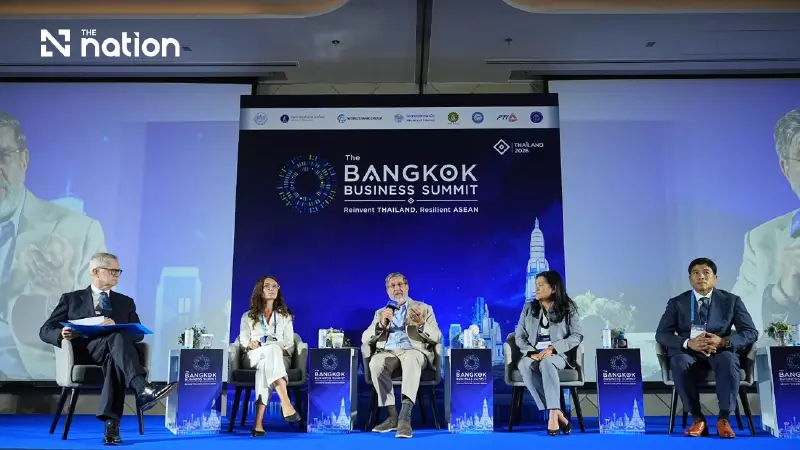


Business leaders at the Bangkok Business Summit warn outdated laws, rigid visa rules and unclear health-data regulations risk costing Thailand its wellness crown
- Business leaders warn that outdated laws, rigid visa rules, and unclear health-data regulations are preventing Thailand from capitalizing on the multi-trillion-dollar global wellness economy.
- The country's 30-day visa restriction is a significant obstacle, as it is unsuitable for medical and wellness tourists who often require longer stays for treatment and recovery.
- Thailand is losing its competitive edge to countries like Malaysia, which has more flexible regulations in areas such as regenerative medicine and is attracting more visitors.
- Experts propose creating a "Wellness Sandbox" to allow private operators to trial new wellness innovations and services that current laws have not yet caught up with.
Business leaders at the Bangkok Business Summit warn outdated laws, rigid visa rules and unclear health-data regulations risk costing Thailand its wellness crown.
Thailand's ambition to become a global hub for wellness tourism and preventive healthcare is being held back not by a shortage of talent or infrastructure, but by regulation that has failed to keep pace with a rapidly evolving industry, according to senior executives and experts who spoke at the Bangkok Business Summit 2026 on Thursday.
Speaking on a panel titled "The Future of the Human-Centric Economy: Leveraging Tourism, Wellness and Healthcare", held under the summit's theme "Reinvent Thailand, Resilient ASEAN", four prominent voices from medicine, hospitality, neuroscience and landscape design converged on a single message: Thailand has the ingredients for a world-class wellness economy, but bureaucratic constraints are preventing it from realising that potential.
The panel featured Sophie Hascher, a multidisciplinary expert and neuroscientist working at the intersection of science, longevity and capital; William E. Heinecke, founder and chairman of Minor International PCL; Dr Poramaporn Prasarttong-Osoth, president and chief executive of Bangkok Dusit Medical Services (BDMS); and Touchapon Suntrajarn, principal partner at Landscape Collaboration.

A Multi-Trillion-Dollar Opportunity
The discussion was framed against a global backdrop in which the wellness economy is expanding rapidly.
Moderator Kent Wertime, visiting marketing professor at Sasin Business School and former Asia chief executive of Ogilvy Worldwide, noted that the sector—spanning tourism, wellness, healthcare and sustainability—is currently valued at close to US$7 trillion and is projected to reach US$10 trillion by the end of the decade.
Consumer demand, panellists said, is being driven by two distinct groups: older travellers seeking to reclaim a longer "health span" and younger generations increasingly focused on "health maxing" and biohacking to an extent previous generations never pursued.
Tourism itself is shifting accordingly, moving away from leisure trips with an incidental spa visit towards journeys designed explicitly around health outcomes, particularly longevity.
Heinecke said this shift now cuts across every age group.
Modern travellers, he argued, expect hotels to address sleep quality, stress management and biohacking as standard, not as a premium add-on.
"Resort hotels that do not offer wellness, longevity and biohacking services risk falling behind evolving consumer expectations," he said.
Thailand's Ecosystem Advantage—and Its Blind Spot
Heinecke argued that Thailand possesses a genuinely strong ecosystem: world-class hospitality, quality and affordable medical care, a globally admired culinary scene, cultural tourism, traditional Thai herbal medicine, and complementary practices such as acupuncture and heat therapy drawn from Chinese medicine.

Wellness travellers to Thailand, he noted, already stay an average of ten days—considerably longer than typical leisure tourists.
He pointed to Chiang Rai as a model of how wellness tourism can be woven into community development and conservation to attract high-spending visitors and cited seagrass ecosystem conservation projects and a sea turtle hospital in southern Thailand as examples of destinations successfully linking wellness with sustainability.
Yet Heinecke was blunt about the obstacles.
Thailand's 30-day visa restriction, he said, is poorly suited to medical tourists who require longer periods for treatment and recovery. Rather than limiting the length of stay, he urged the government to strengthen immigration processing, security screening and airport clearance systems instead.
He also warned that Thailand is losing ground to Malaysia in regenerative medicine.
Malaysia's regulatory framework has permitted stem cell treatment through mainstream medical channels for nearly four to five decades, he said, while Thailand's legal framework in this area remains considerably more complex—one factor behind Malaysia recently overtaking Thailand in total visitor numbers, reaching 43 million arrivals.
"Thailand needs to move decisively from a volume-focused approach towards seriously targeting high-quality tourists," Heinecke said. "If we remain locked into outdated regulations while competitors like Malaysia stay more flexible, we risk losing our competitive edge in the long run."
On elderly care, Heinecke noted that Thailand's market has developed more slowly than in Western countries because family structures remain strong, meaning most elderly relatives are cared for at home rather than in dedicated facilities.
He suggested Thai ageing-care businesses should be designed to accommodate entire families rather than isolated elderly residents, while also capitalising on Thailand's relatively low cost of living to attract foreign retirees.
He additionally proposed introducing queue-booking systems at congested natural attractions, such as Koh Phi Phi and Maya Bay, to manage visitor density more sustainably.

BDMS Proposes a "Wellness Sandbox"
Dr Poramaporn Prasarttong-Osoth of BDMS said the wellness market has fundamentally changed from being perceived as a "Silver Economy" reserved for older, wealthier consumers.
The average age of wellness service users has dropped significantly, she said, reflecting that "wellness must be practised daily and is relevant to everyone."
She noted growing consumer interest in preventive medicine over reactive treatment, with personalised data—including genetic information and laboratory results—enabling more effective long-term health planning.
Thailand's challenge, she argued, is not a lack of individual components but the absence of a seamless customer journey linking food, lifestyle, scientific innovation and environment into one coherent ecosystem for Thai residents, expatriates and tourists alike.
BDMS's own "Well Era" project, she said, is intended as a prototype combining residential living with integrated wellness services—linking clinics, health-focused retail and retreat facilities with building design, air and water quality, and functional space planning.
Dr Poramaporn's central policy proposal was the creation of a "Wellness Sandbox" in selected provinces, allowing private operators to trial new wellness innovations and services that current law has not yet caught up with, under controlled risk conditions, before scaling more broadly.
On elderly care financing, she identified the central unresolved question as "who pays"—noting that other countries have developed specific insurance systems to absorb this cost, whereas Thailand has not.
She added that healthcare professionals are increasingly open to task-based artificial intelligence to reduce human error and improve speed, though she stressed this must be developed with robust oversight given the sensitivity of health data, and that patients still value engagement with clinicians skilled in using such technology—not the technology alone.

Designing for the Senses
Touchapon Suntrajarn argued that wellness-orientated design goes beyond simply adding green space; it must harness the qualities of nature to meet human health needs directly.
He described a concept of "humanised atmosphere" attentive to both physical and psychological comfort—using tree canopies to manage heat and airflow in Thailand's tropical climate and "sensory gardens" incorporating water sounds as white noise and elevated boardwalks to calm the senses.
He also emphasised storytelling and cultural memory in design, referencing traditional Thai literature on the relationship between people and nature and the reintroduction of native plant species—such as the olive tree linked etymologically to Bangkok's name.
While visually striking, "Instagrammable" spaces attract initial interest, he said, what brings visitors back is a sense of genuine welcome and safety, adding that scale is not the determining factor—the grandeur of Singapore's Jewel Changi cannot simply be replicated at a boutique hotel in Koh Samui.

Data, Trust and the Neuroscience of Rest
Sophie Hascher observed that premium global travellers are drinking less alcohol and increasingly travelling specifically to "reset", seeking data-driven insight into their brain and physical health.
Sleep optimisation, cognitive performance, stress management and concerns about early cognitive decline were identified as the areas of greatest client interest, prompting her call for wellness properties to apply neuroscience principles holistically—from pre-sleep lighting and room temperature to sleep-supporting supplements, green space and phone-free zones.
However, Hascher warned that regulation around health data collected in spas and wellness hotels remains unclear and that any long-term data collection must be built on trust rather than used for personalised marketing.
Sharing limited health information with nutrition teams to design condition-specific menus—for cardiac patients, for example—can enhance service, she said, but must be handled discreetly so guests do not feel their private medical details are being overexposed to staff.
The Path Forward
Across all five perspectives, panellists converged on the view that wellness is shifting from being a peripheral service to a core component of daily life—spanning travel, medicine, hospitality, design, neuroscience and artificial intelligence.
Thailand, they agreed, holds a genuine opportunity to establish itself as a global wellness and longevity destination, provided it can unify its existing strengths into a coherent ecosystem while reforming regulation and developing the workforce needed to serve a higher-quality, longer-staying market.
