
Samed Tai moves to calm fears over reported 1,200-plot Jewish cemetery
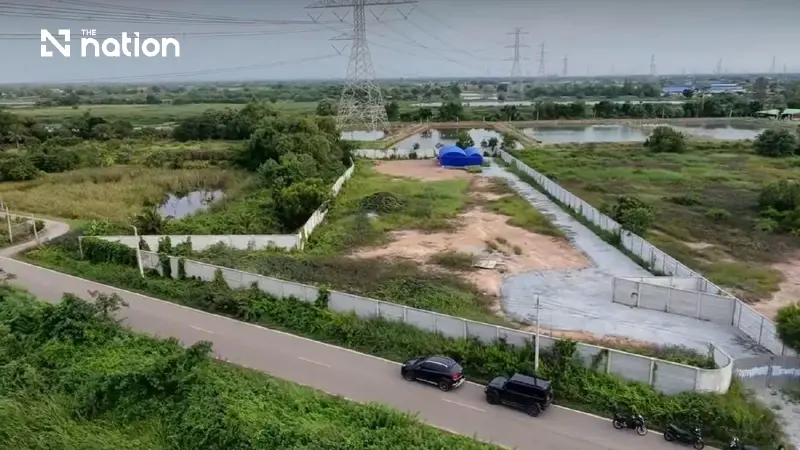


Samed Tai officials say no burials are currently taking place at a proposed Jewish cemetery after reports of 1,200 burial plots alarmed local residents.
- Local officials clarified that no bodies are currently buried at the proposed cemetery site, which has caused concern among residents over potential environmental contamination.
- The cemetery's original three-year operating license has expired, and an application for its renewal was rejected by provincial authorities and the interior minister.
- The local authority only approved the construction of a perimeter wall, and specifically denied permission for a mortuary or a body-washing facility on the site.
- The dispute over the cemetery's license is currently pending before the Rayong Administrative Court, and a committee of 13 agencies is reviewing the case.
Residents of Samed Tai subdistrict in Bang Khla district, Chachoengsao, have raised concerns after reports circulated online that a site identified as Jewish Cemetery Thailand was being prepared to accommodate as many as 1,200 burial plots.
The reports prompted residents in Moo 2 to gather in opposition to the project, citing concerns over potential environmental effects, particularly possible water contamination. The site is close to natural waterways, local shrimp and fish ponds, and about 500 metres from a subdistrict child development centre.
Some residents also expressed unease about having a cemetery close to their homes.

Local leaders inspect six-rai site
On Wednesday (September 2), Samed Tai subdistrict head Namphueng Khamsa-at and community leaders inspected the site, which covers more than six rai and is enclosed by a wall about four metres high.
A 70-year-old resident living beside the cemetery said that in 2024, a van carrying a body had stopped outside her home and its occupants asked her for a key to open the cemetery gate, apparently believing she was the caretaker.
She said the incident alerted local residents to the proposed use of the property and led to continuing opposition.
Namphueng said provincial authorities had previously determined that the cemetery licence could not be renewed. An appeal by the operator was rejected by the interior minister in 2025, she said, while the dispute remains before the Rayong Administrative Court.


Local authority seeks to clarify reports
On Thursday (September 3), Kittiphong Sileuang, president of the Samed Tai Subdistrict Administrative Organisation, called an urgent meeting of relevant agencies to clarify the situation and counter what he described as misleading information circulating online.
Kittiphong said there were currently no bodies buried at the site.
He explained that the original cemetery licence had been issued by a former provincial governor in 2021 and was valid for three years.
The Samed Tai authority had not approved construction of a mortuary or a facility for washing bodies, he said, allowing only construction of the boundary wall. The original cemetery licence has since expired, while issues surrounding its renewal have gone through further administrative review.

Mortuary construction was not approved
Kittiphong said plans submitted for the site had included a mortuary and a body-washing facility, which the local authority declined to approve.
When the operator later sought to proceed with construction, the municipal engineering division posted an official order halting the work.
On June 5, 2024, the operator submitted a revised application seeking permission only to construct a perimeter wall measuring 917.32 metres in length and approximately three metres in height.
Kittiphong said the authority was required to approve that application because it complied with building-control regulations.
No further development had subsequently taken place, he said, and vegetation had since grown across much of the site.
Thirteen agencies involved in review process
Kittiphong said Bang Khla district had issued Order No. 40/2567 on February 2, 2024, establishing a committee involving 13 agencies to review the case under regulations governing cemeteries and crematoria.
The committee was formed after a representative acting for the operator sought renewal of the cemetery licence as its three-year validity period was approaching expiry.
The Samed Tai Subdistrict Administrative Organisation had earlier asked Bang Khla district to review the matter in a letter dated January 15, 2024.
Local authorities said they would continue following the relevant legal and administrative procedures while keeping residents informed about developments surrounding the site.

Former landowner says plot changed hands before becoming cemetery site
On Friday (September 4), Sant Sricharoen, 74, a former village headman in Bang Khla district, Chachoengsao, and former deputy president of the Samed Tai Subdistrict Administrative Organisation, spoke about a plot of land he had sold several years ago that has recently attracted attention following reports that it was later acquired for use as a Jewish cemetery.
Sant said he originally bought the land, measuring 15 rai, 2 ngan and 86 square wah, or about 2.51 hectares, from a Bangkok resident around 2005–2006.
He said he held the property for about 14-15 years before selling it to a local resident in Moo 3, Khlong Khut subdistrict of Ban Pho district, an adjoining area. The buyer was identified as Tee or Meedet, and the sale took place about six or seven years ago.
Sant said he did not know who subsequently bought the land from that owner and had no involvement in later transactions.
“I had already sold the land to someone else, so anything that happened after that had nothing to do with me and I had no knowledge of it,” he said.
Regarding the proposed cemetery, Sant said he believed the matter had been settled some time ago and questioned why it had resurfaced.
He said the subdistrict head, village headman and Bang Khla district chief had already suspended the cemetery establishment licence, meaning the site could no longer be used as a cemetery.
Sant said he had previously heard that a local politician serving as a subdistrict administrative organisation president in the railway-bridge area near the 11th Infantry Division intersection had acted as a broker in a later sale of the land.
He said he did not know who ultimately bought the property and only later learnt from news reports that the site was being developed as a Jewish cemetery.
