
Thailand issues new airport rules on checked baggage inspections
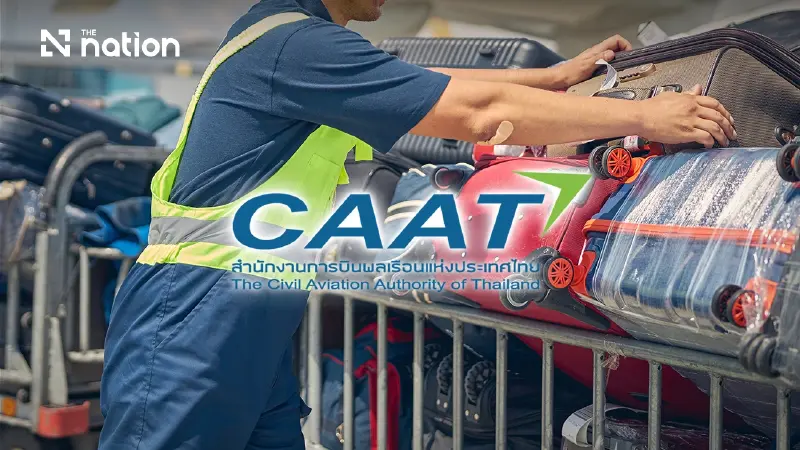


From October 16, airport staff in Thailand can open checked bags flagged by security screening without passengers present, with inspections recorded.
- Airport staff in Thailand are now authorized to open and inspect checked baggage without the passenger being present.
- This rule only applies when an X-ray scan detects suspicious, prohibited, or potentially dangerous items inside a bag.
- Inspections are visually recorded for review, and a notice is placed inside the bag to inform the passenger of the search.
- Passengers are advised to use standard-compliant locks (e.g., TSA locks), as staff may break other locks without compensation to complete an inspection.
Deputy Government Spokesperson Ploythalay Laksameesaengjan announced on Friday (October 16, 2026) that the 2026 notification issued by the Civil Aviation Authority of Thailand (CAAT) on the inspection of checked baggage to be carried aboard aircraft took effect that day.
New CAAT rules allow checked bags to be opened without owners
The new rules authorise airport staff to open checked bags immediately without waiting for their owners to be present.
The aim is to strengthen aviation security in line with international standards and practices used in many countries.
Bags will be opened only where there are reasonable grounds for suspicion, under strict procedures that allow inspections to be reviewed afterwards.
The provision for opening bags without advance notice does not extend to passengers’ baggage in general.
It applies only when X-ray screening detects suspicious objects or items that could affect aviation safety.
Inspections will be conducted in designated areas, with images captured and evidence retained at every stage so that it is possible to establish who carried out the search and what was found.
Passengers must subsequently be informed that their baggage was opened under the prescribed procedures.
This approach is an aviation security standard used in countries including Singapore, Japan and South Korea, as well as many countries in the Middle East and Europe and the United States.
It aims to prevent potentially dangerous items from being taken aboard aircraft, improve flight management efficiency and reduce delays caused by having to locate baggage owners to open their bags before departure.
Key provisions
If screening detects an irregularity or raises suspicion that a checked bag contains prohibited, dangerous or suspicious objects, staff may open it immediately for inspection without the passenger being present.
Whenever a bag is opened, a visual record must be made of the inspection and a notice of inspection placed inside the bag.
If prohibited items are found, staff may seize them and take action under the law.
Advice for passengers
Passengers should use locks or locking systems that meet recognised standards, such as TSA locks, so staff can open bags for inspection without damaging them.
However, if a bag cannot be opened, staff may break its lock or locking mechanism, with no compensation for the damage.
Before checking in a bag, passengers should therefore check not only its weight but also whether its contents are allowed in checked baggage, to avoid problems and travel delays.
