
Trump threatens renewed strikes as US-Iran talks open amid Hormuz dispute
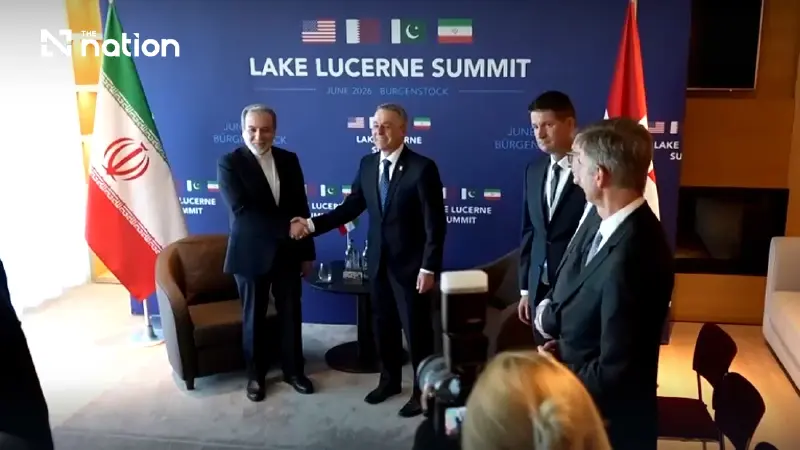


US-Iran peace talks opened in Switzerland under fresh tension after Iran said it had again closed the Strait of Hormuz, a claim disputed by US officials.
US President Donald Trump threatened renewed attacks on Iran on Sunday as the first US-Iran talks under an interim peace deal began in Switzerland, amid a dispute over Tehran’s claim that it had again closed the Strait of Hormuz.
The talks were held at the Buergenstock resort in Switzerland, with US Vice President JD Vance meeting Iranian officials in the presence of Qatari mediators. They marked the first negotiations under a memorandum of understanding reached last week to end the war between the two countries.

The memorandum extended a fragile ceasefire announced in April for at least another 60 days. It also called for the reopening of the Strait of Hormuz, a key global energy route, and an end to hostilities, including in Lebanon, where Israel and Iran-backed Hezbollah have continued to clash.
Iran said Washington had failed to ensure an end to fighting in Lebanon and announced at the weekend that it had again halted maritime traffic through the Strait of Hormuz. Tehran also said the Swiss talks would not cover substantive issues such as Iran’s nuclear programme.

Trump warned on social media that Iran must stop its Hezbollah allies in Lebanon from causing trouble, adding that the United States could strike Iran again if it failed to do so. Reuters also cited Fox News as reporting that Trump had warned Iranian officials against closing the strait.
Vance, however, played down the impact of the violence in Lebanon, saying progress had been made towards ending hostilities there. He also said Trump had asked US officials to “turn over a new leaf” in relations with the Iranian people.

The two sides did not pose for a joint photo. Reuters reported that Iranian Foreign Minister Abbas Araqchi briefly entered the room and embraced Pakistani Prime Minister Shehbaz Sharif, a mediator in the process, but did not publicly interact with Vance.
A US diplomat later told Axios that the talks had made good progress on keeping the Strait of Hormuz open. The discussions also focused on enforcing the ceasefire in Lebanon and the nuclear deal, the diplomat said, according to Reuters.
US disputes Hormuz closure claim
Iran said it had closed the Strait of Hormuz again because fighting in Lebanon had not stopped. The strait’s earlier closure for nearly four months caused major disruption to global energy supplies.
US officials disputed Iran’s claim that the waterway was closed, but Reuters reported that commercially available shipping data showed an immediate effect. Only one small tanker crossed the strait with its location-signalling transponders on after Iran’s announcement, compared with dozens of vessels in recent days.
Iran’s Fars news agency cited a military source as saying no new permits were being issued for ships to cross the strait until further notice.
Iran’s announcement came at the weekend, when markets were closed, delaying any immediate impact on oil prices until Monday. Trump said last week’s memorandum was intended to prevent a global economic crisis triggered by high oil prices linked to the strait’s closure.

Nuclear talks and sanctions relief remain unresolved
The memorandum provides for 60 days of talks on issues including limits on Iran’s nuclear programme in exchange for the lifting of international sanctions.
Before those wider issues are resolved, Iran expects to receive initial economic benefits, including sanctions waivers and access to some frozen assets.
Iranian President Masoud Pezeshkian, quoted by Fars, said he was optimistic the talks with the United States could create a strong basis for economic growth. He said the first goal of negotiations was to restore access to some Iranian assets frozen abroad.
However, Iranian Foreign Ministry spokesman Esmail Baghaei said the Swiss meeting would focus only on implementing the memorandum, not the deeper issues planned for the next stage, because Washington had failed to guarantee a ceasefire in Lebanon.

Lebanon sees quieter day
Sunday appeared to be the quietest day in Lebanon for some time, with no reports of major violence by nightfall, after two days of heavy Israeli strikes and Hezbollah fire on Israeli positions.
More than 1 million people have fled their homes in Lebanon since Israel invaded in March to pursue Hezbollah fighters who had fired across the border in support of Tehran.
Reuters journalists in southern Lebanon reported some of the heaviest traffic since the memorandum was signed, as residents began returning to their homes. Some people were seen waving Hezbollah flags beside cars backed up on the highway.
Despite the opening of talks, the dispute over Hormuz, continued uncertainty in Lebanon and unresolved nuclear issues show that the US-Iran peace process remains fragile.
Source: Reuters
