
Venezuela hit by fresh quake as toll tops 900
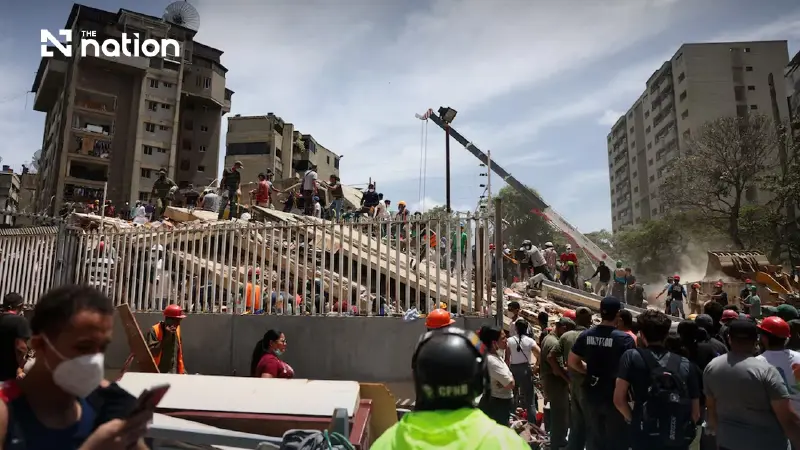


Venezuela earthquake rescue efforts intensify after twin major quakes kill more than 900, with a fresh 4.9 tremor felt in Caracas
- A new 4.9-magnitude earthquake has struck Venezuela, following two major quakes earlier in the week.
- The official death toll from the initial earthquakes has risen to 920, with 3,360 people injured and over 50,000 reported missing.
- The disaster was triggered by two powerful earthquakes on Wednesday, with magnitudes of 7.2 and 7.5, causing an estimated US$6.7 billion in damage.
- Rescue operations are in a critical phase, with foreign aid and teams arriving to assist in the search for survivors trapped in collapsed buildings.
Venezuela’s rescue operation has entered a critical phase after twin earthquakes killed more than 900 people, injured thousands and left families searching desperately for missing relatives, even as a fresh tremor shook parts of the country.
A new 4.9-magnitude earthquake was felt in Caracas and the nearby city of Maracay on Friday afternoon, according to the European-Mediterranean Seismological Centre. The tremor came two days after two major earthquakes devastated parts of the Venezuelan capital and surrounding areas.

The government said 920 people had died, 3,360 had been injured and 172 remained trapped. More than 50,000 people were reported missing, underlining the scale of the disaster and the difficulty facing emergency crews.
The first two earthquakes, with magnitudes of 7.2 and 7.5, struck on Wednesday evening. A United Nations report estimated direct damage at about US$6.7 billion, while the second quake was described as Venezuela’s strongest in more than a century.

Search intensifies in devastated areas
In La Guaira state, one of the worst-hit areas, frustration has grown over the uneven pace of relief. Residents and volunteers were still digging through debris by hand in some neighbourhoods, with heavy machinery in short supply and official teams struggling to reach every collapsed site.

In La Guaira city, Jennifer Palacios, 25, said her six-year-old son and five other relatives remained trapped beneath the Hugo Chavez housing complex, an eight-tower residential development badly damaged by the quakes.
She said local residents had helped pull people out alive, but more equipment was urgently needed to move heavy slabs and reach those still trapped.

Reuters witnesses travelling through the area saw highways cracked by the earthquakes and buildings reduced to broken concrete and twisted metal. Some collapsed structures had been marked with names to help rescuers identify locations.
Volunteers used motorcycles to bring supplies from Caracas and Valencia, but officials later asked people to stay away from La Guaira city, saying clogged roads were hampering rescue operations. Authorities said roads would be closed from 8pm local time, except for official and registered response teams.

Government faces pressure
The disaster is becoming a major test for interim President Delcy Rodriguez, who took power after the United States captured her predecessor in January and has promised a major relief deployment.
The crisis comes as Venezuela continues to face the long-term effects of political turmoil, economic collapse and weakened infrastructure, factors that could make recovery more difficult for millions of residents.
In Catia la Mar, a town in La Guaira, Reuters witnesses saw people taking basic goods, including toilet paper, cooking oil and bread, from a damaged store. Police, national guard members and other officials at the scene did not intervene, according to Reuters.
Some families were also struggling with administrative delays after relatives were recovered from collapsed buildings, adding to the distress in communities already overwhelmed by loss and uncertainty.

Foreign aid begins to arrive
Foreign rescue teams began arriving late on Thursday and into Friday, including crews from countries that have long had strained ties with Venezuela.
Rodriguez spoke by phone with US President Donald Trump and Secretary of State Marco Rubio on Friday, after Venezuelan officials earlier met with the US military’s Northern Command and disaster experts.
Washington said it was mobilising US$150 million in aid and easing sanctions, while the US military sent two ships and said helicopters and aircraft would support rescue efforts.
In the beachside neighbourhood of Los Corales, a 50-member rescue team from El Salvador assessed the ruins of three 10-storey buildings using drones, heat scanners and dogs to search for survivors.
Roberto Gavidia, who led the Salvadoran team, said residents had reported hearing trapped people calling for help and answering phones from inside damaged buildings.
Salvadoran President Nayib Bukele also shared a video on X showing the team preparing to enter one building, saying they had found a 15-year-old trapped with her pet on the ninth floor and were working to free them.
Oil sector spared major damage
Despite the scale of destruction in residential areas, Venezuela’s oil production was not affected, Oil Minister Paula Henao said in a radio interview on Friday. She added that fuel distribution would be guaranteed.
Oil executives and workers also said the sector had avoided major infrastructure damage.
The wider humanitarian picture, however, remains severe. The US Geological Survey estimated that more than 10,000 deaths were possible, a toll that would make the disaster one of Latin America’s deadliest earthquakes of the past century.
The UN’s migration agency said nearly 7 million people could be affected as it moved emergency shelter and other relief items into the country.
For now, the focus remains on the rubble. With aftershocks still shaking the country and families waiting at collapsed buildings, rescue teams are racing against time to reach those who may still be alive.
