
Malaysia’s durian price plunge sparks a boom in durian parties
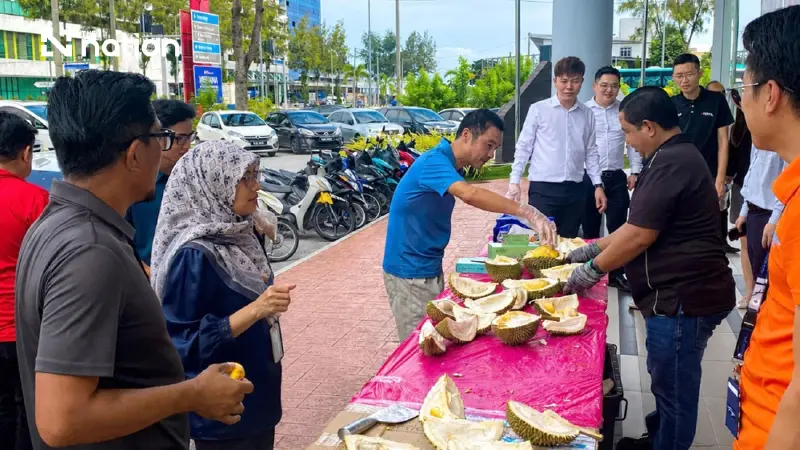


A bumper harvest and maturing orchards have halved prices, drawing families, companies, political groups and hotels into Malaysia’s durian celebrations.
- An oversupply of durians, dubbed a "durian tsunami," has caused prices to plummet, with the Musang King variety dropping from approximately RM60 to as low as RM10 per kilogram.
- The low prices have fueled a surge in "durian parties," which are being hosted by diverse groups including corporations for staff appreciation, political organizations for rallies, and families for social gatherings.
- The scale of these events has increased significantly, with some companies doubling their orders to two tonnes of fruit and government bodies distributing tonnes of free durians to thousands of residents.
Conference organisers in Malaysia are turning to a fruit that hotels often keep out of guest rooms.
Palm Garden Hotel in Putrajaya has won bookings from Malaysian and overseas groups by adding durian to conference catering.
Across the border in Singapore, however, it is still prohibited on MRT trains, buses and at many hotels because of its powerful smell.
Behind that reversal is a supply surge widely described as a “durian tsunami”.
Trees planted during the previous decade’s durian boom are now bearing fruit, while this year’s harvest is exceptionally large.
The result has been painful for growers but highly favourable for buyers.
Two years ago, Musang King was priced at about RM60 (S$19) per kg; this season, it is available for roughly RM10.
Market prices have fallen to about half their 2025 level.
Black Thorn is changing hands at RM15 to RM30 per kg, and kampung varieties at RM5 to RM8.
For a time, buyers could obtain a whole durian for under RM1.
Eating South-east Asia’s king of fruits can therefore cost less than a café lunch.
The abundance has widened the durian-party circuit.
Employers are using the fruit for appreciation functions, households are staging weekend kendurian, or durian feasts, and political organisations are handing it out.
Around tables piled with fruit, guests are also debating how much they can finish.
At one Kuala Lumpur event on 2 July, a supplier’s event manager summed up the atmosphere by saying: “Durian parties are a vibe.”
He then hurried away, adding: “I have two more parties planned later today.”
Politics provided one of the season’s biggest queues.
About 1,000 Pakatan Harapan supporters gathered in Johor on 9 July to hear Prime Minister Anwar Ibrahim and receive free D24 and kampung durians outside the venue.
Some ate them immediately; others left with a fruit in each hand.
In Melaka, the state government ran a festival on 5 July and distributed 2.5 tonnes to roughly 3,000 residents one day later.
Corporate hosts are also ordering more.
Faithview Group, a Melaka property developer, held the largest edition of its annual durian gathering on 24 June, inviting about 80 staff and business partners.
The five-year-old tradition featured freshly harvested Black Thorn and Musang King from a farm belonging to managing director Steven Tan.
Sales manager Jessie Tan said the event would continue whether durians were cheap or expensive.
Lower prices allowed wider participation, she said, but “the main purpose of our durian party is not about the cost”.
Faithview uses the occasion to mark the season, thank employees and partners, foster a positive workplace and strengthen business ties.
Precious metals investment firm MEEM Gold has doubled its order for its own 2026 celebration later in July, from one tonne to two tonnes, for 2,000 clients and staff.
Chief executive Amran Bachok said durian had become part of Malaysian food culture, even though not everyone enjoyed it.
“It is something that brings people together, regardless of background,” he said.
These gatherings are rooted in a long-standing habit rather than a new fad, although they have grown larger in 2026.
Harits Asyraf Hasnan, a television news editor at Astro AWANI, attended a telecommunications company’s party for media representatives.
“It reflects our local culture of hospitality and togetherness,” he said.
A formal venue was unnecessary, he added, because a table of different varieties quickly prompted guests to discuss favourites, compare tastes and share stories.
Demand has also risen for professionally arranged events.
Khairul Anuar Mohamadiah, who founded supplier and organiser EzyDurian, said cheaper fruit had brought in enquiries from businesses, families, community associations and committees attached to surau, or Muslim prayer halls.
“The experience (at planned gatherings) is different from eating durian at a stall,” he said, adding that larger groups could meet, deepen relationships and build shared memories.
Not every customer is looking for a bargain-led feast.
Steven Yam of Durian Tasting Home in Penang offers an RM250 omakase-style session, guiding guests through several varieties and explaining their flavours, origins and histories.
The one counter-message comes from dietitians.
Khoo Wei Jin of Alpro Pharmacy said two pieces were a sensible portion, whereas 15 pieces consumed together could amount to an entire meal.
She warned that “just one more piece” could turn into 10, 15 or 20 before diners realised it, a limit likely to be challenged while prices remain so low.
Source: The Straits Times
