
Houthi tanker attacks lift oil prices, widen Red Sea risk
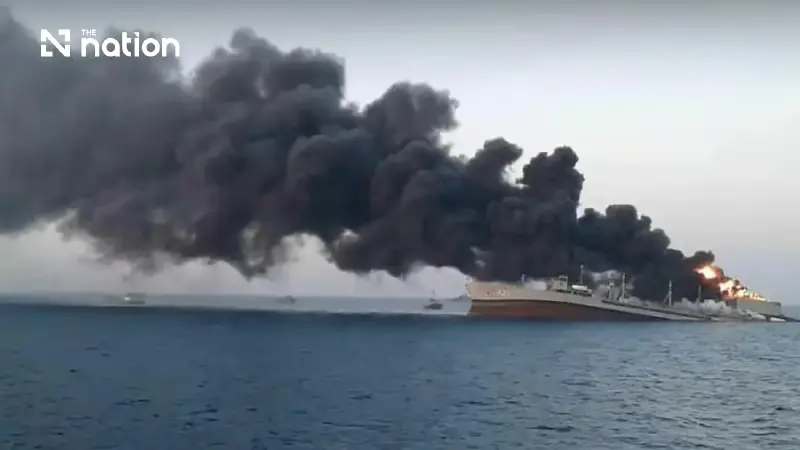


Trump threatened Iran with military action after Houthi attacks on Saudi tankers sent Brent crude above US$100 a barrel
- Yemen's Houthi movement attacked two Saudi oil tankers in the Red Sea, escalating the regional conflict.
- The attacks occurred near the Bab el-Mandeb strait, a critical chokepoint for global energy shipments.
- As a direct result, Brent crude oil prices rose above $100 a barrel, and insurance costs for vessels in the area doubled.
- The US has threatened "major military punishment" against the Houthis and Iran, whom it holds responsible for the attacks.
US President Donald Trump threatened Iran and Yemen’s Houthi movement with “major military punishment” after attacks on two Saudi oil tankers widened the Middle East conflict to another major energy-shipping route.
The Houthis reported missile and drone attacks on the Encelia and the Layla in the Red Sea on Thursday, days after announcing what they described as a naval blockade of Saudi Arabia.

Brent crude rose by more than 6% and climbed above US$100 a barrel for the first time since May as traders assessed the risk of further disruption to global oil supplies.
The reported attacks brought the conflict closer to the Bab el-Mandeb strait, which connects the Red Sea with the Indian Ocean and serves as one of the world’s most important routes for energy shipments.
Saudi Arabia has been moving millions of barrels of oil each day through pipelines to Red Sea ports to bypass the Strait of Hormuz, where Iran’s blockade has severely restricted Gulf oil exports.
Trump threatens further military action
Trump said Washington would hold Iran responsible for any further Houthi attacks, describing the Yemeni movement as a surrogate or proxy of Tehran.
“If they do this again, the US will hold Iran responsible,” Trump wrote on social media, adding that Iran and the Houthis would face “major military punishment”.
Trump later told Axios that he was close to deciding whether to restart large-scale combat operations against Iran, saying Tehran had not “received enough pain yet”.
He also said frozen Iranian assets held by the United States would be used to cover damage inflicted on cargo ships, although he did not explain how such payments would be arranged.
Sources in Iran and Yemen told Reuters that Iran had flown Islamic Revolutionary Guard Corps commanders, military advisers and missile- and drone-related equipment into Yemen shortly before the Houthis declared the blockade. The Houthis rejected the report.
One tanker attack confirmed
A maritime security source said the Encelia issued a distress call after being struck by a missile near the Saudi port of Jizan, north of Yemen, late on Wednesday.
Saudi Arabia’s state news agency reported that the strike caused a fire at the tanker’s bow.
Reuters was unable to independently confirm the reported attack on the Layla or several other battlefield accounts, although Trump referred to attacks on two Saudi tankers.
Insurance costs for some vessels using the southern Red Sea doubled following the attacks, according to shipping industry sources.
Several tankers have already changed course to avoid the Bab el-Mandeb. Ships travelling between Europe and Asia may instead have to sail around Africa, adding time and expense to their journeys.
Iran reports attacks on US positions
The escalation came as US forces continued attacks on Iran for a 13th consecutive night following the collapse of an interim truce two weeks earlier.
Iran said it struck US missile systems, weapons and fuel-storage sites in Jordan, as well as American military positions in Kuwait.
Jordan’s military reported intercepting four Iranian missiles and six drones during the previous day. One missile fell in an uninhabited area.
Iran’s Revolutionary Guards also reported an attack on a US electronic-warfare unit at Kuwait’s Al-Adiri base and alleged that it caused casualties. Neither the United States nor Kuwait reported any casualties at the site.
Iranian military spokesman Brigadier General Mohammad Akraminia said Tehran would continue retaliating for as long as the United States attacked Iranian infrastructure and coastal areas.
US Congress challenges Trump
Rising oil prices have added to global inflation concerns and increased political pressure on Trump’s Republican Party ahead of November’s congressional elections.
The Republican-controlled House of Representatives approved legislation directing Trump to halt US military action against Iran, delivering another congressional rebuke over the war.
Similar resolutions passed in recent months have not stopped the fighting. The Senate later voted against a separate measure seeking to restrict the military campaign.
