
Thai tech and training prospects draw Chinese business interest


Talks in Bangkok highlight healthcare technology, artificial intelligence and vocational education as areas for closer China-Thailand collaboration.
- A delegation of young Chinese entrepreneurs visited Thailand to explore business opportunities in artificial intelligence, digital technology, healthcare, and vocational education.
- Thai officials are actively seeking Chinese investment and partnership in priority tech sectors, particularly to upgrade the country's healthcare industry with AI and advanced gene technology.
- There is significant potential for cooperation in vocational training to develop a skilled workforce that can meet the demands of growing Chinese business operations in Thailand and the wider region.
Opportunities across artificial intelligence, digital technology, healthcare and vocational education came into focus as a delegation of around 20 young Chinese entrepreneurs met Thai officials and industry figures during a study tour to Bangkok this week.
Thailand’s healthcare sector was highlighted by Thai Health Tech Association president Phongchai Petsanghan, who put the number of healthcare start-ups in the country at more than 140.
He noted strong interest among Thai companies in China’s advances in gene technology and AI-assisted medical services as they seek to upgrade their healthcare capabilities.
Lu Guoliang, a member of the visiting delegation and director of Global Affairs at BGI Group, highlighted Thailand’s internationally recognised strengths in wellness and healthcare services.
He explained that BGI, one of China’s leading gene-sequencing companies, has launched several projects in Thailand and elsewhere in Southeast Asia in recent years.
Through those initiatives, BGI works with local research institutions, hospitals and government agencies to improve healthcare using advanced technologies.
Its regional activities include prenatal screening programmes for diseases with high prevalence across the region, including thalassaemia.
Lu said the tour had given the delegation a much clearer understanding of Thailand’s long-term development vision.
He linked the country’s strategic commitment to improving public health through technological innovation with what he described as “tremendous potential” for future China-Thailand cooperation.
AI investment featured prominently at a workshop held on Monday.
Suchana Sinthavathavorn, an official with the Digital Economy Promotion Agency’s Digital Transformation Promotion Unit, welcomed greater Chinese investment in digital technologies and AI.
She noted that AI is one of Thailand’s national development priorities and expressed hope that cooperation with China could be strengthened by combining the two countries’ respective advantages, producing “win-win outcomes”.
Representatives from the Digital Economy Promotion Agency, the National Science and Technology Development Agency and the Thai Health Tech Association also presented Thailand’s digital development priorities and innovation ecosystem, together with the role of digital technology in supporting sustainable development.
The wider programme, supported by the Global Development Promotion Centre of the China International Development Cooperation Agency, connected the Chinese visitors with Thai government and industry representatives in digital healthcare, education, big data and AI.
Its purpose was to strengthen regional partnerships to advance digital transformation and sustainable development across the Greater Mekong Subregion and the Global South.
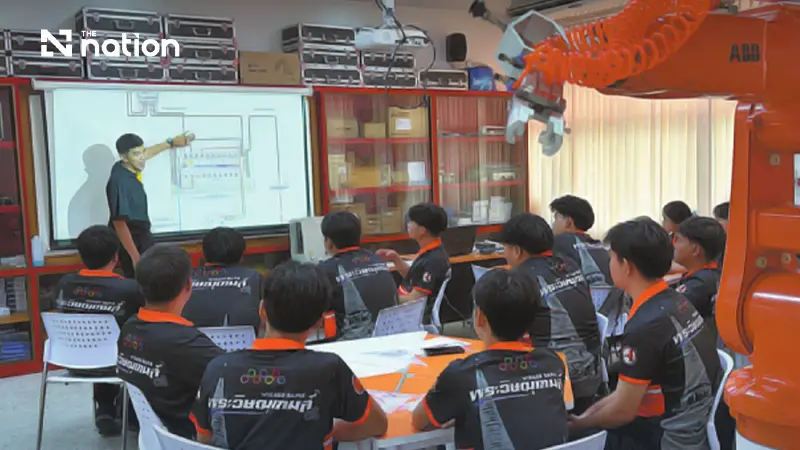
Skills development was examined during the delegation’s visit to the China-Thailand Luban Workshop in Ayutthaya, one of Thailand’s key industrial provinces.
Established in 2016, it was the first Luban Workshop outside China.
The visit reflected the growing importance of skills development to sustainable growth across the Global South.
Zhao Peng, a delegation member and chairman of Yize Investments Limited, described the tour as “extremely rewarding”.
He added that the delegation had been deeply impressed both by the warmth and hospitality of Thai people and by the scale of the opportunities for bilateral cooperation in vocational education.
More Chinese companies are operating in Southeast Asia as China-Thailand cooperation deepens in areas such as AI and cloud computing, increasing demand for highly skilled professionals.
Zhao added that Thailand’s longstanding friendship with China and supportive policies had reinforced confidence in the substantial potential for the two countries to jointly develop the skilled workforce needed for the future.
Source: China Daily
