
Deutsche Bank named first European renminbi clearing bank
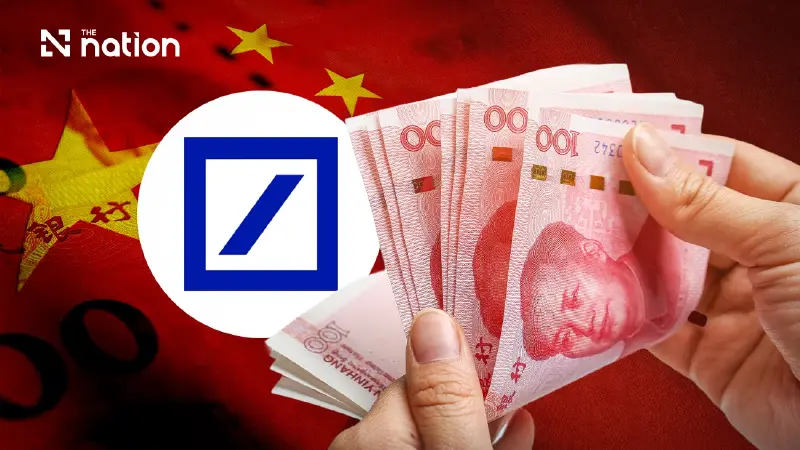


China’s central bank has appointed Deutsche Bank as Europe’s first local renminbi clearing bank, expanding access to cross-border yuan transactions.
China is taking another step towards expanding the renminbi’s global role after the People’s Bank of China appointed Deutsche Bank as a renminbi clearing bank in Europe.
The appointment makes Deutsche Bank the first European financial institution to receive the role, marking a significant development in financial links between China and Europe.
It will allow renminbi transactions to be processed and settled without having to pass directly through banks in mainland China.
Deutsche Bank said the status would enable it to provide direct processing, clearing and settlement services for cross-border renminbi transactions from its operating base in Frankfurt.
The bank will serve as a bridge connecting European financial institutions and businesses with China’s domestic payment system.
Appointment could strengthen China-Europe trade
The move is expected to make trade and investment between China and Europe more efficient by giving European companies easier access to China’s financial infrastructure, capital markets and renminbi liquidity.
It will also provide businesses with more options for conducting cross-border transactions in the Chinese currency.
Deutsche Bank’s appointment reflects Beijing’s broader strategy to increase the use of the renminbi in international trade and investment while reducing reliance on a global payment system dominated by the US dollar.
Alexander von zur Muehlen, Deutsche Bank’s chief executive officer for Asia-Pacific, Europe, the Middle East and Africa, and Germany, said the new role reinforced the bank’s position as a trusted global clearing partner.
“Securing renminbi clearing capabilities in Europe strengthens our role as a trusted global clearing partner and reflects our longstanding support for the internationalisation of the renminbi,” he said.
China expands global clearing network
China has previously expanded its renminbi clearing network into other regions.
In June, it appointed Standard Bank and the Industrial and Commercial Bank of China as joint renminbi clearing banks for Africa, covering transactions across 19 countries.
Renminbi clearing services were already available in Europe, but they had previously been provided through Chinese banks operating in the region.
Giving the role directly to Deutsche Bank, a European financial institution, therefore represents a significant change.
For Deutsche Bank, the appointment will also strengthen its position in facilitating trade and investment between China and Europe.
Leo Yin, president of Deutsche Bank China, said connecting the renminbi’s onshore and offshore ecosystems would help clients pursue new business opportunities as the currency’s international role continued to develop.
The arrangement could ultimately encourage more European companies to use the renminbi for trade and investment, while providing China with an additional channel through which to expand the currency’s presence and influence in the global financial system.
Source: Finance
