
Anutin invites Australian firms to invest in Thailand and access ASEAN
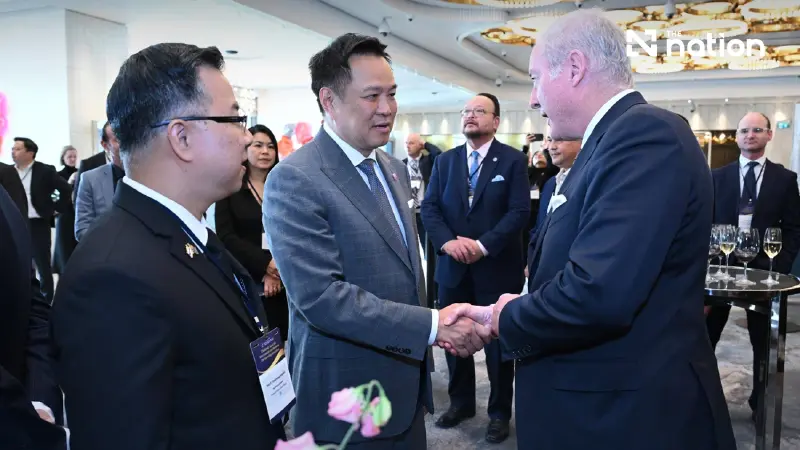


Prime Minister Anutin Charnvirakul presented Thailand as a stable ASEAN investment gateway to more than 70 Australian business leaders in Sydney.
Prime Minister Anutin Charnvirakul presented Thailand as a strategic investment partner and gateway to Southeast Asia during a meeting with more than 70 leading Australian business figures in Sydney on Tuesday (August 18).
Anutin delivered the opening address at the Thailand–Australia Investment and Business Partnership Reception at 4pm local time, three hours ahead of Thailand.
The Australian participants represented 10 target industries, including advanced manufacturing, agriculture and food, automotive, digital technology, mining and renewable energy. Companies represented at the event included Canva, ARB Corporation, Cochlear and NEXTDC.
The Thai delegation comprised 25 business leaders from 17 organisations, including Charoen Pokphand Foods, SCG, Thai Beverage, PTT, Gulf, Mitr Phol Group, Central Group and Minor Group.
The reception was held before Anutin travelled to Canberra for formal talks with Australian Prime Minister Anthony Albanese later on Tuesday.

Business sector central to bilateral partnership
Anutin said governments could open doors for trade, but businesses were ultimately responsible for creating jobs and turning bilateral partnerships into tangible economic results.
“Global geopolitics is changing around us,” he said. “Thailand’s response is to build resilience through a stronger business ecosystem driven by technology and innovation, while developing deeper partnerships with countries that share an interest in a stable and open region.”
As a founding member of ASEAN and the grouping’s prospective chair in two years, Thailand was committed to strengthening regionalism and shared resilience by translating policies into concrete action, he added.
The prime minister said Thailand’s geographical and logistical strengths allowed it to serve not only a domestic market of 66 million people but also as a gateway to an ASEAN market of almost 700 million.
That role is supported by increasingly sophisticated and integrated regional supply chains.
Thailand has also expanded its strategic partnerships with Indonesia and Singapore to improve industrial links across the region, Anutin said. Australian companies that began engaging with Thailand and planning their operations on a regional scale would be well placed to benefit from future growth.

Investment applications reach record levels
Anutin highlighted strong investment figures recorded by the Thai Board of Investment as evidence of continued confidence in the country.
Applications for investment promotion reached a record A$80 billion in 2025, equivalent to more than 1.87 trillion baht at an exchange rate of about 23.47 baht to the Australian dollar. The value represented an increase of 67% from the previous year.
During the first six months of 2026, applications had already reached A$61 billion, or approximately 1.43 trillion baht.
The principal target industries included agriculture and food, renewable energy, digital and creative businesses, advanced manufacturing and education.
Anutin said the figures showed that investors were continuing to express confidence in Thailand and strengthen their commitment to expanding their operations in the country despite uncertainty in the global economy.

FastPass and skills programme support investors
The government understood that attracting investment required an environment in which companies could operate with confidence, Anutin said.
Thailand had therefore introduced the Thailand FastPass to help investors move more quickly from the approval stage to the start of operations.
The government had also launched the Skill Bridge programme to develop workers in artificial intelligence and advanced technology, alongside a green electricity tariff designed to make renewable energy easier for businesses to obtain.
“Thailand intends to be an open, stable and competitive country supporting the success of those who choose to build their businesses alongside us,” Anutin said.
Thailand positioned as strategic ASEAN partner
The prime minister encouraged Australian executives to build on the trust developed over nearly 75 years of diplomatic relations and more than two decades of bilateral free trade.
The two countries should use those foundations to strengthen supply chains and deepen ties between their people, he said.
Anutin stressed that a partnership became strongest when it was supported by investment decisions and the selection of suitable local business partners in growing sectors.
He urged Australian companies to view Thailand as more than a conventional trading market, describing the country as a strategic partner and an important gateway to extensive opportunities across ASEAN.
