
Thailand proposes 3 military AI safeguards at IPU on Oct 6
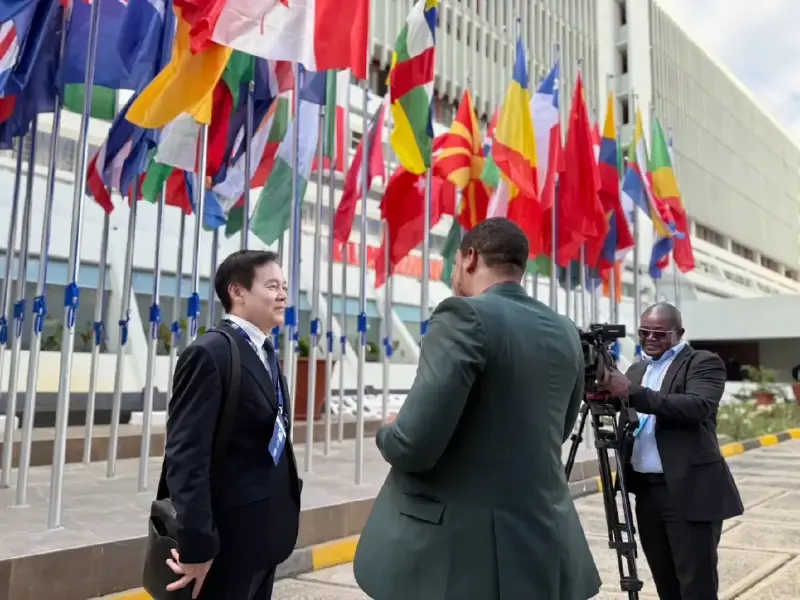


Thai senator Nophadol In-na urges parliamentary networks, government coordination and impartial monitoring of peace agreements at talks in Tanzania.
- At an Inter-Parliamentary Union (IPU) meeting, Thailand proposed three safeguards for military AI, arguing it must remain subject to human judgment and international law.
- The first proposal calls for "meaningful human control," ensuring that human decision-making is central throughout the life cycle of military AI and that AI systems are not solely responsible for using force.
- A second proposal urges parliaments to enact stronger legislation and oversight to promote transparency and accountable governance in the development and use of military AI.
- The third safeguard involves creating practical national policies that turn commitments into concrete measures, using established tools like UN roadmaps adapted to each country's needs.
Assistant Professor Dr Nophadol In-na, chairman of the Thai Senate’s Advisory Committee on Foreign Affairs, presented three proposals for regulating military artificial intelligence (AI) at an Inter-Parliamentary Union (IPU) meeting in Arusha, Tanzania, on October 6, 2026.
Nophadol represented Thailand’s parliament at the IPU Standing Committee on Peace and International Security, where he argued that military AI must remain subject to human judgement and international law. He also outlined principles for parliamentary diplomacy and mediation to support lasting peace.
Nophadol was preparing to stand for chair of the IPU Working Group on Science and Technology. A Cambodian representative also attended the peace and security committee meeting without referring to Thailand, the broadcaster reported.

Nophadol urges human control throughout military AI’s life cycle
Human judgement must remain central throughout the life cycle of military AI, Nophadol told the discussion on “The role of parliaments in securing peace in the age of military artificial intelligence”, held under agenda item 3.
Nophadol said AI was rapidly transforming military operations, raising a fundamental question about whether the technology would promote global peace or threaten it.
Nophadol reaffirmed Thailand’s commitment to United Nations General Assembly resolution 80/58 and the 2019 guiding principles on lethal autonomous weapons systems (LAWS), emphasising that human responsibility could not be transferred to machines.
Nophadol proposed three areas for parliamentary action to help ensure military AI protects human rights and the rule of law:
1. Meaningful human control. Nophadol said human decision-making must remain central throughout the life cycle of military AI. “Decisions to use force should not be left to AI systems alone,” he said.
2. Stronger legislation and oversight. Nophadol urged parliaments to use their legislative and budgetary powers to promote transparency and accountable governance, while encouraging international dialogue.
3. Practical national policies. Nophadol called for policy commitments to become concrete national measures, drawing on practical tools such as road maps from the United Nations Institute for Disarmament Research (UNIDIR), adapted to each country’s circumstances.
Nophadol calls for stronger parliamentary peace efforts
Nophadol called for closer cooperation between parliaments to strengthen peacebuilding as conflicts emerged around the world. He spoke under agenda item 4, “Shaping peaceful futures: Parliamentary diplomacy, mediation and dialogue for lasting peace”.
Nophadol described the IPU as an important forum for building trust, sharing accurate information and reducing misunderstandings. He said the IPU Secretariat could help mediate sensitive issues to ease tensions, while parliamentary diplomacy could open negotiations and support conflict mediation.
Nophadol cited Thailand’s earlier emergency proposal on transnational crime and cybercrime at an IPU Assembly as an example of how the parliamentary forum could address urgent threats.
Nophadol set out three principles for building lasting peace:
1. Parliamentary networks. Nophadol urged lawmakers to use networks such as the IPU to exchange good practice and work with civil society to encourage dialogue.
2. Coordination with governments. Nophadol said regular information-sharing between legislatures and the executive branch was essential to coherent peacebuilding efforts.
3. Peacebuilding mechanisms. Nophadol called for support for mechanisms that mediate conflicts, monitor peace agreements impartially and identify breaches.
“Conflicts will not end if each country considers only its own interests,” Nophadol said. He urged countries to pursue shared goals of building trust, encouraging dialogue and strengthening mediation to reach agreements or resolutions and achieve lasting peace at regional and international levels.
