
450-baht tourist fee plan gains backing as Thailand targets 8bn baht a year
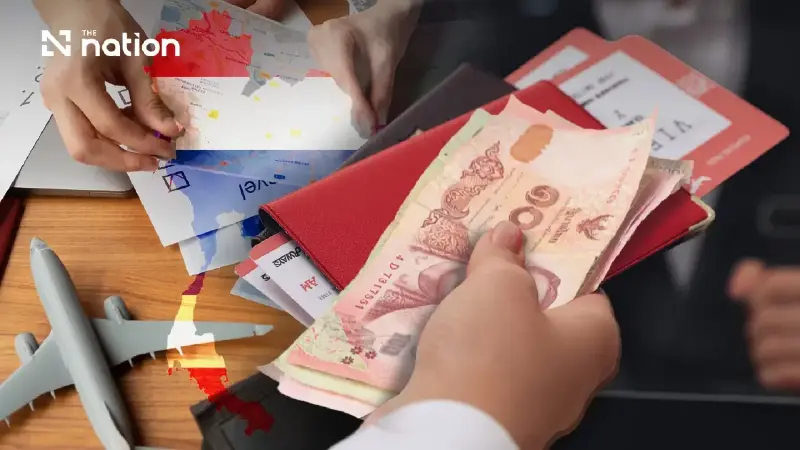


Thailand’s fee plan would fund visitor insurance and tourism sites, with about 8 billion baht or more a year left after collection and insurance costs
- Thailand plans to implement a 450-baht fee for foreign tourists, aiming to generate approximately 8 billion baht in annual revenue.
- The collected funds will be used to provide visitor insurance and to finance the development and maintenance of tourist destinations.
- The proposal has gained significant backing from government and business representatives, as well as over 80% support in a public online consultation.
- The fee will initially apply to tourists arriving by air and still requires final approval from the National Tourism Policy Committee and the Cabinet.
Tourism and Sports Minister Surasak Phancharoenworakul chaired talks in Bangkok on October 6, 2026, on a proposed 450-baht foreign tourist fee to finance visitor insurance and tourism development. Officials expect around 8 billion baht or more a year to remain for tourism projects after collection and insurance costs. Government and business representatives backed the fee proposal at the consultation, which also included civil society, according to the Tourism and Sports Ministry. The draft still has to go before the National Tourism Policy Committee and then the Cabinet.
450-baht fee would apply first to eligible air arrivals
The proposed fee would initially apply to eligible foreign tourists entering Thailand by air once the announcement takes effect. Collection from arrivals by land and water would be deferred for one year.
Revenue from the proposed foreign tourist fee would go to Thailand’s Tourism Promotion Fund, with a share allocated to insurance and the remainder used to restore and develop destinations, conserve and rehabilitate natural resources, and promote Thai tourism.
Surasak said the proposed funding would help tourism sites and communities receive support without relying solely on annual government budgets. Participants also discussed how to distribute funding fairly among areas, communities and relevant agencies.
Thailand received more than 22 million foreign tourists during January–September 2026, generating over 1 trillion baht, Surasak said. The minister described tourism as a major economic driver and said maintaining confidence required both traveller safety and quality destinations.
Tourist insurance would cover those who pay the fee
The proposed insurance would protect tourists who pay the fee, covering death and medical expenses subject to policy terms. The Tourism and Sports Ministry is considering broader coverage and wants hospitals to be able to verify eligibility and obtain reimbursement in practice.
Thansettakij reported that the meeting discussed around 7 billion baht a year in unpaid medical bills owed by foreign patients to state hospitals along Thailand’s borders. The estimate covers several groups of foreigners, whereas the proposed insurance would cover fee-paying tourists.
The Tourism and Sports Ministry is checking the base year and scope of the 7 billion baht estimate with public-health agencies. The insurance proposal aims to reduce unrecoverable treatment costs and the burden on Thai taxpayers.
Private-sector representatives estimated that more than 80% of tourists, particularly those from Europe and America, already have travel insurance. Businesses called for clear communication about the benefits and conditions of the proposed policy.
Online consultation records 80.50% support for draft fee
The online consultation ran from August 24 to September 28, 2026, and attracted 5,954 respondents. Of those participating, 80.50% supported the draft announcement and 78.30% supported the proposed charge of 450 baht per person.
Charging the same rate for air, land and water arrivals remained a point of disagreement in the consultation. Ticket-based collection was the most popular collection option, supported by 36.26% of respondents, as a way to reduce procedures and delays at immigration.
Comparative information cited by the Tourism and Sports Ministry indicated that more than 80 countries impose tourism taxes or fees. Examples of different approaches included destinations in Europe, Japan, Australia, New Zealand and Bali.
The Tourism and Sports Ministry said the proposed fee would allow visitors to contribute towards their safety and the upkeep of destinations, reducing reliance on Thai taxpayers alone.
Tourism businesses call for exemptions and transparent spending
Business representatives urged the Tourism and Sports Ministry to set a fee that would not deter travel, avoid adding delays at immigration and consider exemptions for border traders and frequent cross-border travellers.
Private-sector participants also requested disclosure of the tourism fund’s revenue, disbursements, insurance premiums and destination-development results. Thailand’s Tourism Promotion Fund agreed to consider oversight arrangements and disclosure rules that would make spending open to scrutiny.
The October 6 meeting took place at the Tourism and Sports Ministry in Building C of Bangkok’s Government Complex. Public Health Minister Pattana Promphat attended alongside representatives of the Tourism Council of Thailand, a Chinese chamber of commerce association, Central Group, The Mall Group, Siam Piwat, King Power, Platinum Group, the Thai Hotels Association, international airlines and GrabTaxi (Thailand) Co Ltd.
The Tourism and Sports Ministry plans to combine the meeting’s recommendations with the online responses before submitting the revised draft to the National Tourism Policy Committee and subsequently the Cabinet. The ministry also plans further discussions with airlines, the Immigration Bureau and other stakeholders on collection methods, exemptions, insurance procurement and the use of fund revenue.
