
Climate change examined after deadly Nepal-Tibet glacier collapse
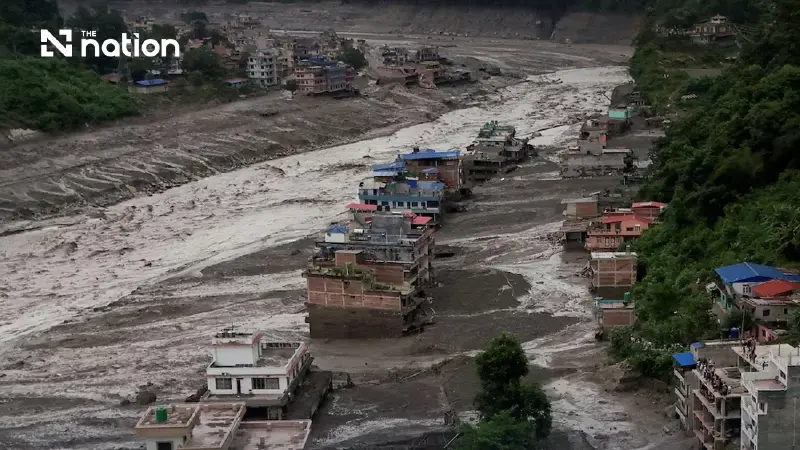


Scientists say warming may have destabilised Himalayan ice and rock before a glacier collapse triggered a flood that killed hundreds in Nepal and Tibet.
- A catastrophic flash flood in Nepal and Tibet was triggered by a massive collapse of ice and rock from a Himalayan glacier, not an earthquake as initially suspected.
- Scientists caution against directly blaming global warming for this specific event, but state that climate change could have contributed to the unstable conditions that led to the collapse.
- Rising temperatures in the region, which is warming twice as fast as the global average, are causing glaciers to retreat and mountain permafrost to thaw, weakening the stability of slopes.
- Evidence suggests unusually warm conditions and significant snow loss occurred just before the disaster, which may have weakened the ice and rock structures.
Climate change could have contributed to the conditions behind the catastrophic flash flood that struck Nepal and Tibet, although scientists caution that it is too early to attribute the glacier collapse directly to global warming.
The immediate trigger is believed to have been a massive avalanche of ice and rock high in the Himalayas. The collapse sent a torrent of water, mud, boulders and glacial debris through valleys and populated areas on both sides of the Nepal-China border on Wednesday (August 26).
At least 359 people had been reported dead and about 1,000 remained missing as rescuers continued searching damaged valleys and settlements. Hundreds of foreign tourists and pilgrims from more than two dozen countries were among those unaccounted for, although casualty figures remained provisional.

Seismic signal came from collapse, not earthquake
Early reports suggested that a magnitude 4.4 earthquake might have caused part of a glacier to break away.
The US Geological Survey later concluded that no earthquake had occurred. The seismic signal was instead generated by the collapse of glacial ice and rock and the subsequent debris flow, which registered as an event of about magnitude 5.2.
Preliminary analysis of satellite images indicated that a section of glacier covering about 0.2 square kilometres broke away at an altitude of approximately 5,200 metres and fell about 1.2 kilometres to the valley floor.
The impact converted enormous potential energy into heat and movement, possibly melting some of the ice. The avalanche then swept rock, sediment and glacial moraine into the Lhende Khola river system, rapidly increasing in volume as it travelled downstream.
Chinese government geologists estimated that the debris flow moved at roughly 50 metres per second and travelled for more than 20 kilometres, leaving people along its path almost no time to escape.
Water levels in rivers downstream rose by between seven and nine metres within about 30 minutes, according to the International Centre for Integrated Mountain Development.
The surge destroyed homes, roads, bridges, hydropower facilities and the Gyirong border crossing, while cutting communications and transport links along a major route connecting Kathmandu with Lhasa.

Warming may have weakened mountain ice and rock
Scientists said climate change should not be presented as the sole or confirmed immediate cause of the collapse. Events on this scale have been documented too rarely for researchers to establish a clear statistical relationship between individual glacier collapses and global warming.
However, there is strong evidence that rising temperatures are causing glaciers to retreat and mountain permafrost to thaw.
Permafrost — ground that remains frozen throughout the year — can act like glue holding fractured rock and adjacent ice together on steep mountain slopes. As it thaws, the structure of the mountainside can become less stable.
Satellite imagery also appeared to show significant snow loss in the valley during the 24 hours before the disaster. Some glaciers that had been snow-covered were largely exposed as bare ice by the following day, suggesting unusually warm conditions may have been present.
Researchers said such heat could weaken snow, allow meltwater to enter cracks and reduce the bonds holding ice and rock in place. Nevertheless, detailed meteorological, geological and satellite analysis will be required before the precise causes can be established.
The Himalayan region, spanning Nepal, China, India, Bhutan and Pakistan, is warming about twice as quickly as the global average.
Nepal’s mountains have lost close to one-third of their ice in slightly more than three decades, while glaciers across the Hindu Kush Himalayas disappeared 65% faster between 2011 and 2020 than during the previous decade.
These changes can increase the risks of avalanches, landslides and floods, although local geology, steep terrain, heavy rain, snow conditions and human activity can also influence whether a particular slope fails.

Search complicated by destroyed roads and further flood risks
More than 5,000 soldiers and police officers joined rescue operations in Nepal, using helicopters to search for survivors and deliver food, tents and other emergency supplies to communities cut off by damaged roads and bridges.
Many of those missing had been travelling along a route used by trekkers and people making pilgrimages to Kailash Mansarovar, a high-altitude site considered sacred by several religions.
The original collapse has also created the possibility of further flooding.
Debris blocked river channels and formed unstable lakes near the disaster zone. Authorities in Nepal and China warned that the barriers could fail, particularly if more rain or meltwater entered the lakes, forcing some rescuers and residents to move to higher ground.
Scientists said the disaster demonstrated the need for stronger monitoring and early-warning systems in high mountain valleys.
Although such systems cannot prevent glaciers or mountainsides from collapsing, better satellite surveillance, river gauges and community alerts could provide more time for people downstream to evacuate.
The scientific picture is therefore still developing. The direct cause was an immense collapse of Himalayan ice and rock, not an earthquake. Climate change cannot yet be identified as the sole trigger, but researchers say rising temperatures, retreating glaciers and weakening permafrost may have helped create the unstable conditions in which the disaster occurred.
Sources: Reuters, The Guardian
