
Unhealthy air recorded in the Philippine capital region amid haze
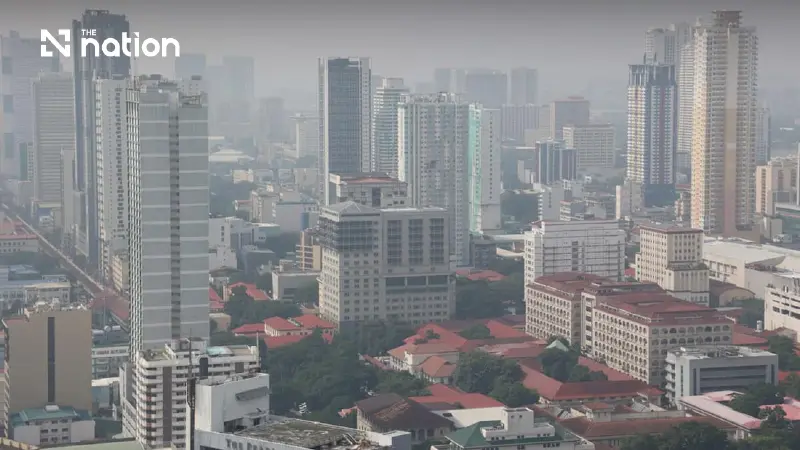


Haze from Kalimantan forest fires may persist over parts of the Philippines until Thursday, while health officials advised people to limit exposure.
- Unhealthy air quality in Metro Manila is attributed to a cross-border haze, caused by smoke from forest fires in Indonesia being carried by the southwest monsoon.
- Several cities in the region recorded "very unhealthy" to "acutely unhealthy" air quality indices, according to the Department of Environment and Natural Resources (DENR).
- Health officials have advised residents to stay indoors, wear N95 masks when outside, and take extra precautions for vulnerable groups like children and the elderly.
- The haze is expected to persist for several days, with improvement depending on external factors like wind patterns, rainfall, and the status of the Indonesian fires.
Parts of Luzon and the Visayas came under transboundary haze on Tuesday as the prevailing southwest monsoon, or “habagat”, transported smoke from forest fires in Kalimantan, Indonesia, environment and health officials said.
Monitoring by the Department of Environment and Natural Resources’ Environmental Management Bureau (DENR-EMB) put several Metro Manila cities in the “very unhealthy” to “acutely unhealthy” range on Tuesday morning.
Its data as of 4pm gave “acutely unhealthy” air-quality indices of 265 for Parañaque; 245 for Las Piñas; 237 for Quezon City’s Ateneo area; 227 for Malabon; 226 for Taguig; 225 for Manila; 221 for Valenzuela; 217 for Marikina; 216 for Muntinlupa; 214 for San Juan; and 208 for Mandaluyong.
On the EMB scale, 201 to 300 is the second-highest category, below “emergency” at 301 to 500.
“Very unhealthy” readings were Makati 188, Navotas 180, Quezon City’s Commonwealth area 171 and Pateros 167.
The Department of Health (DOH) recommended that people remain indoors where possible and wear an N95 mask whenever they went outside.
If no N95 was available, it suggested placing a wet handkerchief or cloth over the mouth and nose, or wearing two surgical or ordinary masks in layers.
The department said haze could aggravate respiratory diseases such as asthma and cause chest pain, coughing, breathing difficulties, nasal itching and watery eyes.
“Extra caution is essential for children, the elderly, and those with respiratory and heart illnesses,” the DOH said.
Central Luzon, CALABARZON (Cavite, Laguna, Batangas, Rizal and Quezon) and MIMAROPA (Mindoro, Marinduque, Romblon and Palawan) were among the affected regions named in a separate DENR-EMB Facebook post.
For journeys at night or through poor visibility, motorists should switch on headlights or fog lights, said Bernardo Rafaelito Alejandro IV, the Office of Civil Defence deputy administrator for administration.
In Bohol, Mel Micayabas, 34, of Dauis town, said smoke appeared to envelop Panglao Island from afar.
Residents of Tagbilaran City and nearby towns also reported hazy, smoke-filled skies, which some had noticed since Monday.
From Tagbilaran, Cebu Island, normally visible across the Bohol Strait, was barely seen, while the mountains of Maribojoc were obscured.
DENR-EMB in Central Visayas rated Metro Cebu’s air quality “very unhealthy” on Tuesday morning.
Bohol Governor Erico Aristotle Aumentado urged residents to wear masks outdoors and avoid unnecessary exposure.
Official readings in Iloilo City remained within the “Good to Fair” range from August 28 to 31 despite Monday reports from residents of Tubungan town in Iloilo, Western Visayas, of haze, a strong smell of smoke and discomfort while breathing.
The haze could remain over parts of the country through Thursday, according to Jundy del Socorro, chief of the Environmental Quality Management Division of DENR-EMB.
“At this point, the haze situation is largely beyond our control because it depends on several factors outside the Philippines, including the intensity of the forest fires in Kalimantan, prevailing wind patterns, and rainfall across the region,” Del Socorro said.
At no more than 2.5 micrometres, PM2.5 particles can be inhaled deep into the lungs, while elevated levels can pose greater risks to people sensitive to air pollution.
Rainfall can help reduce pollution by removing PM2.5 and smoke particles from the atmosphere, Del Socorro said.
He said air quality “could gradually improve if rainfall remains widespread and wind patterns begin to shift” between September 4 and 6.
Conditions after September 6 would depend “primarily on whether the fires in Kalimantan continue to generate smoke, whether new hot spots emerge, and whether winds continue to carry smoke toward the Philippines”, he added.
With reports from Gabryelle Dumalag, Hazel Villa and Leo Udtohan.
Source: Inquirer
