
Trump and Xi meet on September 24 after two-month trade truce extension
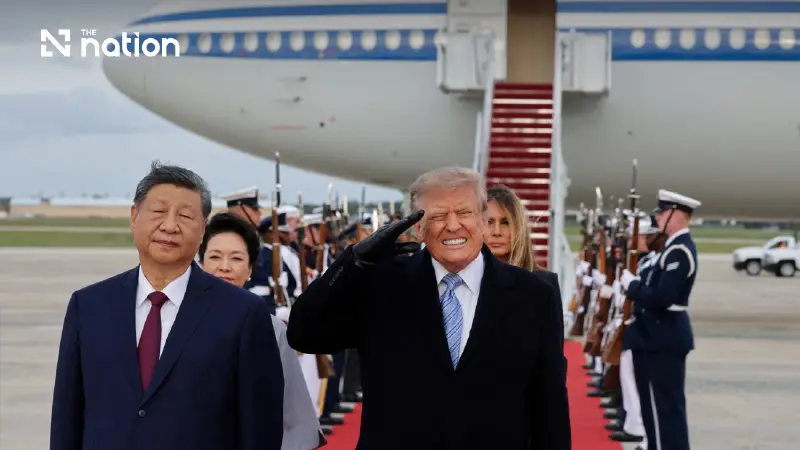


Donald Trump and Xi Jinping’s Washington talks will test progress on China’s pledge to buy 200 Boeing jets and US agricultural products.
- U.S. President Trump and Chinese President Xi are scheduled to meet at the White House on September 24 after extending their trade tariff truce by two months to January 10, 2027.
- The summit's agenda focuses on trade negotiations, with Trump seeking large Chinese purchases of U.S. agricultural products and Boeing aircraft ahead of the U.S. midterm elections.
- Beyond trade, other central issues for discussion include U.S. support for Taiwan, pressuring Iran, China's control of rare-earth minerals, and establishing a dialogue on artificial intelligence (AI).
US President Donald Trump is due to host Chinese President Xi Jinping at the White House in Washington on Thursday, September 24, 2026, for their second summit of the year. A two-month extension of their tariff truce gives the countries more time for trade negotiations, while Taiwan, Iran and artificial intelligence (AI) remain central issues.
Xi arrived in Washington on September 23, his first visit to the city in more than a decade. Four months after the leaders met in Beijing in May, China’s trade with the world has surged.

Trump approaches the Washington summit with low approval ratings and the war in Iran still unresolved. The US president wants economic gains to present to Americans frustrated by rising prices, ahead of November’s midterm congressional elections.

US-China tariff truce extended until January 10
US Treasury Secretary Scott Bessent said on September 23 that Washington and Beijing had agreed to extend their tariff truce until January 10, 2027, from its previous November 10 expiry date. Speaking after talks with Chinese Vice Premier He Lifeng, Bessent said the extension would allow more time to negotiate a potentially larger trade agreement.
The Busan Agreement, reached after a Trump-Xi summit in South Korea, halted an escalating trade war in which reciprocal tariffs exceeded 100% and threatened global supply chains.
US Trade Representative Jamieson Greer said in September that the countries would make “some announcements on agriculture and non-tariff barriers”. Markets will also watch for progress on an agreed mutual tariff reduction covering US$30 billion in goods, with lower duties on US farm imports offering China the easiest route to implementing the cuts.
China’s Boeing and farm commitments face scrutiny
Trump wants to secure prominent Chinese purchases of Boeing aircraft and US agricultural products before November’s congressional elections. Greer said on September 21 that China was making progress towards fulfilling its commitment to buy 200 Boeing aircraft, but gave no indication that additional orders were imminent.
Trump suggested in May that China could increase its Boeing order to as many as 750 aircraft. The purchase would be Boeing’s first major Chinese deal in nearly a decade, although chief executive Kelly Ortberg has played down analysts’ expectations of another order around the September summit.
The White House’s May 17 fact sheet said China had committed to buying US agricultural products at a rate of at least US$17 billion a year in 2026, 2027 and 2028, with the 2026 amount prorated. The pledge is additional to China’s earlier soybean purchase commitments.
Republican Senator Pete Ricketts, who chairs the Senate Foreign Relations subcommittee on East Asia, urged Trump ahead of the summit to press Xi to fulfil China’s farm-purchase commitments and promises to admit more US beef.
China’s rare-earth dominance shapes the bargaining
China’s control of critical minerals helps explain Trump’s less confrontational approach before the summit, according to experts cited by Reuters. Consultancy AlixPartners estimates that China accounts for up to 70% of global rare-earth mining, 85% of refining capacity and about 90% of rare-earth metal alloy and magnet production.
Washington wants Beijing to relax export controls on rare earths and other critical minerals needed for high-technology applications. Beijing, meanwhile, is seeking a further postponement of a US rule that would prevent thousands of Chinese companies from accessing advanced American technology.
Trump’s administration has approached the September summit without threatening steep new tariffs on Chinese imports or bans on US technology exports, unlike its stance before earlier meetings. China’s restrictions on rare-earth exports in 2025, imposed in retaliation for Trump’s tariffs, unsettled markets worldwide.
US allies fear Taiwan concessions in pursuit of trade gains
US allies in Asia are concerned that Trump could weaken Washington’s support for Taiwan to secure economic concessions from China. Taiwan is democratically governed and strongly rejects Beijing’s claim to sovereignty over the island.
The United States has no formal diplomatic relations with Taiwan, as is the case for most countries. Washington nevertheless remains Taiwan’s most important international supporter and arms supplier.
Trump said Xi challenged US arms sales to Taiwan during their May meeting. The US president subsequently called a pending arms package worth up to US$14 billion a “negotiating chip”.
People familiar with Beijing’s efforts told Reuters that China also wanted Trump to declare publicly that the United States “opposes” Taiwanese independence. Washington’s longstanding wording is that it “does not support” independence, a distinction with significant political implications.
A change in US policy towards Taiwan would raise questions about Washington’s resolve to defend the island and face congressional opposition. On September 21, US Secretary of State Marco Rubio reaffirmed American defence commitments to Japan and South Korea during talks with their foreign ministers, and all three countries expressed support for Taiwan.
Republican John Moolenaar, chairman of the House Select Committee on China, urged Trump in a September 18 letter to resist Beijing’s objections to American arms sales and security cooperation with Taiwan and US allies in Asia. Such objections should be “rejected out of hand”, Moolenaar wrote.
Washington wants Beijing to put pressure on Iran
Washington believes Xi is particularly well placed to exert pressure on Tehran because China maintains close ties with Iran and is by far the largest buyer of its oil exports. Xi has shown little willingness to use that influence as Washington wants.
Bessent said Trump and Xi would continue discussing China’s financial links with Iran at the summit. Despite US frustration with Beijing, Bessent did not impose penalties on Chinese banks when he announced an “economic onslaught” against Iran in August and warned countries to sever business ties with Tehran.
Trump dismissed a report in September that Iranian authorities had obtained satellite imagery of a base in Jordan from Chinese entities before a July attack that killed three US troops there.
Reuters reported on September 10 that China was supplying billions of dollars’ worth of goods to Iran through a sanctions-evasion arrangement. China’s foreign ministry said it was unaware of the arrangement.
US-China AI dialogue offers limited scope for cooperation
Artificial intelligence could offer Washington and Beijing room to cooperate because both are concerned about misuse and the technology’s consequences for national security, economic competitiveness and military capability, analysts say. However, experts cited by Reuters expect fierce competition between the countries to limit the prospects for agreements with more than symbolic value.
Following weekend talks with He Lifeng ahead of the summit, Bessent said the two sides had discussed establishing a new US-China dialogue on artificial intelligence.
Rubio said officials were considering “the equivalent of a hotline that we had during the Cold War”. The aim was to prevent dangerous incidents that “could impact economies or societies and even lead to a conflict between nation-states”, Rubio said.
Anthropic chief executive Dario Amodei warned in September that Chinese dominance in artificial intelligence could threaten US security. Chinese state media dismissed the warning as drawn from a “Cold War playbook”.
In his United Nations speech on September 22, Trump again opposed new regulations for artificial intelligence, saying US law enforcement agencies could rein in the sector if necessary.
