
Bangkok BTS Green Line transfer plan aims to end duplicate entry fees
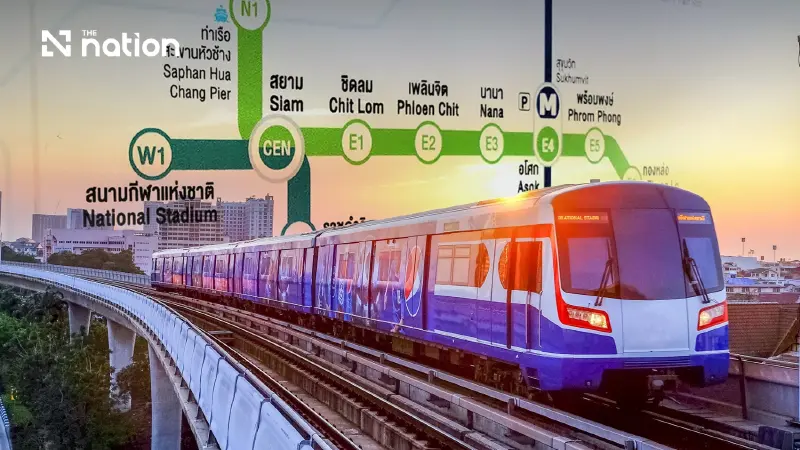


A draft agreement is under legal review for a transfer that would end the city’s Green Line subsidy burden and support lower rail fares.
- The Thai government plans to transfer management of the Bangkok BTS Green Line from the Bangkok Metropolitan Administration (BMA) to the Mass Rapid Transit Authority of Thailand (MRTA).
- The primary goal of the transfer is to eliminate duplicate entry fees for passengers when they switch between different rail lines under a new "Single Ownership" model.
- This restructuring also aims to lower overall fares to a range of THB17–45 per journey and enable an integrated common ticketing system.
- The transfer, scheduled for January 2027, will relieve the BMA of the significant financial burden of subsidizing the line's operating costs.
The government aims to transfer the Green Line rail project from the Bangkok Metropolitan Administration (BMA) to the Mass Rapid Transit Authority of Thailand (MRTA) as part of a restructuring of rail transport in Bangkok and surrounding areas.
The restructuring is intended to introduce fares of THB17–45 per journey and eliminate duplicate entry charges, with the transfer placing the project under a “Single Ownership” model for integrated rail management.
Bangkok deputy governor Wisanu Subsompon said the BMA and the MRTA had jointly prepared a draft memorandum of understanding (MOU) for the transfer.
The draft has already been endorsed by the legal subcommittee and the steering committee.
The draft MOU is now being reviewed by the Office of the Attorney General.
Once the office has reviewed and endorsed it, the two agencies will sign the MOU.
The MRTA is scheduled to assume the project’s management rights in January 2027.
As soon as it assumes those rights, the MRTA will receive the project’s revenue and take over the BMA’s responsibility for paying for contracted train operations.
For the asset transfer, the MRTA will request a government budget allocation to cover compensation and financial obligations payable to the BMA, based on figures in financial statements certified by the State Audit Office of the Kingdom of Thailand.
Revenue from Green Line extensions 1 and 2, for which the BMA is responsible for both income and expenditure, falls short of operating costs.
The BMA therefore uses its own budget to cover the deficit.
Its average monthly subsidy ranges from more than THB400 million to nearly THB500 million.
The annual subsidy is projected to reach approximately THB5.7 billion this year, with the amount expected to increase each year.
The transfer would end the BMA’s obligation to subsidise the shortfall, allowing it to use the billions of baht saved each year to develop infrastructure, utilities and other public services for Bangkok residents.
A shift to a “Single Operator” model, with the MRTA as the main state agency overseeing all urban rail lines, would also directly benefit passengers in the following ways:
- Lower fares: The government would be able to set the fare structure independently, allowing passengers to travel at reduced fares.
- Abolishing duplicate entry charges: Passengers would no longer face repeated entry charges when transferring between lines, removing a problem that affects the fare structure.
- Putting integrated ticketing into practice: The change would support the implementation of Common Ticket and Common Fare policies, making travel between different rail lines more convenient.
