
Wang Yi stresses importance of Trump-Xi Jinping talks amid rising global tensions
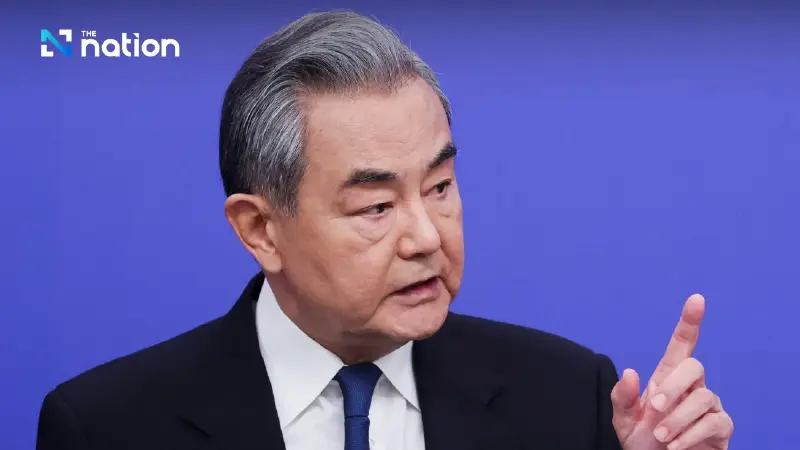


Chinese Foreign Minister Wang Yi said on Sunday that continued dialogue between Beijing and Washington is crucial to preventing mistakes that could spiral into a broader international crisis, as attention builds around a possible summit later this month between President Xi Jinping and Donald Trump.
Speaking on the sidelines of China’s annual parliamentary meeting in Beijing, Wang warned that a lack of communication between the world’s two largest economies would deepen misunderstanding, lead to poor judgement and increase the risk of confrontation.
He said preparations for high-level exchanges with the United States were under discussion, but added that both sides would need to create the right conditions to handle existing disputes.
His comments came as analysts watched closely to see whether Trump would still travel to meet Xi at the end of the month.
Beijing has not officially announced the summit.
The issue has taken on greater significance as Trump remains focused on the war that he and Israel launched against Iran.
On that conflict, Wang called for military operations to stop immediately, saying the war should never have broken out and that force could not resolve the crisis.
Even so, he stopped short of moving beyond China’s earlier expressions of concern and condemnation, despite reports that Tehran had been close to securing supersonic anti-ship missiles from Beijing.
According to Tehran, the week-old war has killed Supreme Leader Ayatollah Ali Khamenei and more than 1,300 other people in Iran.
Trump’s decision in January to authorise the capture of Venezuelan President Nicolas Maduro has also added to questions over how far Beijing is willing to defend its strategic partners.
The broader geopolitical clash is also widening in the Americas.
Trump’s so-called “Donroe Doctrine”, described as a reworking of a 19th-century policy asserting US influence in the region, is increasingly colliding with Xi’s Belt and Road and Global Security initiatives, both of which are central to China’s long-term international strategy and carry major political weight for Xi personally.
Trump has also threatened military action against Colombia and Mexico, while saying Cuba’s communist regime appeared close to collapse, prompting concern across Latin America over whether close ties with China would offer any real protection if pressure from Washington intensified.
Yasser Nasser, a historian at the University of Tennessee, Knoxville, said Chinese foreign policy had not faced such intense examination since the Cold War.
He said the current moment was significant because it exposed the limits of Beijing’s economic promises and arms relationships, showing that such commitments do not necessarily mean China will directly challenge the United States or block intervention, as it once did during the Vietnam War.
Wang also appeared to criticise Trump’s foreign policy approach without naming the United States directly.
He asked whether Asia would remain as stable as it is today if China behaved like traditional great powers by carving out spheres of influence, fuelling bloc confrontation or shifting its own problems onto neighbouring countries.
That message, however, came as analysts said Beijing itself had become more assertive in the region over the past year.
China has staged large-scale military exercises around Taiwan, intensified friction with Japan after remarks by Prime Minister Sanae Takaichi that an attack on Taiwan could trigger a military response from Tokyo, and repeatedly confronted Philippine vessels in disputed parts of the South China Sea.
Even so, Wang tried to present China as a source of economic steadiness in contrast to Trump’s readiness to use force.
He argued that strength should not be measured by coercion, and warned that the world must not slide back into what he called the “law of the jungle”.
Reuters
