
Singapore Bets on AI "Conversion" as It Deepens China Ties
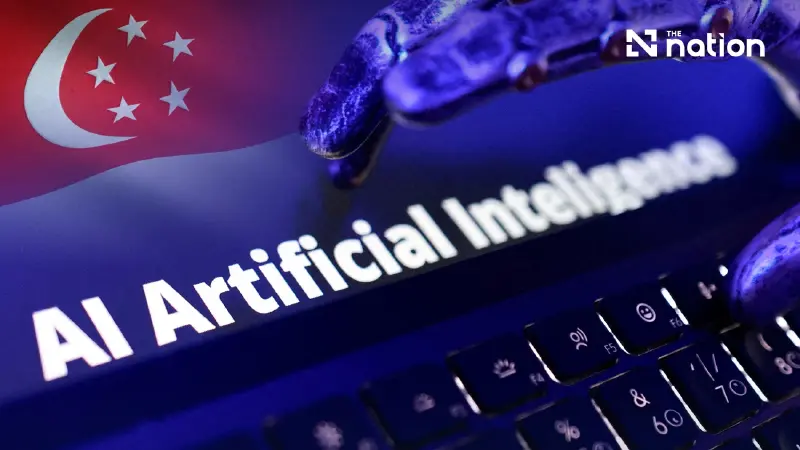


"Not the biggest, but the most useful": Singapore stakes its AI future on turning other nations' breakthroughs into hard economic value
- Singapore's national AI strategy focuses on "conversion"—applying other nations' AI breakthroughs to create economic and social value, rather than competing to build the largest models.
- This strategy is being pursued while deepening ties with China, highlighted by a new, dedicated AI track at the FutureChina Global Forum and joint work on digital policies.
- By collaborating with China, Singapore aims to build the regional "institutional plumbing," such as testing standards and trust frameworks, that will shape AI adoption across Southeast Asia.
"Not the biggest, but the most useful": Singapore stakes its AI future on turning other nations' breakthroughs into hard economic value.
Singapore does not intend to win the artificial intelligence race by building the biggest models or buying the most chips. Instead, it wants to become the place that turns other people's AI breakthroughs into real economic value — and it wants China, Thailand and the rest of Southeast Asia to build that capability alongside it.
That was the central message from Tan Kiat How, Singapore's Senior Minister of State for Digital Development and Information and for Health, as he opened the inaugural AI track of the 17th FutureChina Global Forum at the Sands Expo and Convention Centre, Marina Bay Sands, on Thursday (September 24).
"The strategic challenge for Singapore is familiar," Tan told delegates. "The first AI race was about making AI more capable. This will increasingly be about how much more capable AI can make us."
He argued that relevance for a small country "does not come from being the largest or the biggest" but "from being useful" in the next phase of the AI-powered global economy.
The two-day forum, themed "Strengthening Resilience, Rebuilding Trust", is organised by Business China, a non-profit founded by the city-state's first prime minister, Lee Kuan Yew, to deepen ties between Singapore, China and the wider region.
This year's edition, running until Friday, debuts a dedicated AI track alongside the main programme, which culminates on Friday with an address by Singapore's Deputy Prime Minister Gan Kim Yong as guest of honour and a fireside chat with Minister Chan Chun Sing.

A different race
Tan's speech centred on a distinction he said too few countries were making: between the race to build more powerful AI models and the race to absorb and apply them.
Two companies handed the same frontier model, he said, would not get the same results — one might simply speed up existing work, drafting emails and summarising documents faster, while another redesigns its workflows, retrains staff and reorganises how decisions get made.
"Same AI, very different value," he said. "The model may be the same. The capability system around it is not — and that difference compounds."
He extended the logic to healthcare, his other portfolio, arguing that hospitals with "trusted data, connected digital infrastructure" and clinicians trained to know when to trust an AI recommendation would get far better outcomes than those with fragmented systems, even using identical technology.

"The technology being equally capable, the health system is not," he said. Applied to entire economies, he said, the lesson was that Singapore should not try to compete on scale with far larger powers.
"We will not have the most compute. We will not build every frontier model. We will not manufacture every advanced chip," he said, invoking the Chinese phrase zhàn duì — literally "choosing one's side" or one's race — to describe the need for clarity about which competition actually matters.
Singapore's answer, he said, is to become "exceptionally good at converting AI capability into economic and social value", much as it built its financial sector not on domestic capital but on trusted rules and connections to markets far larger than itself.
Guardrails without gridlock
Tan devoted much of his address to governance, arguing that oversight should be proportionate to risk rather than uniform.
"A simple productivity tool is different to a highly autonomous system capable of operating critical infrastructure," he said, calling for a "drug trial discipline about evidence" — not identical to pharmaceutical regulation, but built on the same logic of testing, evidence-gathering and continued monitoring after deployment.
He pointed to Singapore's own progression "from governance to testing" through its AI Verify programme and noted that Beijing had updated its own AI security governance framework earlier this month to address risks from increasingly capable AI agents.

With trade talks between Washington and Beijing under way this week, he said competition between major powers would not produce "one global rule book" — but added that catastrophic risks, from attacks on critical infrastructure to biological misuse, were "outcomes that nobody benefits from", making some cooperation on evaluation standards and incident reporting a shared interest regardless of rivalry.
He cited a Singapore-brokered initiative between Mastercard and Visa, developed under the Monetary Authority of Singapore's regulatory sandbox, to build a common framework for identifying and trusting AI payment agents across rival networks, as a model for interoperability "without requiring uniformity".

Why an AI-only track, in two languages
Opening the session, Business China chief executive Kwek Poh Heok said the forum had added AI as a standalone track this year after years of feedback from participants, drawing scientists, entrepreneurs, investors, big technology firms and regulators onto one stage.
Business China's own experiment in preparing the forum, she said, illustrated the scale of the shift: multiple AI tools, including paid versions, took unusually long to answer a simple question about how many AI conferences exist worldwide before concluding there was no precise figure — "hundreds, even thousands", each year.
The bilingual format, she said, was deliberate. Many of the forum's younger audiences access English-language coverage of AI easily but "understand China's technology far less deeply"; the Chinese-English sessions were designed to open "another window" onto China's advances in the field.
"Today's bilingual forum offers a window into China's rapid advances in AI, how they are being applied, and what these developments could mean for businesses and society," Kwek said, adding that Singapore was also seeing demand for a new kind of bilingualism — professionals who combine deep industry expertise with fluency in applying AI, whom he called "AI bilinguals".

Why it matters beyond Singapore
For readers across the region, the forum's significance lies less in any single announcement than in the positioning on display: a small, trusted, English- and Chinese-speaking hub actively building the institutional plumbing — testing regimes, payment-agent frameworks, and cross-border data arrangements — that could determine how AI capability actually reaches Southeast Asian businesses.
Singapore's Singapore-China Digital Policy Dialogue, which Tan co-chairs, is already working on trusted data flows and shared digital credentials with Beijing.
The stakes are sizeable.
The Economic Research Institute for ASEAN and East Asia has projected the region's AI market could grow from roughly USD 8.9 billion in 2025 to USD 30.3 billion by 2030, with AI adoption potentially adding 10 to 18 per cent to ASEAN's GDP — worth close to USD 1 trillion — over the same period.
China, meanwhile, is entering its 15th Five-Year Plan, running through 2030, with innovation and industrial upgrading as central economic priorities, deepening Beijing's incentive to export AI applications and standards through regional partners such as Singapore.
For Thailand and its ASEAN neighbours, the message from Thursday's session was less a warning than an invitation with an edge: the rules, testing standards and trust frameworks now being shaped between Singapore and China are likely to define how AI moves through the region's economies — with or without direct participation from other capitals.
The forum's main track continues on Friday, featuring Deputy Prime Minister Gan Kim Yong as guest of honour.
