
Laos ready for year-end exit from least developed country status
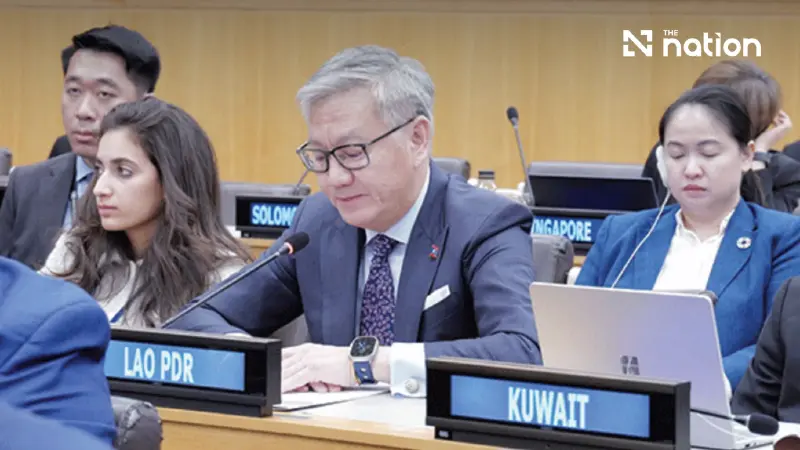


Laos has incorporated its transition strategy into the 2026–2030 development plan and called for continued assistance from development partners.
- Laos has confirmed its full readiness to graduate from its least developed country (LDC) status, with the transition scheduled for the end of 2026.
- The country has met all three UN criteria for graduation, significantly surpassing the required thresholds for gross national income per capita and the Human Assets Index.
- Despite its readiness, Laos is appealing for continued international assistance through the UN to ensure a smooth economic transition and strengthen its economy post-graduation.
Laos has appealed for international help to strengthen its economy beyond its scheduled graduation from least developed country (LDC) status by the end of 2026.
Deputy Prime Minister and Foreign Minister Thongsavan Phomvihane made the request during talks in New York on September 25, when he reaffirmed the government’s commitment to the transition.
Rabab Fatima, the United Nations (UN) Under-Secretary-General and High Representative for the Least Developed Countries, Landlocked Developing Countries and Small Island Developing States, met Thongsavan on the sidelines of the 81st UN General Assembly.
Thongsavan identified the Sustainable Graduation Support Facility (iGRAD) as the channel for the continued assistance he requested from the UN and development partners during his meeting with Fatima.
The Lao Ministry of Foreign Affairs said he had also confirmed Laos’ full readiness for formal graduation.
Health, education and better nutrition for women and children were priorities Thongsavan raised with Catherine Russell, executive director of the United Nations Children’s Fund (UNICEF), in a separate meeting during the General Assembly in New York.
Thongsavan stressed the importance of continued UNICEF assistance in preserving and improving Laos’ Human Assets Index.
Thongsavan and Russell also highlighted the adoption of the UNICEF Country Programme Document for 2027–2031 and the cooperation between Laos and the agency.
Progress in human assets contributed to Laos’ qualification for graduation.
Further gains in human development will remain important after the country leaves the LDC category.
The UN bases its assessment on gross national income per capita, the Human Assets Index and the Economic and Environmental Vulnerability Index.
Laos first satisfied the income and human assets requirements in 2018, before meeting all three criteria by 2021, a significant step towards graduation.
The US$1,306 graduation threshold for gross national income per capita was well below Laos’ US$2,503 in the UN’s 2024 review.
Against a required Human Assets Index minimum of 66, Laos scored 74.8. On the Economic and Environmental Vulnerability Index, the ceiling was 32 and Laos’ score was 29.8.
Graduation preparations are embedded in Laos’ wider development agenda through the 10th Five-Year National Socio-Economic Development Plan for 2026–2030.
The plan incorporates the government’s Smooth Transition Strategy, drawn up to guide the country through 2026 and beyond.
Addressing a high-level meeting on the fifth anniversary of China’s Global Development Initiative, Thongsavan affirmed that Laos would pursue projects under the initiative alongside efforts to meet the 2030 Sustainable Development Goals.
Thongsavan also attended the 50th Annual Meeting of Foreign Ministers of the Group of 77.
Thongsavan set out three principles to guide development cooperation.
Cooperation must be consistent with each country’s actual priorities and needs, strengthen South-South cooperation and accelerate long-term work to build the capacity of personnel in developing countries, he said.
Reciprocal visits by government delegations were agreed in bilateral talks between Deputy Foreign Minister Anouparb Vongnorkeo and his counterpart from the Democratic People’s Republic of Korea.
Their agreement also covered expanded cooperation in economic affairs, trade, investment and tourism, and mutual support at regional and international forums.
Equitable access to vaccines, the sharing of information and stronger cross-border disease surveillance were the Lao delegation’s requests at a high-level meeting on pandemic prevention, preparedness and response, where it raised public health concerns.
Source: Vientiane Times
