
Macron faces calls for early departure after French unrest
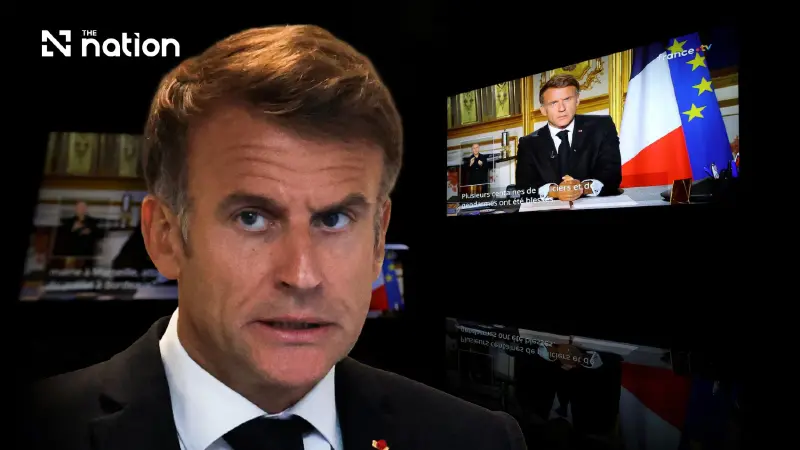


Former allies criticise Macron’s response to unrest in France as analysts see potential gains for far-right leader Marine Le Pen
- Following severe civil unrest, former political allies are openly questioning whether President Macron should complete his final six months in office, with some urging an early departure.
- The calls are fueled by criticism over his handling of the crisis, his weakened political authority from a 2024 snap election, and limited financial resources to appease protesters.
- Actions such as traveling to Kuwait during the turmoil have intensified criticism, reinforcing opponents' portrayal of him as detached from the public mood and unable to restore order.
French President Emmanuel Macron faced mounting criticism on Monday (October 19, 2026) over his handling of France’s worst civil unrest in years, as former allies questioned whether he should complete his remaining six months in office.
Rioting on October 17 left shops looted, buildings burnt and public institutions defaced across France. The destruction has intensified pressure on Macron to restore order and address social anger, despite limited financial resources and weakened political authority.
Macron entered office almost a decade ago promising to overhaul an entrenched political establishment, accelerate economic reform and assert presidential authority. His final months are instead dominated by parliamentary paralysis, acute financial pressures and questions about the state’s ability to maintain order.

France’s finances limit Macron’s options
France’s strained public finances and fractured parliament leave Macron with less room to make concessions than during the Yellow Vest uprising of 2018–2019, when he committed billions of euros to defusing public anger.
Investors have also reacted nervously to the violence. Market analysts say the unrest adds political risk while France is under scrutiny over mounting debt and efforts to narrow one of the eurozone’s largest budget deficits, leaving Macron caught between markets demanding spending restraint and protesters demanding more support.


Macron’s response draws criticism from former allies
Macron’s response to the unrest has disappointed opponents and former allies, including former prime minister Édouard Philippe, who is preparing his own presidential bid.
Macron chaired an interministerial crisis meeting at the Élysée Palace on October 18 before addressing the nation, but stopped short of declaring a state of emergency. Looting continued for a second night, including in wealthy Paris districts, and Prime Minister Sébastien Lecornu announced local curfews on October 19.
Macron’s office also announced on October 19 that he had rejected his interior minister’s resignation and ordered a review of apparent failures in intelligence gathering and police preparedness.
“Mr President, I listened to you last night,” Philippe wrote on X after Macron’s address. “I would have preferred, like millions of French people, decisions and initiatives to restore order.”
“Our country needs to be commanded,” Philippe added.
Criticism from Macron’s former allies also centres on his decision to call a snap parliamentary election in 2024, which weakened his authority.
“The end of this term is a slow agony,” Loïc Kervran, a former MP from Macron’s camp, wrote on X. “The president paralysed the country with his absurd decision to dissolve parliament in 2024. Arguably the worst decision in the history of the Fifth Republic.”
Le Pen could gain from anger over living standards and public order
Politicians and analysts cited by Reuters see potential gains for far-right National Rally leader Marine Le Pen, already the frontrunner in the 2027 presidential race, from frustration over declining living standards and fears about public order.
“Le Pen no longer needs to spend any money to campaign,” Jean-Baptiste Moreau, another former MP from Macron’s camp, told Reuters. “It's not just a clear path ahead of her — it's a six-lane highway.”
Le Pen used a video address on October 18 to portray Macron’s administration as a crumbling power and present herself as capable of restoring order.
Philippe, meanwhile, is struggling to distance himself from his association with Macron. Most recent polls cited by Reuters show far-left politician Jean-Luc Mélenchon edging ahead of Philippe for a place in the second-round run-off, a contest the polling suggests would make a Le Pen victory overwhelmingly likely.
Macron visits Kuwait despite calls to remain in France
Macron arrived in Kuwait on October 19 despite opponents’ calls for him to remain in France. The president said his Gulf tour would help secure fuel supplies and ease economic pressures that had contributed to the protests.
Macron’s trip risks reinforcing critics’ portrayal of him as detached from the public mood. Images of the president attending a Céline Dion concert with his wife Brigitte on October 16, hours before the unrest erupted, had already prompted ridicule on social media.
Some former allies are now openly discussing whether Macron should leave before his term ends. Moreau said he spoke to Macron on October 18 and urged him to prepare an orderly early departure to break the political deadlock and avoid another six months of drift.
“He doesn't want to give up, that's not his character. But that's what he should do for the country,” Moreau said.

