
France prepares troop-backed security response to new protests
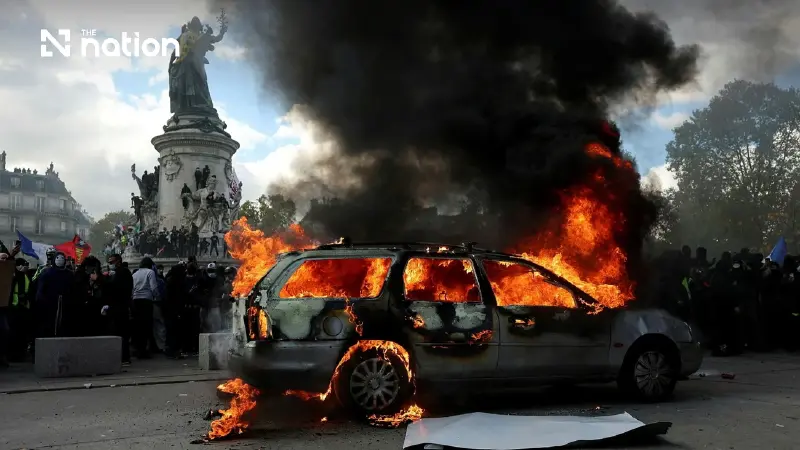


France plans a major police operation with military support ahead of protests on October 24 after riots and looting exposed gaps in its security response.
- The French government is deploying military personnel to support police in a large-scale security operation for new protests planned for Saturday.
- This response follows widespread riots and looting, with the government admitting to significant security failures in its handling of the recent unrest.
- Ministers have apologised for the security shortcomings, and a parliamentary inquiry is being launched to investigate the disturbances and the effectiveness of the official response.
- Further demonstrations are being organised by student unions and Yellow Vests activists over issues including the cost of living, public services, and rising fuel prices.
France is preparing to deploy military personnel to support police ahead of another round of demonstrations on Saturday (October 24), following widespread violence that exposed serious weaknesses in the government's handling of public unrest.
Prime Minister Sébastien Lecornu announced plans for a large-scale security operation on Tuesday (October 20), making the restoration of public order his immediate priority. His announcement followed riots and looting in Paris, Marseille, Lyon and several other cities on October 17.
Interior Minister Laurent Nuñez confirmed that troops would support the police operation, while the government was preparing changes to its security strategy. The measures follow criticism of the authorities' failure to protect major city centres from rioters and looters.
Lecornu described the planned police deployment as "massive", reflecting growing concern that further demonstrations could lead to renewed violence.

Government admits security failures
The scale of the disturbances has raised questions about the authorities' ability to maintain public order, particularly as France approaches its presidential election in 2027.
Lecornu acknowledged that the weekend's policing operation had been undermined by several failures. Intelligence services had not adequately anticipated events, officers had been deployed too rigidly, and the authorities had decided against cancelling scheduled police leave.
Nuñez also apologised for the security shortcomings and accepted personal responsibility for the response.
Despite the earlier violence, several affected areas experienced relative calm following the introduction of targeted overnight curfews. The government credited the restrictions with helping restore control, while some local authorities maintained curfews for young people under 18.
The government has blamed far-left groups for much of the disorder, with Lecornu presenting the crisis as a choice between violence and the Republic. Groups on the far left, however, have accused the authorities of failing to recognise public frustration over rising living costs and deteriorating public services.
Parliament launches inquiry into unrest
French lawmakers are establishing a parliamentary inquiry into the disturbances and the effectiveness of the security response.
Authorities have also assigned 200 investigators to identify those responsible for violence and property destruction.
Police arrested a suspect on Tuesday in connection with an arson attack that destroyed a historic town hall in Limoges, central France. Officials reported that the suspect had previously been placed on a security watch list and was associated with a far-left group.
Sylvain Maillard, a Paris lawmaker from President Emmanuel Macron's Renaissance party, raised concerns about the role of digital communications in the unrest. He told Reuters that certain applications had become tools for coordinating rioters and looters.
Protests add pressure to France's economy
The political consequences of the unrest are becoming increasingly significant as France moves towards its next presidential election, with far-right and hard-left candidates gaining support in opinion polls.
Demonstrations in other European countries, including Italy and Albania, have added to fears that dissatisfaction over living standards could spread further at a time when governments are struggling with budgetary pressures.
Financial markets have also responded to the uncertainty. French government borrowing costs increased on Tuesday, with yields on benchmark 10-year government bonds approaching their highest levels in 24 years as investors assessed the risk of further instability.
The economic damage has extended to the retail sector. French supermarket chain Carrefour reported losses amounting to tens of millions of euros from stolen goods and damaged property, describing the disruption as unprecedented.

Student unions and Yellow Vests plan further protests
The prospect of renewed unrest remains a major challenge for Macron's government.
UNEF, France's main student union, has called for further demonstrations on Saturday, criticising what it considers declining educational standards and insufficient funding for schools and universities.
The union has pledged to continue pressuring the government to address these concerns, signalling that the protest movement is unlikely to end immediately.
Separately, groups identifying themselves with the Yellow Vests movement have called for demonstrations against rising fuel prices.
The movement first emerged in 2018 during Macron's first presidential term in response to proposed fuel tax increases. Months of road blockades and street protests eventually prompted government concessions.
