
Hoax bomb threats disrupt at least 27 passenger flights across Europe
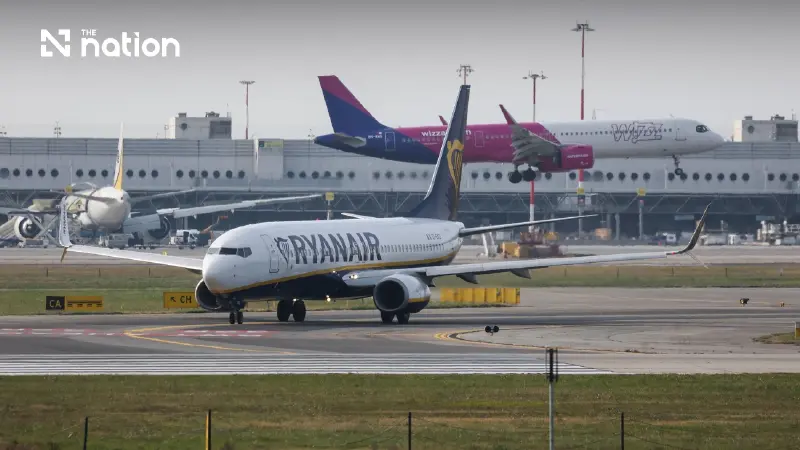


At least 27 European flights faced hoax bomb threats on November 5, prompting diversions, emergency landings and fighter-jet escorts as authorities investigated.
At least 27 passenger flights across Europe were affected by hoax bomb threats on Thursday (November 5), forcing some aircraft to divert or make unscheduled landings while fighter jets were deployed to intercept or escort others.
The disruption marked the second major wave of similar incidents this week. At least seven flights and a cruise ship had received bomb threats on Tuesday (November 3).
Authorities have yet to identify those responsible, and no claim of responsibility has been independently verified.
The incidents have raised concerns about possible coordinated disruption at a time when several European governments have accused Russia of conducting sabotage and other hybrid operations.
However, aviation security specialists have cautioned that the threats could also have originated from individuals acting on personal grievances or people copying earlier incidents.

Fighter jets deployed as bomb threats spread
An airport source in Italy told Reuters that an email headed "Threat report" had been distributed to airlines, airport operators and ground-handling companies at Rome's Fiumicino Airport and Milan's Malpensa Airport.
The message claimed to have been sent by "Fighters of the Male State" and alleged that explosives had been placed aboard incoming flights from Helsinki and Dublin, with detonation threatened within 60 minutes.
Reuters was unable to independently establish who sent the email.
In France, Prime Minister Sébastien Lecornu's office reported that fighter jets had been dispatched to intercept an Aer Lingus flight travelling from Dublin to Rome.
The aircraft was escorted to the Évreux military airbase after the pilot did not respond to authorities as expected. The prime minister's office did not provide further details about the pilot's actions.
Bulgaria's air force also deployed fighter jets to accompany three passenger aircraft during their landings.
A Ryanair flight from London to Sofia was diverted to Plovdiv, Bulgaria's second-largest city.

Spanish police, meanwhile, received three bomb-threat emails within 20 minutes. The messages concerned two Air Europa flights from Madrid to Paris and four Iberia flights arriving from Rome and Milan.
Several aircraft were stopped or returned to their parking stands while passengers disembarked and security inspections were carried out.
At Warsaw Airport, a LOT Polish Airlines flight bound for Paris was halted while taxiing towards the runway. Passengers were subsequently transferred to another aircraft.
Danish police also searched two aircraft at Copenhagen Airport following security alerts.
Other threatened services operated by EasyJet, Finnair, LOT, Wizz Air, Ryanair and Air Serbia reached their scheduled destinations, including Prague, Sofia, Vienna, Brussels, Bucharest, Rome and Milan. Some received military escorts.
A passenger aboard a Wizz Air flight from Milan to Bucharest described how the aircraft was directed to a parking area away from the terminal after landing.
Fire engines, ambulances and counter-terrorism personnel surrounded the aircraft, although passengers were informed only that an emergency had occurred.
Joji Waites, director of flight safety at the British Airline Pilots' Association, noted that airlines generally act on bomb threats only after specialist assessors determine that they are credible.

Possible hybrid attacks remain under scrutiny
The incidents have prompted renewed examination of security threats facing European transport networks.
Denmark, Poland and Romania, all affected by Thursday's disruptions, have previously accused Russia of involvement in hybrid operations.
Germany has also attributed an attack at Leipzig Airport in August to Russia.
Britain has previously made similar allegations against Moscow and linked Iran to a suspected plot targeting a US airbase.
Both Russia and Iran have denied the accusations.
Hybrid operations can involve relatively inexpensive actions that disrupt essential services while making responsibility difficult to establish. Such incidents may also fall below the threshold likely to provoke a military response.
Eric Schouten, head of aviation security group Dyami, observed that most countries affected by the latest flight disruptions support Ukraine in its war against Russia.
Analysts at aviation risk consultancy Osprey Flight Solutions also considered a connection with Russian hybrid operations plausible.
However, they stressed that other explanations remained possible, including personal disputes and copycat threats.
No evidence has yet established that Russia, Iran or any other state was responsible for the latest aviation incidents.

Aviation threats coincide with cyberattacks
The latest disruption has also drawn attention to cyberattacks targeting essential infrastructure in Europe.
Eliran Almog, chief executive of aviation cybersecurity company Cyviation, suggested that repeated false bomb threats could serve two purposes: interrupting normal operations and observing how airlines, airports and government agencies respond to emergencies.
He noted that the aviation incidents were occurring alongside cyberattacks targeting refrigeration systems at supermarkets in several European countries.
The cyber incidents also affected blood banks in France.
Almog indicated that disruption to essential services could create economic losses while weakening public confidence in systems on which people depend.
Although the aviation threats and cyberattacks occurred during the same period, their possible connection has not been established.
Authorities across Europe continue to investigate the bomb threats and assess the security risks facing commercial aviation.
