
US flight disruption enters third day with over 10,000 cancellations and delays
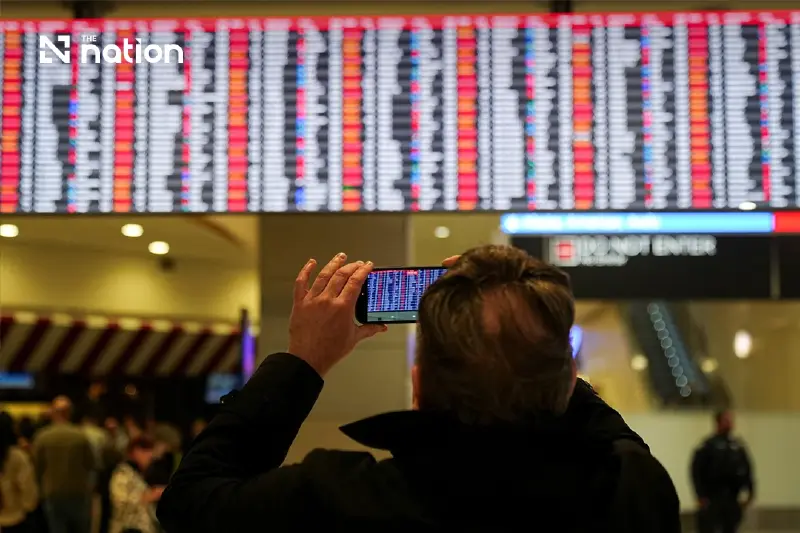


US transport chief Sean Duffy expects normal flights by November 16, but investigators have yet to establish the cause of the nationwide departure halt.
- Over 10,000 US flights were affected on November 15, consisting of more than 2,300 cancellations and approximately 7,700 delays.
- The travel chaos was an extension of a multi-day disruption that began with a nationwide halt to departures on November 13.
- Officials attributed the cause to a communications failure following a contractor's replacement of a router, which overloaded the air traffic control network.
- Investigators have found no evidence of a cyberattack or malicious intent, with the Transportation Secretary expecting operations to fully normalize by November 16.
Airlines cancelled or delayed more than 10,000 flights across the United States on Sunday (November 15, 2026), extending disruption into a third day after a nationwide halt to departures. US Transportation Secretary Sean Duffy expected operations to return fully to normal by Monday, November 16, although the underlying cause remained unresolved.
FlightAware recorded more than 2,300 US flight cancellations and about 7,700 delays on November 15. The disruption followed more than 6,400 cancellations and 8,000 delays on November 14.
JetBlue cancelled 28% of its flights on November 15, while American Airlines cancelled 17%. Cancellation rates at United Airlines, Southwest Airlines and Delta Air Lines ranged from 3% to 5%.
The Federal Aviation Administration (FAA) had stopped nearly all departures nationwide for almost five hours on November 13. The restriction was the longest nationwide halt to US air travel since the al-Qaeda attacks of September 11, 2001.

Router investigation continues without evidence of a cyberattack
Duffy told ABC’s This Week on November 15 that investigators had found no evidence of a cyberattack or malicious intent. He expected flights to move “back to normal” that day, but “probably fully normal” on November 16, while stressing the FAA’s responsibility to protect passengers.

Officials linked the communications disruption to work by FAA contractor L3Harris, which installed at least one replacement router at a remote facility. A subsequent flood of data overwhelmed equipment at other air traffic control centres.
According to Duffy, replacing a router at the FAA’s El Dorado facility in Arkansas triggered problems with another recently replaced router in Amarillo, Texas. The Texas router then began broadcasting data that overloaded routers elsewhere in the national air traffic control network.
The FAA announced on November 15 that it had disabled the relevant function on the routers where the problem originated. The same function was disabled on about 60 similar routers elsewhere in the system as a precaution.
Duffy stressed that the root cause was still unknown, even though the maintenance procedure had been carried out thousands of times without incident. He described the installer as “a good American patriot” whom officials believed to be a veteran, adding that they did not suspect deliberate sabotage during installation.
“But we don’t actually have the root cause,” Duffy acknowledged.
Two people familiar with the investigation described the installation itself as successful. One explained that an FAA employee supervised the replacement and that communications problems appeared only after the work had been completed.
The two people familiar with the investigation also noted that a detailed, step-by-step procedure is submitted to the FAA. The second person explained that problems began shortly after the agency had signed off on the work and resumed responsibility for service at the facility.
Duffy’s US$50 billion upgrade request faces scrutiny
Duffy has increased his request for air traffic control modernisation funding to US$50 billion since the November 13 disruption, compared with an earlier request for US$30 billion. Congress had already approved US$12.5 billion for upgrades in 2025.
The US air traffic control network faces ageing technology, equipment and communications problems, alongside a shortage of several thousand controllers. Duffy said the routers involved in the disruption had been purchased in 2001 and were obsolete by 2006.
President Donald Trump backed additional spending in his first public comments on the disruption on November 15. He urged Congress to fund the work comprehensively.
“We have already started the work, but it should be done all at once, not in drips and drabs,” Trump wrote on social media. “Congress must approve.”
Democrats are set to take control of Congress from Trump’s fellow Republicans in January 2027 following their gains in the November 3 midterm elections.
US Representatives Rick Larsen and André Carson challenged the case for further funding. Larsen is the senior Democrat on the House of Representatives Committee on Transportation and Infrastructure, while Carson holds the corresponding position on its aviation subcommittee.
Larsen and Carson stated on November 14 that about US$11 billion of the US$12.5 billion approved in 2025 remained unspent.
“Explain to Congress, again, why they need more money?” Larsen and Carson asked in their joint statement.
Duffy responded on November 15 that the existing allocation was restricted to particular purposes. It did not provide funding for new software to manage US airspace, he explained.
Airports group calls for private infrastructure investment
Justin Erbacci, director general of Airports Council International (ACI) World, also called for private capital to help meet the aviation industry’s infrastructure needs.
“We can’t rely only on government investments. … You have to have private investment,” Erbacci told an aviation infrastructure forum in Montreal on November 15.
Erbacci did not refer directly to the US ground stop. His comments concerned the need to accommodate rising air traffic and replace outdated systems.
The International Air Transport Association projects that global air passenger traffic will more than double by 2050.
