
Thailand urges COP31 funding to strengthen disaster protection and reach net zero by 2050
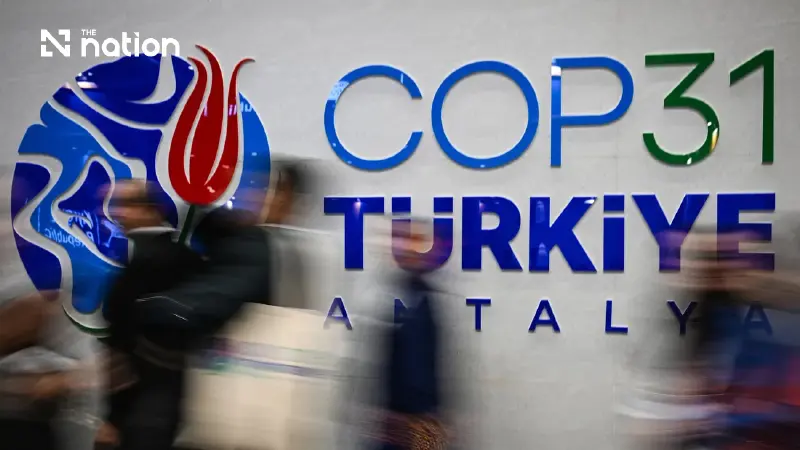


Thailand wants finance and clean technology to strengthen flood and drought protection as COP31 confronts gaps in support for developing countries.
- At the COP31 climate conference, Thailand is urging developed countries to provide climate finance, clean technology, and disaster preparedness support.
- This support is deemed essential for Thailand to meet its national target of achieving net zero greenhouse gas emissions by 2050.
- The requested funding is intended not only for emissions reduction but also for climate adaptation, such as protecting communities from floods and droughts.
- Thailand's position emphasizes a "fair transition," calling on developed nations to lead in emissions reduction and provide financial and technological aid to developing economies.
Thailand is pressing developed countries for climate finance, clean technology and stronger disaster preparedness at the COP31 UN climate conference in Antalya, Türkiye, running from November 9–20, 2026. The Thai delegation links that support to protecting communities from floods and droughts while pursuing net zero greenhouse gas emissions by 2050.
Natural Resources and Environment Minister Suchart Chomklin, who heads Thailand’s delegation, is scheduled to join high-level meetings from November 16–18. He has directed the Department of Climate Change and Environment, Thailand’s national coordinating agency, to advance the country’s negotiating priorities.
Türkiye hosts COP31, with Australia leading the negotiations. The conference coincides with the tenth anniversary of the Paris Agreement entering into force and the launch phase of the second global stocktake, a review of collective climate progress.
Thailand presses for finance and a fair transition
Thailand wants developed countries to lead emissions reductions and provide funding, technology and training for developing economies, Deputy Government Spokesperson Lalida Periswiwatana said. The country’s position emphasises fairness and responsibilities reflecting national capabilities.
Bangkok BizNews reported that the Cabinet endorsed Thailand’s negotiating framework on October 20, 2026, covering COP31, COP32 and related talks in 2026–27.

The Thai framework prioritises energy security, low-carbon industries and access to grants, debt instruments and public-private partnerships. It also supports carbon markets under Article 6 of the Paris Agreement, with safeguards against counting the same emissions reduction twice.
Thailand’s transition measures are intended to protect workers, farmers, small and medium-sized enterprises and vulnerable groups from the effects of economic restructuring.
“These negotiations are not focused solely on reducing greenhouse gas emissions,” Suchart explained. Preparing Thailand for floods, droughts and other climate-related disasters must accompany the 2050 target, he stressed, with protection for farmers, low-income households, vulnerable people and small businesses.
Prime Minister Anutin Charnvirakul appointed Chaturont Chaiyakam, Thailand’s ambassador in Ankara, to observe the opening of the November 11–12 Leaders’ Summit alongside officials from the Department of Climate Change and Environment.
The Thailand Pavilion combines local knowledge and modern technology under the theme “Rooted in Wisdom, Resilient in Action, Flowing Toward Net-Zero”. Its six themes cover climate policy and law, collective action, clean technology, climate finance, public understanding and disaster resilience.
Thailand Pavilion side events bring together academics, businesses, international organisations and young people. Thailand’s second-week priorities include the second global stocktake, the global goal on adaptation and the fund for responding to loss and damage.

Climate finance remains far below developing countries’ needs
Developed countries are expected to lead efforts to mobilise at least US$300 billion annually for developing countries by 2035, within a broader goal of US$1.3 trillion a year from all sources. An assessment presented by Brazil at COP31 projected an annual US$840 billion shortfall against the larger goal if current trends continue.
The UN Environment Programme’s Adaptation Gap Report 2026 estimates developing countries’ adaptation needs at US$305 billion annually by 2035. International public adaptation finance from developed to developing countries totalled US$28.2–31.7 billion in 2024.
Even tripling adaptation finance by 2035 would cover only 20–29% of developing countries’ estimated needs after adjusting for inflation, UNEP found. The loss and damage fund separately received initial funding requests worth US$2.8 billion against an initial funding envelope of US$342 million.
UN Secretary-General António Guterres, whose term ends this year, argued that climate disasters were eroding development and deepening poorer countries’ debts. He called for reform of the international financial system established after the Second World War and windfall taxes on fossil fuel companies to support people suffering climate damage.
Guterres maintained that those profiting from environmental destruction should not dictate the planet’s future, insisting that “polluters must pay”.
Fossil fuel divisions complicate the 1.5°C goal
COP31 faces continuing disagreements over fossil fuels, despite the COP28 agreement in Dubai in 2023 to transition away from them in energy systems. COP30 in Brazil in 2025 failed to secure an agreed transition roadmap despite support from more than 80 countries, and its main final outcome text omitted fossil fuels.
Negotiators must reconcile the interests of fossil fuel producers and exporters with countries pushing faster emissions reductions. Unequal access to finance, consensus-based decision-making and geopolitical pressures, including wars and trade tariffs, further complicate agreement.
Climate negotiations have lowered warming projections from close to 4°C before the Paris Agreement, but the remaining gap is substantial. UNEP estimates that fully implementing current climate pledges would still mean 2.6–2.7°C of warming this century, above the agreement’s 1.5°C goal.
Simon Stiell, executive secretary of the UN Framework Convention on Climate Change, argued that cutting methane emissions and accelerating clean electrification could reduce projected warming by 0.5°C. He described the measures as a “planetary icepack”.
Stiell also highlighted developing countries’ cycle of debt, disasters and high financing costs. The UN climate secretariat itself faces expanding responsibilities and shrinking funding, he noted, calling for discussions with member countries.
Selwin Hart, the UN secretary-general’s special adviser on climate action and just transition, pointed to unequal investment despite advances in clean technology. Emerging and developing economies excluding China, home to almost two-thirds of the world’s population, received just 18% of global clean energy investment in 2025.
Hart noted that around 600 million Africans still lacked electricity. Financing the same renewable technology could cost several times more in developing countries than in wealthier economies, restricting investment where it was needed.
COP31 presidency promotes electrification and easier finance
COP31 President Murat Kurum, Türkiye’s environment, urbanisation and climate change minister, is promoting an implementation-focused conference. His “35 by 35” pledge aims to raise electricity’s share of global final energy consumption to 35% by 2035.
Kurum’s Climate Implementation Bridge is designed to connect projects with investors and countries with the technology they need. His agenda also promotes zero waste and resource efficiency, drawing on the Turkish tradition of imece, or sharing work, burdens and hope.
Chris Bowen, Australia’s climate change and energy minister and COP31 president of negotiations, highlighted US$2.2 trillion in global clean energy investment in 2025 but called for faster deployment.
Australia has launched an Access to Finance Statement and Action Plan for small island developing states and least developed countries, aiming to simplify procedures and speed up funding. Bowen is overseeing negotiations on an agenda containing more than 160 items, with finance access and implementation among the central priorities.
Source: Bangkokbiznews
