
China calls for unity with ASEAN and reaffirms free trade commitment
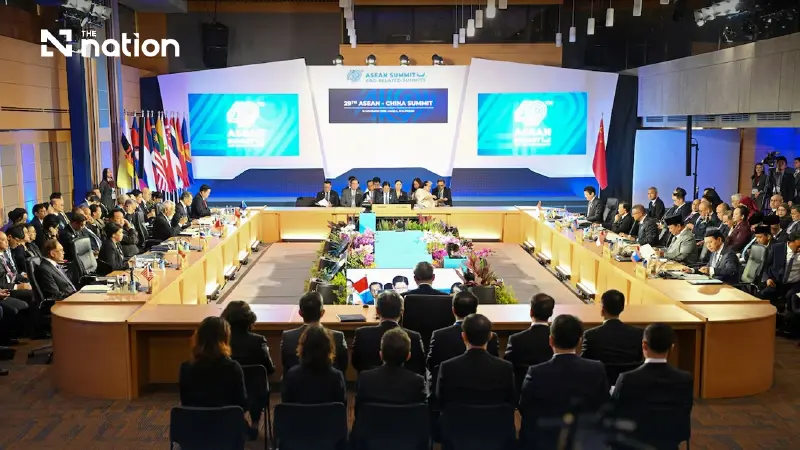


Li Qiang cites trade of over US$1 trillion last year and cumulative two-way investment above US$500 billion ahead of Donald Trump's Manila visit.
- Chinese Premier Li Qiang reaffirmed Beijing's commitment to free trade and multilateralism during a summit with ASEAN leaders.
- Li called for China and ASEAN to "stand united, ward off interference, and work together" in response to global turbulence and growing protectionism.
- The call for stronger ties is supported by significant economic activity, with China-ASEAN trade exceeding US$1 trillion last year.
China's trade with the Association of Southeast Asian Nations (ASEAN) exceeded US$1 trillion last year, Chinese Premier Li Qiang told regional leaders in Manila on Monday (November 16).
He reaffirmed Beijing's commitment to free trade ahead of US President Donald Trump's visit.
The bloc has a combined economic output of more than US$3.9 trillion and counts China as its biggest trading partner and a key source of investment.
Its largest economies are nevertheless keen to strengthen links with the United States amid trade and diplomatic uncertainty under Trump's administration.
“We remain firmly committed to safeguarding multilateralism and promoting free trade and endeavour to make the pie bigger,” Li told the summit.
Li's opening remarks presented stronger economic ties as an achievement despite global trade restrictions, growing unilateralism and protectionism, and recurring geopolitical conflict.

He put cumulative two-way investment at more than US$500 billion.
“The past five years have been truly extraordinary, and the achievements we scored have not come easily,” he said.
A readout of Li's closed-door remarks by state news agency Xinhua also carried his appeal for unity in a turbulent world: “it is all the more important for China and ASEAN to stand united, ward off interference, and work together”.
Japanese Prime Minister Sanae Takaichi used an X post to set out her aims for Manila: promoting Japan's efforts to strengthen a free and open Indo-Pacific, with ASEAN central to that vision.
She described the international community as facing historic changes.
ASEAN's 11 members were due to meet leaders from Japan, Australia and South Korea, as well as the United Nations, on Monday.
Trump is due to reach Manila on Tuesday as the summit draws to a close.
His visit includes talks with ASEAN leaders and his first meeting of the Quad, whose members are the United States, Japan, Australia and India.
Trump's predecessor Joe Biden took part in six Quad meetings.
The Manila gathering will be the first of its kind in two years for the group, which is widely viewed as a counterweight to China's growing regional influence.


Members say it is not directed at any particular country.
As ASEAN chair, the Philippines had hoped to complete a code of conduct with Beijing this year to manage persistent South China Sea disputes.
However, the long-running process remained unfinished when ASEAN leaders concluded their summit on Sunday.
Any return of Myanmar's leaders to ASEAN summits will depend on demonstrated “sustained and concrete progress” on the peace plan agreed with ASEAN after the coup five years ago.
Leaders kept the existing policy excluding their counterparts from the war-torn country.
Persistent haze spreading across borders from forest and peatland fires brought an apology from Indonesian President Prabowo Subianto to neighbouring Singapore and Malaysia.
The fires have continued for months.
Demonstrations against Trump are expected when he arrives, following four days of protests by leftist groups, students and workers.
Their demands include an end to the Middle East war and the scrapping of the US-led Pax Silica initiative.
Beyond Manila, Trump's itinerary takes him to the Asia-Pacific Economic Cooperation forum in Shenzhen, where he is scheduled to sit down with Chinese President Xi Jinping and Russian President Vladimir Putin for a three-way meeting.


Source: Reuters
