
Hope glimmers for Pakistan's outcast transgenders
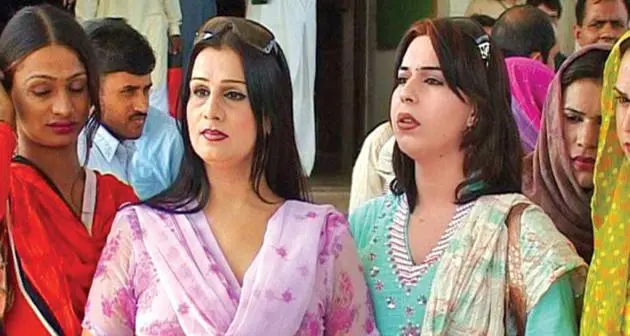


Play
Having spent her life as a social outcast, Sajid Hussain, a transgender now known as Laila, today finds no reason to prolong her life in Pakistan's conservative society.
Even her death, she says, will not grieve her family and it is for this reason that she has collected money for her burial.
“I even thought of having narban [getting castrated] a few months ago so that I could attain a better status in my community.
But my sangat [close friends] convinced me that it’s a major sin and I shouldn’t spoil the life hereafter,” she says impassively.
Hailing from a small village in Pakistan’s Punjab, Laila grew up working as a domestic help.
“I was the eldest among my siblings and started working at an early age since my father was not interested in supporting the family. He had a bad temper and used to beat my mother and the children at home.
“If my father had accepted me the way I was or had told me with love that what I was doing was wrong, I would have felt embarrassed about being a heejrah [transvestite]. But that never happened and my life was ruined,” she laments.
Things aren’t quite so bad for Zahoor, Laila’s friend and fellow heejrah. “This is all because of my parents who loved me too much despite my way of life that society looks down upon.”
Recalling his childhood, Zahoor speaks of the deep wounds of shame left by the teasing of his peers. At school he learned nothing more than how to write his own name, after the headmaster refused to allow him to attend classes.
While Zahoor lives in Karachi where he earns an income seeking alms at shrines, his family is settled in Sargodha.
“I don’t want to trouble them and know the truth. They know that their father is different and earns money by dancing in functions, but they don’t know that I beg,” he says.
The heejrah community
Members of the heejrah community say that though discrimination and stigma affect them at every level, it is even more painful when they are denied education and health facilities that limit their chances to live a better life.
The Supreme Court’s orders for their welfare and recognition last year was a ray of hope.
Most transsexuals in Pakistan grow breasts with the help of hormone injections while some even pay for surgery to remove their reproductive organs.
The treatment is said to be carried out in highly unhygienic conditions and at times causes death.
Only a very small number of people are actually born intersex – a group of conditions that occur when there is a discrepancy between the appearance of external genitalia and internal reproductive organs.
“Only people with intersex condition deserve employment opportunities by the government. In fact they should be given the status of a special person and offered privileges. A majority of those in the transgender community are of those who want to have a free life and enjoy drugs and sex,” says Mirza Aleem Baig, head of the Gender and Reproductive Health Forum.
Baig doesn’t accept psychological reasons for being a transgender.
“Though a majority is there for fun, it doesn’t mean that we won’t make a beginning to improve their lives. It is also important for parents to keep an eye on their children, their behaviour and people they hang on with,” he says, adding that the community also has a high prevalence of HIV infection.
‘Gender identity a human right’
Other medical experts counter Baig’s assertions, saying that no one would choose to lie about their gender identity in order to gain entry to a such a marginalised segment of society. “It’s not easy to become a heejrah and survive in [a conservative] society,” says Dr Syed Hamid Ali, a virologist working at the Aga Khan University and Hospital.
They are deprived of opportunities for a better life, he adds, and are forced onto the street to face police harassment and high risk of infections on a daily basis.
“A study also showed us that they are paid very little for sex.
“Besides, it’s also a human rights issue.”
