
Draconian bill ignores the cause of the drug issue


Play
The deputy PM wants to execute drug convicts on death row, thus completely missing the point that this is a social problem, not just a legal one
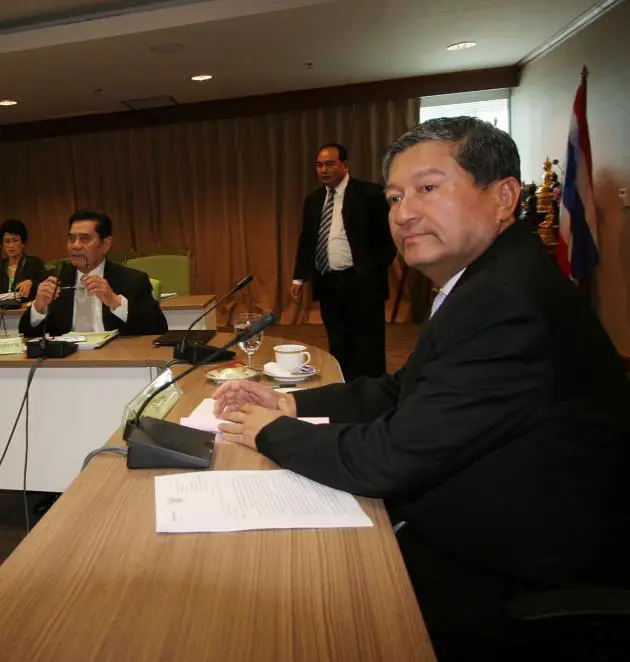
Deputy Prime Minister Chalerm Yoobamrung has vowed to push for law amendments to have drug convicts executed 15 days after the Appeal Court’s verdict upholds a death sentence.
Chalerm’s logic is that if drug convicts are simply jailed, they could deal drugs from behind bars and mingle with other criminals.
“Criminal meeting criminal equals arch-criminal. I won’t listen to the National Human Right Commission or NGOs, because I answer to the country and the public,” Chalerm said.
He was speaking after presiding over a press briefing on the Wednesday drug bust that seized 1,020,000 methamphetamine tablets and 20 kilograms of crystal meth (also known as ice) worth Bt400 million.
Drugs are a problem and a challenge for law enforcement, indeed. This past month alone has seen some serious drug hauls in the northern region of the country. Millions of methamphetamine tablets worth billions of baht have been seized over this past month alone in the northern provinces. The thought of these illicit drugs reaching schoolyards is a scary prospect for most parents.
But what is even scarier is when you have a controversial politician taking up controversial measures because he and his party are in desperate need of political capital from the public.
Chalerm and his Pheu Thai people know how Thailand’s reputation suffered internationally during the 2003 so-called “war on drugs” carried out by Thaksin Shinawatra, the then premier. About 2,500 people were killed during that three-month campaign. The authorities claimed that all but a handful of the deaths were the result of bad guys killing bad guys.
Nobody in their right mind believed this claim, but most people were so tired and disgusted with the drug problem that they were willing to turn a blind eye to the illegal and controversial aspect of the campaign. If anything, this reflects the weakness in our society. Any society that is quick to employ controversial, knee-jerk measures, rather than abide by the legal due process and respect for the rule of law, is a weak society.
But the drug war and the extrajudicial killings were popular and generated a lot of political points for Thaksin.
Today, nearly a decade later, Chalerm is toying with a similar idea, and the executions will be carried out in the name of the state.
Given the fact that our society hasn’t matured much over the past nine years, the country’s law-makers will probably pass this controversial bill so that they can’t be accused of being soft on drugs.
Indeed, it’s easier to pass such a bill instead of debating the merit of it. That’s how shallow our politicians have become, regardless of what party they represent.
One of the biggest ironies of all this is that the man who is pushing for this law is not exactly what you could call a “clean” politician. His record, not to mention those of his sons, is not exactly spotless when it comes to controversy. Chalerm represents everything that is wrong with Thai politics. But then again, there is a thing called a political mandate, and like it or not, we have to live with it if we are to stay on a democratic course.
But while Chalerm may be classified as morally bankrupt, unfortunately he has got a great deal of political capital among his peers because he is willing to do the dirtiest of political work for his master Thaksin and his sister, Prime Minister Yingluck.
Thai gutter politics aside, Chalerm’s idea is doomed to fail even if it is passed into law because it totally ignores the root causes of drug abuse. This a social problem, not just a legal one, and it is what all governments continually fail to understand and act upon. Again, it is easier to come up with benchmarks such as body counts for drug-dealers, to keep voters happy and safe, but it’s harder to talk about education, employment, social mobility – or lack thereof – that push people into lives of drugs and crime.
