
Adapting for survival


Play
How an encounter at an exhibition led Bunpei Yorifuji, Hirokazu Nagata and Masashi Sogabe to launch a concerted campaign to help us prepare and cope with disaster
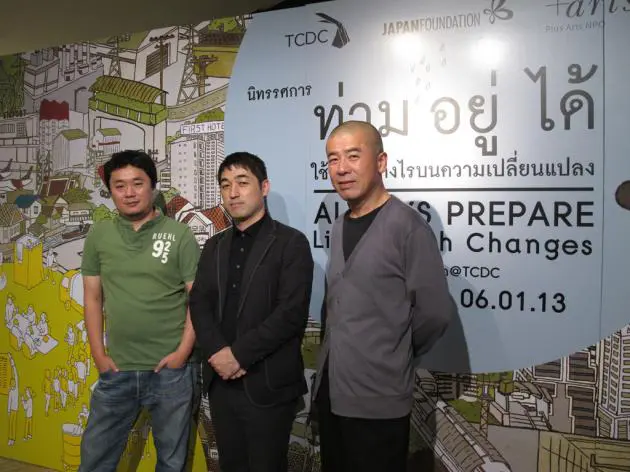
Bunpei Yorifuji, Hirokazu Nagata and Masashi Sogabe have no problems remembering the first time they met. It wasn’t, they explain, earth-shattering although it was certainly related to the earth shaking, taking place at an exhibition organised to commemorate the tenth anniversary of the 1995 Great Hanshin earthquake, the most devastating to hit Japan in more than 60 years. There and then, they agreed to work together to promote awareness at the individual, community and society levels so that people would be prepared for any disaster at any time. Now they’ve brought their exhibition to Thailand.
Nagata is the founder of non-profit organisation Plus Arts, which has been running awareness and preparation campaigns since 2006. Sogabe is an award-winning architect and university professor while Yorifuji is a graphic designer and illustrator.
The exhibition “Always Prepare: Living with Changes” is being organised by Thailand Creative and Design Centre in collaboration with Japan Foundation Bangkok and Plus Arts to inform Thai visitors about flooding in Thailand and how to brace themselves and be prepared in the event they have to face a disaster. It runs at the TCDC until January 6 and is reviewed in today’s Sunday Leisure section.
When the earthquake hit in 1995, Nagata, now 44, was in Osaka. He was unable to contact his family in the earthquake-hit area. He could not travel to see them either as the roads and expressways had collapsed. He remembers clearly how worried he was. Luckily, he says, they were all safe though their residences were completely destroyed.
Nagata vowed there and then work towards creating awareness so that everyone could be prepared to handle disasters.
After earning his master's degree, Nagata worked at Takenaka Corporation before establishing the Iop City Culture Creation Research Institute in 2001, which provides designs for city building and planning, architecture and arts. Nagata was also asked by Kobe municipality to design the Iza! Kaeru Caravan, a fun drill of activities to educate children organised as part of the event and exhibition commemorating the anniversary of the Great Hanshin earthquake.
Sogabe, a professor at Kanagawa University and founder of design office Mikangumi, had never faced such a disaster himself. Wandering around the exhibition in Kobe, he looked at Nagata’s work and found it inspiring. He decided to join further campaigns and the two men then approached Yorifuji, who was also at the exhibition, who immediately agreed to help.
But Nagata knew that something bigger than just the three of them would be needed if they were to be effective in achieving their goal, leading him to set up Plus Arts in 2006.
Yorifuji took charge of illustrating “Jishin Itsumo Note”, a handbook offering tips, suggestions and guides to preparedness gathered from first hand experience of the great earthquake victims.
While Yorifuji’s name might not be familiar to many Thais, two of his books “Uncocoro for Natural Unco Life” and “Wonderful Life with the Elements: The Periodic Table Personified” have been translated into Thai.
The first explains the nature of human excrement and how everybody should pay attention to it. The second is an illustrated guide to the qualities of elements and helps the reader to remember them easily.
Totally committed to his work, Yorifuji says he sometimes continues with his projects even while he’s asleep. While writing “Uncocoro of Natural Unco Life”, he recalls, he had dreams about excrement. Likewise, after looking at the pictures of the Great Hanshin earthquake for several days while designing the illustrations for the book, Yorifuji dreamed he was picking up the debris and forming the pieces into architectural structures and bridges.
The Japanese know Yorifuji for his series of “Do It At Home” advertisements for Tokyo Metro that subway passengers to beware of their manners in a humorous way. He has been creating the ad campaign for five years and passengers instantly recognise his work.
He is also the art director of the ad campaign for Japan Tobacco Inc, which aims to tell that smokers are not antagonists and that smokers and non-smokers can live together peacefully.
Among the items on show in Bangkok, Nagata and Yorifuji both favour the shuffle cards, presented at TCDC in a Thai version that’s been translated and adapted from the Japanese
In the game, young players are asked to put the cards in the correct order and in groups of instructions of what to do when they face disaster.
Exhibition space director Sogabe, who has designed everything from schools and broadcasting centres to private residences, says he prefers the section showing how everyday items can be adapted for use in times of need during the disaster period.
One of these pieces is the shelter made with supermarket baskets and plastic bags used to store umbrellas. Another is a car cover canvas adapted for use as part of a tent.
“After a disaster, it takes about 3 or 4 days before public shelters are available. During that time, the victims need somewhere to stay,” Sogabe points out. “These bring together design and architecture elements to help people.”
Nagata, who serves as a disaster preparedness consultant to many major companies including Tokyo Gas and Muji and has received awards for both his social activities and contributions to city buildings, is currently working on the KIITO - Kobe-city design strategy project. He says he wants to stress that we should always be prepared for the worst.
“If we don’t help ourselves, nobody will.”
