
Why the number of farmers is shrinking


Play
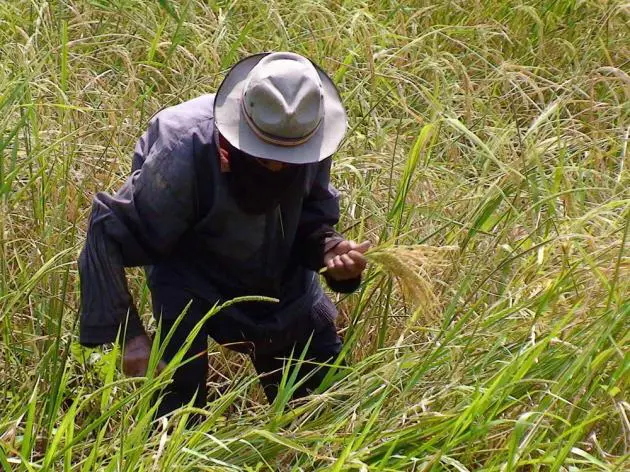
A recent article in The Nation on farmers in China turning their backs on farming attracted overwhelming interest. After it was posted on Facebook/Nationnews, one commentator noted that this is also a phenomenon here in Thailand. The comment had a negativ
It’s easy for people who work in air-conditioned offices to say so, assuming that people who work in the harsh sun, and their children, should continue with what their ancestors did.
Well, well. If an accountant’s children must carry on with their father’s profession and if a farmer’s children must grow something on their land, what innovations can society achieve? Perhaps, improvement in auditing and farming practices. But who would offer wedding or tour arrangements, or any other kind of profession or service – spare accountants and farmers? Needless to say, journalists were around in Thai society some decades ago.
Given the constant income guaranteed in other professions, it is easy to understand why farmers leave their land.
It amused me seeing a friend’s post on Facebook last weekend. It was about the price of chili. One of her friends commented on the price of lemons. Well, having lived for four decades, we can’t help but compare the price of things to when we were young. When we were 10, chili was cheap. A handful of chili then cost Bt3-Bt5. Now that we are over 40, it’s about Bt20. It seems unfair to consumers, but farmers also suffer from inflation like others in society.
One of the facts we often ignore is that when we were 10, most households grew chili at home and most rarely bought chili. The chili available at markets was just excess output that could generate extra income for people. Now? How many families grow chili at home? It’s the rule of supply and demand, folks. If you consume less chili, farmers will cut down production.
It hit me when Deputy Prime Minister and Finance Minister Kittiratt Na-Ranong said at a recent Nation debate that at restaurants a plate of rice costs less than a bottle of water, despite the more complicated production process. People are more concerned about the rice price than the price of drinking water. While a 500-millilitre bottle of water costs Bt6-Bt10, a bottle of flavoured water can cost Bt20. There’s no wonder why some farmers’ kids prefer to work at beverage companies than on their farms.
Another reason to explain why fewer people stay in farming in Thailand involves demographic change. With 12 per cent of Thais aged 60 or over, the median age of the Thai population is now over 30 years. With the birth rate declining by 1.5 per cent, the median age will only increase. Thanks to advancements in medical technology, fewer people die younger. Farming requires physical strength. With fewer people in the workforce, there are automatically fewer farmers.
It is estimated that in 2012 the median age in Thailand was 34.7. In 2010, it was estimated at 33.7, against a global average of 28.4. It’s not beyond the imagination to see this rising to 40 and higher soon.
Regionally, in 2010, the median ages in Indonesia, Vietnam and Myanmar were lower, at 27.9, 27.4 and 26.5, respectively. Interestingly, in 2013, Indonesia’s median age is projected at 23.06, reflecting the higher birth rate.
Indonesia’s median age has remained just above 22 since 2007. This relatively young population is typically perceived as a boon, especially in the context of acquiring an able labour force to boost Indonesia’s growth potential and development. Indonesia’s population is projected to reach 250.4 million this year, with 180.8 million 15 years old and above. This young population can nurture farmland and also be attracted to factories.
But as in Thailand, a young population does not automatically mean a good workforce. In Thailand, teenage pregnancy and poor education are often cited as obstacles to producing productive workers. In Indonesia, an August 2012 survey by the National Bureau of Statistics reveals that approximately 9.73 million Indonesians age 15 over do not attend school, while a further 24.05 million have not completed primary school education. Indeed, only 53.24 million Indonesians (or 30.6 per cent of the working-age population) have completed high-school education or tertiary education at academies and universities.
Higher education can guarantee a good career. It explains why farmers want their children to have the best education possible. Not all farmers succeed, given the huge costs of education. But some do succeed. And this also explains why we see fewer farmers.
I don’t blame them for leaving their ancestors’ path. Few can handle the fact that consumers who can pay over Bt20,000 for the latest smart phone still want agricultural produce at the prices of two decades ago. To get a smart phone, even a cheaper version, it is easier for farmers to switch to factory work. Once on the payroll, they get a credit card and buy new gadgets on installments, along with other consumer goods. That might otherwise be impossible if they stayed on the farm.
