
Japan must safeguard sovereignty but also push for reconciliation


Play
Never has it been more important for country to build constructive relations with neighbours
Thursday marked the 68th anniversary of the end of World War II for Japan.
It is the day on which the nation commemorates its war dead and renews its pledge for peace so that the tremendous suffering caused by war will never be repeated.
This summer, an animated movie titled Kaze Tachinu (The wind has risen) has been attracting attention. Its protagonist is modelled after Jiro Horikoshi, a brilliant designer for the Imperial Japanese Navy who helped create Zero fighters.
The movie’s protagonist is drawn to the beauty of aeroplanes as a boy, but after the war breaks out, the Zero fighter planes he was involved in designing are used by suicide attack units. The movie’s last scene is impressive, as the saddened protagonist stands blankly in front of many badly damaged Zero fighters.
For many younger viewers, the movie will probably be a chance to think again about war. The experiences of World War II should never fade from memory.
Based on its reflections on the war in the Showa period, Japan made a fresh start after World War II and peacefully achieved high economic growth. It has also made extensive contributions to the international community, mainly through official development assistance and peacekeeping operations by the Self-Defence Forces.
These steps by Japan have been applauded by the United States and Southeast Asian nations.
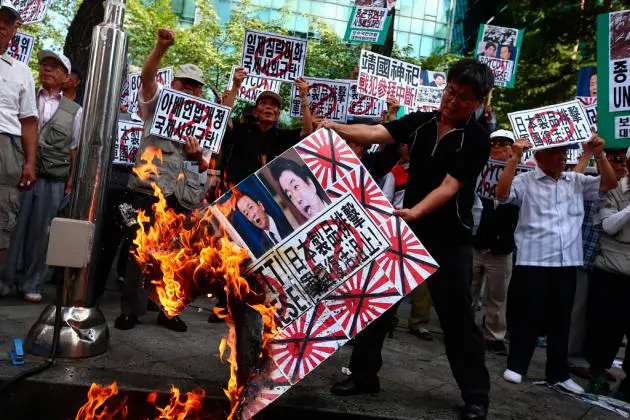
In contrast, China and South Korea have been heightening their criticism of Japan regarding perceptions of history. We believe this is an extremely deplorable situation.
In the United States and elsewhere, South Korean President Park Geun Hye has said Japan should have a correct recognition of history. She has made the remark in connection with sovereignty over the Takeshima islands and the issue of so-called comfort women.
South Korean courts ordered Japanese companies to pay compensation for damages to South Koreans for being forced to work for the firms during wartime.
These rulings are unreasonable because they obviously violate the agreement on property claims and economic cooperation that was reached in 1965, which stated that the issue of property claims was “resolved completely and finally”.
The South Korean judicial authorities also have been taking advantage of the rising anti-Japan sentiment in their country and disregarding the agreement reached between the two countries. This is a mystifying attitude for a country ruled by law. When it comes to the Senkaku Islands, China claims that Japan seized the islets from Taiwan during the Sino-Japanese War (1894-1895).
Beijing also insists that because Japan accepted the Potsdam Declaration, the islands should be returned to China.
Yet Japan incorporated the islands under the administration of Okinawa Prefecture shortly before the end of the Sino-Japanese War, after confirming that they did not belong to the Qing empire. Is China twisting this historical fact? In some respect, the Chinese government is utilising the anti-Japan sentiments of its people to maintain national unity, while the administration of South Korea is doing so to turn the domestic political situation to its advantage.
China and South Korea also oppose the prime minister and other state ministers visiting Yasukuni Shrine, where Class-A war criminals have been enshrined together with war dead, saying the shrine symbolises Japan’s militarism.
How we should pay tribute to the memory of our war dead is, in principle, a domestic affair of Japan, an issue in which other countries have no right to meddle. Nor has Japan forgotten the responsibilities of the Japanese leaders who erred in handling the international situation, started a reckless war and caused suffering to people in neighbouring nations.
Prime Minister Shinzo Abe once said that it was “extremely regrettable” that he did not pay a visit to the shrine during his first term as prime minister. Yet he said he would refrain from visiting the shrine on Thursday, the anniversary of the war’s end.
China and South Korea are intensifying their criticism that Japan is failing to reflect on its past militarism, and is instead leaning to the right and returning to the past. They will probably not change their stance even if Abe refrains from visiting Yasukuni Shrine.
It is difficult to handle the issue of historical understanding, which cannot be dealt with separately from the international politics of today. Abe made a controversial remark during a Diet meeting in April, saying that an academic and international definition of “invasion” had not been fixed. It is true, as Abe said, that the definition of invasion has not been fixed.
There is no war completely of aggression and no war completely of self-defence.
Yet Abe’s remark was interpreted, both at home and abroad, as rethinking a 1995 statement in which then Prime Minister Tomiichi Murayama expressed deep remorse for Japan having caused tremendous damage and suffering to the people of many countries, particularly to those of Asian nations, through its “colonial rule and wartime aggression”.
Abe recently said discussing perceptions of history in the political arena would develop into a diplomatic issue. He then said such issues should be left up to historians and other experts to discuss.
On the other hand, it is important for Abe, as a politician, to tenaciously promote his views on national territory and sovereignty to the international community, including his understanding of history.
We should further ensure the peace and prosperity that we have strived to build since the end of the war. To do so, we must also explore ways to reconcile with our neighbours. Never has it been so necessary for us to be wise and work to build constructive relations with our neighbours.
