
ASEAN must no repeat the mistakes of the EU


Play
Malaysian stateman discusses the regional grouping's plans for greater economic and social integration among other issues during a visit to Bangkok this week
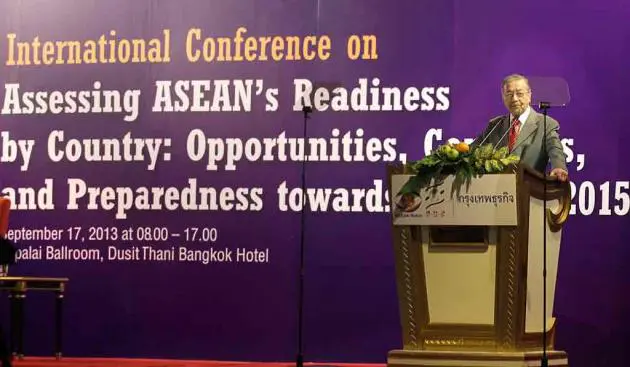
Mahathir Mohamad, former prime minister of Malaysia, recently talked to Veenarat Laohapakakul of The Nation. The following are excerpts from the interview.
Q: It has been 10 years since you were prime minister. What are the big global changes you see today?
A: Well, many things have happened in the world, among which is the collapse of the economy of the West – America and Europe. And we see the problems in the Middle East and of course the emergence of Asia as a very powerful economic group.
Q: Today, we see Asia rising and prospering. Some call this the “Asian century”. What is the dynamic or relationship that you see between Asia and the West?
A: I think Asia wants to continue to grow, and in order to grow we need trading partners. We need the West to be our market as much as we were a market for them before. So Asia wishes to see a peaceful world, because we can only grow in a peaceful world.
Q: The Asean Economic Community in 2015 has become a buzzword, but what does it really mean for Asean?
A: In light of what has happened to the European Union, we need to re-look carefully at the AEC, because being a community is not a guarantee that we will prosper. There can be many mistakes, and we have to avoid the mistakes made by the European Union if we want the AEC to succeed.
Q; How should Asean countries prepare for the AEC?
A: One thing that we need to be careful of is monetary union. The use of a single currency seems to have had very bad effect on many [European] countries, and also we need to give certain consideration to the weaker members of the community because they may not be prepared for the union yet.
Q: Looking around Asean, do you see any rising leaders or politicians who might become the face of Asean, as you and Lee Kwan Yew were in the past?
A: Well, I looked upon [former Indonesian] President Suharto as a kind of father figure before. I think Asean needs one now, but we are changing leaders frequently, so it’s difficult to determine who could be a father figure in the Asean grouping.
Q: How do you view Thailand – more as a friend or more as a competitor?
A: Thailand has always been a friend. Of course, we compete sometimes. Sometimes we have problems, but we have resolved our problems, in particular when there were overlapping claims at sea. And the resources there, we decided to divide the resources 50-50 between us.
Q: There is violence in Thailand’s deep South, and Malaysia is helping facilitate talks between Thailand and the [Muslim separatist group] BRN. How best do you think can we solve the conflict?
A: I think this is a very difficult thing to resolve. Malaysia regards this as an internal problem of Thailand, but sometimes when we are asked to be some kind of mediator, we have done so – for the Philippines, and we hope to do so for Thailand. But the insurgents are not one single group. There are many groups, so when you talk to a few, the rest may not agree.
Q: Some believe that Malaysia is part of the problem in the South.
A: Those people obviously look to Malaysia as something that they would like to achieve, but they are part of Thailand and we accept that they are part of Thailand.
Q: Malaysian politics has become very colourful lately, especially in the past election. There is strong opposition led by Anwar Ibrahim. Was that a wake-up call for [the ruling] UMNO?
A: It is a wake-up call for UMNO, but not because of Anwar Ibrahim. It’s because the party is getting old, the leadership is getting old. We need to renew from the bottom, from the younger people. But Anwar is not the problem.
Q: Anwar is not a challenge at all to UMNO?
A: He thought he was going to win, but we thought he was going to lose because a lot of people rejected him. The main winner [of the opposition] in the last election was the DAP, the Chinese party. Anwar was number two, very far below, and the third party, the Islamic party, was even worse. They don’t think Anwar is their leader. They would dispute [the result] if he had won. The Islamic party wants to be the leader.
Q: Prime Minister Najib Rajak has a new policy, more or less like the Bumiputra policy that gives affirmative action to ethnic Malays. Won’t this cause division between the ethnic groups in Malaysia?
A: What might cause division is not having some affirmative action to correct the imbalance between the races. That would cause problems. But if you correct the imbalance or reduce the imbalance, then people will feel they have a stake in their country, so there will be no instability. As we have seen in Malaysia over the past 50 years, there is no instability.
Q: You are a controversial figure, both at home and abroad. How do you live with this notion every day?
A: I don’t know why I should be controversial. I did what I believed to be right, and it has proven to be right. For example, on the currency crisis, I didn’t want to follow the IMF, and today the IMF admits that what I did was the right thing.
Q: You don’t seem like an 88-year-old and you don’t sound like one either. Do you feel 88?
A: Well, whether I feel it or I don’t, I am still 88.
Q: You look very healthy. What do you do to keep fit?
A: Thank you. I do some exercises. I still ride horses and things like that.
