
Scales of Indonesian justice tipped by political expediency


Play
Condemned Australians Myuran Sukumaran and Andrew Chan have paid a sickening price for their greed, immorality and stupidity, but they deserve a second chance
Barring a last-minute reprieve, it is expected that Australians Myuran Sukumaran and Andrew Chan will soon be tied to wooden stakes in a jungle-kissed clearing on Nusakambangan, or “death island”, Indonesia. Their heads may be hooded – a grotesque personal choice – and they will face a 120-strong police firing squad along with eight other prisoners.
The Australians will stand, sit or kneel. There will be 12 marksmen for each convict, but only three will have live rounds. The rest will have blanks. The execution will take place at night. A torch will illuminate a circle drawn over their hearts on a simple white shirt.
Sukumaran, 33, and Chan, 31, will be acutely aware that death by firing squad does not always bring instant finality. In 2008 an Irish priest, Charlie Burrows, witnessed the execution of two Nigerian heroin smugglers on Nusakambangan, a long-standing penal colony in Central Java dotted with maximum-security prisons. He said it took up to eight minutes for them to die.
“When they were moaning in pain I tried to sing ‘Amazing Grace’,” he told the Sydney Morning Herald. Sukumaran and Chan don’t have to worry about such a fate: prisoners not killed instantly are now shot point-blank in the head.
The popular mood suggests most Indonesians, and many Australians, believe the men deserve this ending; one-time merchants of misery who took a huge risk when they headed a gang of Australians – the Bali Nine – that tried to smuggle 8.3 kilograms of Australia-bound heroin out of Denpasar airport on April 17, 2005.
Conversely, it would seem that when most Australians, and many Indonesians, envisage this execution scenario they see two reformed men who have transformed themselves into valuable members of society and inspirational figures; young men who have paid a sickening price for their greed, immorality and stupidity but deserve a second chance, because to deny them that would be a gross waste of life in the name of political expediency and nationalism. And as the Australian government has argued, they were not smuggling drugs into Indonesia.
Sukumaran and Chan, both now fluent in Indonesian and prepared to remain in Bali’s notorious Kerobokan prison for life, had their freedom truncated when the Australian Federal Police alerted Indonesian authorities. The AFP said Sukumaran – who grew up in Sydney after moving to Australia with his Sri Lankan family in 1985, and Chan, born in Sydney in 1984 to Chinese immigrants – were part of a larger syndicate that successfully imported commercial quality heroin into Australia from Indonesia on October 23, 2004.
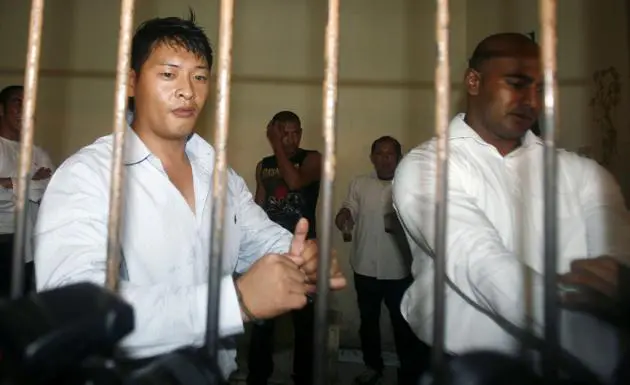
The duo’s chance of avoiding the firing squad was garrotted upon their transfer to Nusakambangan last week amid an absurdly bloated security presence that no doubt played well in Indonesia, but in the eyes of millions of Australians exemplified their usage for enhanced political wattage.
Photos of a smiling senior policeman posing for selfies with a distressed-looking Sukumaran and Chan on a plane en route to the island were rightfully described as “macabre” by Australian Treasurer Joe Hockey.
After arriving on Nusakambangan the men received renewed hope. Last Friday Indonesia’s Attorney General HM Prasetyo postponed the execution to allow a number of the condemned to pursue legal appeals. Sukumaran and Chan’s appeal will be heard at the Administrative Court in Jakarta today.
Their legal team will argue that Indonesian President Joko Widodo gave scant consideration to their mercy pleas, that his rejection of clemency was based on their crime and not their rehabilitation. Late last month the Administrative Court ruled it did not have the power to review the president’s clemency rejection.
Intriguingly, Muhammad Rifan, a former lawyer for the pair, recently alleged there had been “interference” in their trial. He claimed judges asked for money in return for lighter sentences. The men’s prominent Indonesian human rights lawyer, Todung Mulya Lubis, demanded an investigation, and late last week Australian Foreign Minister Julie Bishop said Indonesia’s Judicial Commission had asked Sukumaran and Chan to provide statements about the bribery allegation.
If all this fails, the Australian government will continue to lobby Widodo to spare them. However, the president has said numerous times there will be no clemency, arguing that his pledge to execute drug traffickers must be acted upon given the narcotics “crisis” facing Indonesia.
Widodo’s decision to resume executions after his predecessor, Susilo Bambang Yudhoyono, placed an unofficial moratorium on the death penalty from 2008-2013 has probably signalled the denouement of Sukumaran and Chan’s wretched, yet unexpectedly uplifting, existence.
For countless people that would be, as Australian Prime Minister Tony Abbott put it, “revolting”. Sukumaran received an associate degree in fine arts from Western Australia’s Curtain University last month, and Chan found religion in prison and was ordained a pastor. Together they established and ran a host of prisoner rehabilitation programmes copied at prisons nationwide.
“One of the really frustrating and stupid things about this case is that they have become valuable assets for the Indonesian community. They help Indonesians in prison become better people,” their lawyer, Julian McMahon, told the “Dateline” programme on SBS in Australia. He has reiterated that message to Indonesians.
Unsurprisingly, Jakarta and Canberra’s relationship is severely strained. The death penalty in Australia was abolished decades ago, and while a host of countries, Thailand included, list drug trafficking as a capital offence, only a handful execute the culprits. The last execution in Thailand was of two drug traffickers by lethal injection in Bang Khwang Prison in April 2009.
Sukumaran and Chan’s case has led to renewed calls for Thailand to abolish the death penalty, given the widespread belief it is not a genuine deterrent. It’s also widely considered inhumane, while many people, like prominent Australian Labor MP Tanya Plibersek, argue it prevents prisoner rehabilitation. Plibersek, whose husband, Michael Coutts-Trotter, was imprisoned for drug smuggling in Australia in the 1980s before becoming a respected educator and public servant, last month said in support of Sukumaran and Chan: “What would have happened if he [Coutts-Trotter] had been caught in Thailand instead of Australia? What would the world have missed out on?”
Abbott’s suggestion that there would be consequences if Sukumaran and Chan’s appeals are unsuccessful, and, more controversially, his linkage of the effort to save them to Australia’s donation of A$1 billion to Indonesia following the Boxing Day tsunami, provoked a rebuke from Jakarta and a hostile response from the Indonesian media and public.
Since then Abbott’s tone has been more conciliatory, including saying the men’s deaths would not spark consequences. But in Australia a cacophony of condemnation reverberates. Many consider it a torturous drawn-out affair. And despite what Abbott said, there would be repercussions, perhaps for years to come.
