
Russia offers brotherly respect, not fatherly lectures: Medvedev
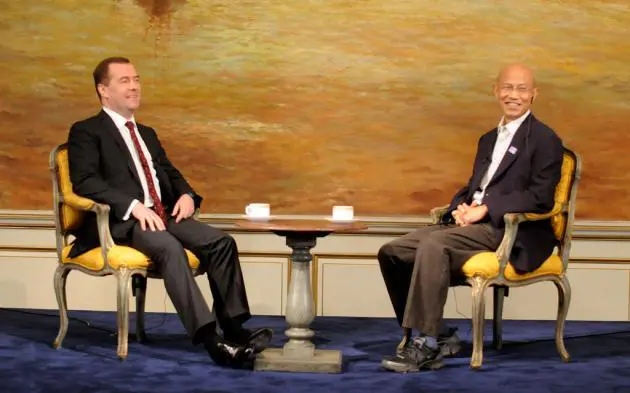


The Russian PM discusses arms sales and nuclear energy development for Thailand in the second half of his interview with Nation Multimedia Group chairman Suthichai Yoon
SY : HOW HAS THE RECENT COUP IN THAILAND INFLUENCED BILATERAL RELATIONS WITH RUSSIA? THE EU AND THE UNITED STATES HAVE DENOUNCED IT, WHILE CHINA HAS SHOWN UNDERSTANDING AND OTHER ASEAN COUNTRIES HAVE EXPRESSED SYMPATHY. WHAT DOES RUSSIA THINK ABOUT THE CHANGE OF REGIME IN THAILAND AND ABOUT THE NEW GOVERNMENT?
DM : You know, we try to be civilised in all circumstances. Regarding the ongoing events in Thailand, they are your country’s internal affairs. We approach them with understanding and respect.
On the other hand, some countries get really worked up about events in countries across the globe. I think the concern is excessive and the lecturing is unnecessary. Sovereign countries must deal with their problems independently. Both Russia and Thailand can deal with our problems ourselves – we with our friends and partners in the West, and you with your partners in Asean and in the West. I think we should get back to the foundational principles of international law – excuse the legalese, but I was trained as a lawyer, after all – and this will be the best formula to follow in international affairs.
SY: I’VE NOTICED THAT YOUR GOVERNMENT IS ACTIVE IN ASIA, ESPECIALLY SOUTH ASIA. DOES THIS REPRESENT SOME KIND OF AN EFFORT TO COUNTER US INFLUENCE IN THE REGION?
DM : Unlike a number of other countries, Russia has had friendly relations with these countries for almost 120 years. We have advanced relations with Asia-Pacific countries. After all, we’re neighbours! Thailand is a little farther from Russia compared to China, with which we share a long border. Russia has maintained friendly ties with a number of other countries as well… The same goes for the Soviet era, although back then cooperation was based on the ideology that, if you start building socialism, then we’ll provide assistance. That’s not what we want. Every country should be free to establish a system chosen by its people.
By the way, I think the advantage of your country, and the reason why many people love it, is to some extent based on the fact that Thailand was never under colonial rule. You were able to maintain your identity and culture, which can be seen everywhere. When you go to a standardised country, where the signs are not in the native language and all the restaurants and museums are the same as everywhere else, it’s not interesting. Your country is very distinctive and true to its roots. I think the fact that you’ve been able to preserve this identity is very valuable and important. For this reason, while it is true that Russia is proactively developing relations with Southeast Asia and Asean countries, we are not copying anyone or acting to spite anyone, neither the Americans, nor the Europeans. We have always acted this way, and will continue to, even more so moving forward. We have taken a number of very important decisions in this respect, including, for instance, to develop cooperation with Southeast Asia in energy and transport. We have signed major contracts on the delivery of our oil and gas to China, and we can also supply our energy resources to other countries in Southeast Asia. An agreement on road junctions and transport links has been signed. We are ready to discuss such major projects as the construction of nuclear power stations, which we build across the globe. I came here from Vietnam, where we discussed this matter with our Vietnamese colleagues. If Thailand decides at a certain point to develop nuclear energy, we are ready to help. And there are many more examples.
SY : DOES THAT MEAN YOU’RE INTERESTED IN |HELPING THAILAND BUILD A NUCLEAR POWER STATION?
DM : It is a decision, a choice to be made. Obviously, nuclear energy requires utmost attention. It’s an issue that is taken very seriously after Fukushima. I’ll tell you, first, that it’s viewed very seriously in Russia, especially in the aftermath of the 1986 accident in Chernobyl. Second, the reactors we currently use are based on different principles. And third, this is perhaps the least expensive energy source, no matter how you look at it.
SY : YOU ALSO HAVE STATE-OF-THE-ART WEAPONS. ARE YOU PREPARED TO DISCUSS, FOR EXAMPLE, THE PURCHASE OF AGRICULTURAL PRODUCTS FROM THAILAND AND THE SALE OF HELICOPTERS, TANKS AND SUBMARINES TO IT?
DM : Of course. If needed, we’ll supply tanks and other types of equipment. As you know, Russia is a major arms exporter. We have no misgivings about it, because states will have armies regardless. No one is willing to disarm just for the sake of disarming. In any event, to be respected, you must have sufficient armed forces. Therefore, if you take these decisions, we’ll be pleased to supply the equipment, even taking into account the fact that Thailand traditionally has been oriented to Western suppliers. Our weapons are no worse than theirs.
SY : YES, I KNOW, AND THEY ARE CHEAPER.
DM : Some types are certainly cheaper.
SY : THE BIG QUESTION IS, HOW WILL THINGS END IN UKRAINE? IS A PEACEFUL SOLUTION POSSIBLE?
DM : A peaceful and negotiated end is possible. For us, it’s a very difficult and painful subject, because we have a close affinity with the people of Ukraine. Regrettably, the nation is divided, and events have occurred in Ukraine that we cannot support for various reasons. But they must restore their country on their own. By themselves. The Kiev authorities and Ukraine must do all they can to keep the country united and encourage the regions that have, in effect, seceded from the central government to return. But the necessary conditions must be created for that, and it ought to be explained to them why they will be better off as part of a united Ukraine. Only the authorities in Kiev can do this. Naturally, we’ll seek to help this process along, but we won’t interfere. At the same time, we can’t be indifferent when we see that people are hungry and lack medicine there. This is why we are sending humanitarian convoys to southeast Ukraine. But this is about all we can do in this situation.
SY : HOW DO YOU KEEP FIT AND FRESH AFTER A LONG DAY OF MEETING WITH THE PRIME MINISTER AND BUSINESS LEADERS? I’VE HEARD THAT YOU SWIM ALMOST EVERY DAY.
DM : I try to swim and I try to do that every day. I cycle. Whenever I have the opportunity, I also do mountain skiing. Come to Sochi, we have wonderful snow there.
SY : I’VE HEARD THAT YOU ALSO DO YOGA.
DM : Yes, but I’m not a serious practitioner. I take some yoga lessons just to relax and experience spiritual practice a bit.
SY : I’VE ALSO HEARD THAT YOU LIKE ROCK MUSIC VERY MUCH, ESPECIALLY BRITISH BANDS DEEP PURPLE AND PINK FLOYD.
DM : Yes, I have them in my record collection. I like to listen to all this music, but on vinyl discs, as I used to do 35 years ago.
SY : WHAT ABOUT THE INCIDENT WITH YOUR NEIGHBOUR? I UNDERSTAND THAT YOU WERE A |NEIGHBOUR OF FORMER PRESIDENT MIKHAIL GORBACHEV AND THAT YOU HAD A CAT THAT FOUGHT WITH HIS CAT.
DM : Everything is fine. Mr Gorbachev is an elderly person, and I would hope that nothing disturb his peace, not even a cat or a dog. I used to be his neighbour, but I moved residence after I became president.
