
Thailand’s coconut industry has room to grow as innovation turns processing complexity into new product opportunities
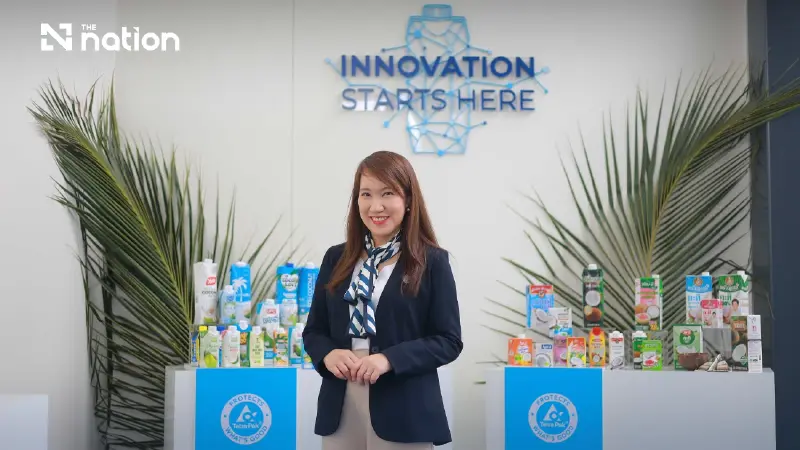


Thai manufacturers can navigate coconut processing challenges and develop new coconut-based products at the Coconut Knowledge Centre and Tetra Pak® Product Development Centre in Rayong
Bangkok, Thailand, 27 August 2026 – Thailand’s coconut industry has an opportunity to expand into differentiated products for local and international markets. At its Coconut Knowledge Centre within the Product Development Centre (PDC) in Rayong, Tetra Pak demonstrates how processing and product development capabilities can help food and beverage manufacturers explore new coconut-based products, processing approaches and applications before moving towards commercial-scale production.
The country has an established presence in international coconut markets, with data from the Government Public Relations Department showing that coconut milk exports reached US$341.11 million (about 12 billion baht) from January to October 2024, a 16.85% increase from the same period in 2023[1]. Asia Pacific also accounted for the largest share of the global coconut products market in 2025 at over 30%, according to Grand View Research[2].
Developing new coconut products, however, requires careful control throughout processing. Coconut water and cream are sensitive to time and temperature, and their quality can deteriorate if not processed quickly after extraction. Depending on the product and formulation, manufacturers may also need to manage challenges such as fat separation while maintaining consistent taste, texture and product quality.
Surapong Kobpraditkul, Processing Director, Tetra Pak (Thailand) Limited, said: “Coconut may appear straightforward as a raw material, but different coconut products behave very differently during processing. Coconut water requires careful control of time and temperature to protect its quality, while coconut cream requires careful management of texture and stability. That is why we look at the raw material, formulation and processing conditions together from the start. Understanding these characteristics helps manufacturers select the right processing approach and achieve consistent quality as they scale up the production."
A key technology for coconut applications is Tetra Pak Direct UHT solution with steam injection and flash cooling. With nearly 40 years of experience in coconut processing and packaging, Tetra Pak applies this expertise to help manufacturers select processing approaches suited to different coconut products and formulations. Direct UHT rapidly heats and cools the product, helping to minimise thermal impact, reduce browning and retain the delicate flavour profile of coconut products. Together with aseptic processing and packaging, it enables products to be stored and distributed at ambient temperatures without continuous refrigeration. Other technologies can be configured according to specific product needs, including airtight separation to minimise oxygen contact during processing and homogenisation to achieve the texture and stability required for coconut cream.
Beyond processing, manufacturers can use the Coconut Knowledge Centre and PDC in Rayong to develop and test product concepts, formulations and processing options before commercial production. Its semi-industrial pilot capabilities allow manufacturers to assess not only whether an idea works as a formulation, but also how it can be processed consistently and prepared for scale-up.
The opportunity also extends beyond established products such as coconut water, coconut milk and coconut cream, coconut ingredients can provide a base for innovation across beverage categories, including ready-to-drink tea and coffee, barista applications, food supplements and nutrition (FSN), energy drinks and sports drinks. This opens up new possibilities for manufacturers to diversify their portfolios and respond to evolving consumer preferences.
Sutthinun Taechathayanon, Customer Experience Manager APAC, Tetra Pak, shared: “There’s still significant untapped potential for coconut across new products and consumption occasions. At our PDC in Rayong, manufacturers can work with our product and processing experts early in the development process to understand how a formulation behaves, what may need to be adjusted and how it can be prepared for scale-up. Looking ahead, we also see opportunities to expand our PDC capabilities for coconut-based applications using Tetra Recart®.”
Tetra Recart is part of Tetra Pak’s broader packaging portfolio and is already used for shelf-stable products such as coconut milk and cream. The portfolio spans advanced premium formats to convenient and differentiated packaging solutions, including Tetra Prisma® Aseptic, Tetra Prisma® Aseptic Edge, and Tetra Classic® Aseptic, giving manufacturers a range of options to protect product quality, meet consumer needs, and differentiate their brands across segments.
To learn more about Tetra Pak's coconut processing and packaging solutions, visit our Coconut webpage and explore the Tetra Pak Coconut Handbook.
[2] Grand View Research. Coconut Products Market Size, Share & Trends Analysis Report, 2026–2033. https://www.grandviewresearch.com/industry-analysis/coconut-products-market
