
Urgent reforms needed to strengthen Thai economy in next decade Wichit Chaitrong


Thailand also needed to focus on technology driven reform, creating better infrastructure and helping people to access and utilise technology.
On the bright side of the 1997-Asian financial crisis, it corrected the value of the baht, making it cheaper and resulting in a boost for Thailand’s exports.
The financial sector and businesses embraced reforms, making them better prepared for later crises.
But the weakest link in the economy is the public sector, which has dodged the urgent need for reforms.
The Covid-19 outbreak and other dynamic forces have demonstrated that Thailand needs reforms in order to moveforward into the next decade, according to experts.
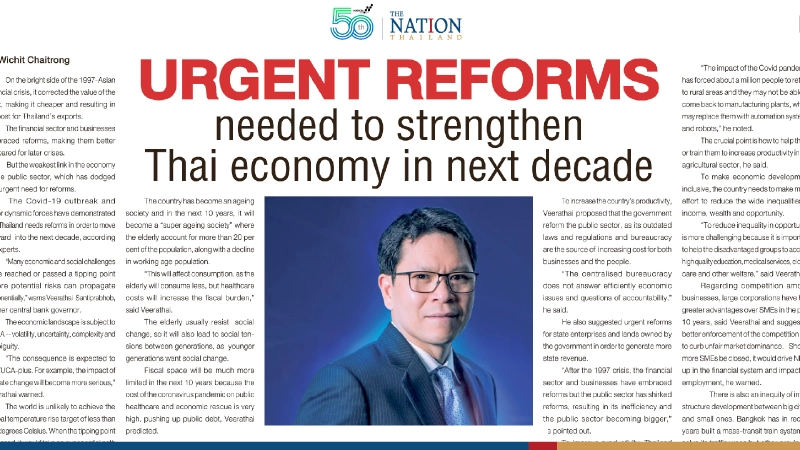
“Many economic and social challenges have reached or passed a tipping point where potential risks can propagate exponentially,” warns Veerathai Santiprabhob, former central bank governor.
The economic landscape is subject to VUCA -- volatility, uncertainty, complexity and ambiguity.
“The consequence is expected to be VUCA-plus. For example, the impact of climate change will become more serious,” Veerathai warned.
The world is unlikely to achieve the global temperature rise target of less than 1.5 degrees Celsius. When the tipping point is passed, it would take an exponential path not a linear one, he pointed out.
While the financial world has been flooded with excessive liquidity, the market has been subject to high volatility.
The evolution of information and communications technology has been rapid with the advent of artificial intelligence and 5G mobile technology. “Those who have high capability in information and communications technology have a great advantage in the new operating landscape,” he said.
The Thai economy faces two key constraints -- ageing population and limitation
of fiscal space, according to Veerathai.
The country has become an ageing society and in the next 10 years, it will become a “super ageing society” where the elderly account for more than 20 per cent of the population, along with a decline in working age population.
“This will affect consumption, as the elderly will consume less, but healthcare costs will increase the fiscal burden,” said Veerathai.
The elderly usually resist social change, so it will also lead to social tensions between generations, as younger generations want social change.
Fiscal space will be much more limited in the next 10 years because the cost of the coronavirus pandemic on public healthcare and economic rescue is very high, pushing up public debt, Veerathai predicted.
Due to lockdowns, many businesses, especially small and medium-sized enterprises (SMEs), have faced debt overhang, resulting in a rise in non-performing loans.
People’s income suffered a steep decline so it has turned already-high household debt into bad debts.
“If there are no urgent reforms, the consequences would be serious in the next 10 years, and the high debt overhang would make Thailand very vulnerable to future shocks,” said Veerathai.
He has a three-word mantra for urgent reforms: productivity, inclusivity and immunity.
To increase the country’s productivity, Veerathai proposed that the government reform the public sector, as its outdated laws and regulations and bureaucracy are the source of increasing cost for both businesses and the people.
“The centralised bureaucracy does not answer efficiently economic issues and questions of accountability,” he said.
He also suggested urgent reforms for state enterprises and lands owned by the government in order to generate more state revenue.
“After the 1997 crisis, the financial sector and businesses have embraced reforms but the public sector has shirked reforms, resulting in its inefficiency and the public sector becoming bigger,”
he pointed out.
To improve productivity, Thailand also needed to focus on technology driven reform, creating better infrastructure and helping people to access and utilise technology.
Widespread corruption also impacts fair competition and productivity as competitive businesses tend to lose out to those who use political connections or bribes, said Veerathai.
The agriculture sector needs to increase yields. The economic value of the sector accounts for less than 10 per cent of GDP but it employs about 20 to 30 per cent of the labour force.
“The impact of the Covid pandemic has forced about a million people to return to rural areas and they may not be able to come back to manufacturing plants, which may replace them with automation systems and robots,” he noted.
The crucial point is how to help them or train them to increase productivity in the agricultural sector, he said.
To make economic development inclusive, the country needs to make more effort to reduce the wide inequalities in income, wealth and opportunity.
“To reduce inequality in opportunity is more challenging because it is important to help the disadvantaged groups to access high quality education, medical services, elderly care and other welfare,” said Veerathai.
Regarding competition among businesses, large corporations have had greater advantages over SMEs in the past 10 years, said Veerathai and suggested better enforcement of the competition law to curb unfair market dominance. Should more SMEs be closed, it would drive NPLs up in the financial system and impact on employment, he warned.
There is also an inequity of infrastructure development between big cities and small ones. Bangkok has in recent years built a mass-transit train system to solve its traffic woes but other provinces face similar traffic problems do not have a mass-transit system in place.
Immunity from economic and other shocks is also a challenge. “Thailand has paid little attention to climate change compared with its potential magnitude of impact,” Veerathai warned.
As Thailand has a long coast and beaches, rising sea water level caused by global warming will have a serious impact on the tourism industry. “A few Thai businesses have been trying to meet the zero-carbon emission target,” he added.

