
Lessons and Opportunities In a Post-Crisis World
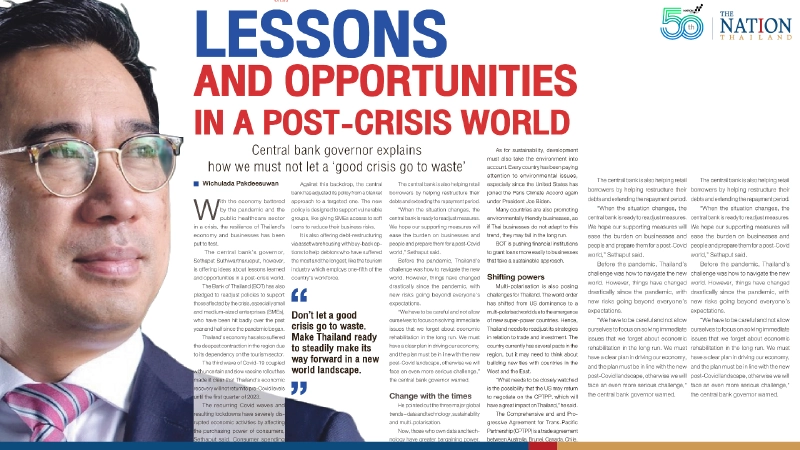


The central bank’s governor, Sethaput Suthiwartnarueput, however, is offering ideas about lessons learned and opportunities in a post-crisis world.
With the economy battered by the pandemic and the public healthcare sector in a crisis, the resilience of Thailand’s economy and businesses has been put to test.
The central bank’s governor, Sethaput Suthiwartnarueput, however, is offering ideas about lessons learned
and opportunities in a post-crisis world.
The Bank of Thailand (BOT) has also pledged to readjust policies to support those affected by the crisis, especially small and medium-sized enterprises (SMEs), who have been hit badly over the past year and half since the pandemic began.
Thailand’s economy has also suffered the deepest contraction in the region due to its dependency on the tourism sector.
The third wave of Covid-19 coupled with uncertain and slow vaccine rollout has made it clear that Thailand’s economic recovery will not return to pre-Covid levels until the first quarter of 2023.
The recurring Covid waves and resulting lockdowns have severely disrupted economic activities by affecting the purchasing power of consumers, Sethaput said. Consumer spending dropped significantly and damaged trade and services, he explained.
This year, the economy is expected to expand by just 1.8 per cent, after it contracted by 6.1 per cent last year.
The challenge that lies ahead is uneven recovery.
Targeting the vulnerable
Though exports have bounced back with a higher growth rate than pre-Covid levels, there is no sign of recovery for tourism-related services, Sethaput said. The tourism industry will take a while before it can return to the pre-Covid level, he predicted.
Against this backdrop, the central bank has adjusted its policy from a blanket approach to a targeted one. The new policy is designed to support vulnerable groups, like giving SMEs access to soft loans to reduce their business risks.
It is also offering debt-restructuring via asset warehousing with buy-back options to help debtors who have suffered
the most and the longest, like the tourism industry which employs one-fifth of the country’s workforce.
The central bank is also helping retail borrowers by helping restructure their debts and extending the repayment period.
“When the situation changes, the central bank is ready to readjust measures. We hope our supporting measures will ease the burden on businesses and people and prepare them for a post-Covid
world,” Sethaput said.
Before the pandemic, Thailand’s challenge was how to navigate the new world. However, things have changed drastically since the pandemic, with new risks going beyond everyone’s expectations.
“We have to be careful and not allow ourselves to focus on solving immediate issues that we forget about economic rehabilitation in the long run. We must have a clear plan in driving our economy, and the plan must be in line with the new post-Covid landscape, otherwise we will face an even more serious challenge,”
the central bank governor warned.
Change with the times
He pointed out the three major global trends – data and technology, sustainability and multi-polarisation.
Now, those who own data and technology have greater bargaining power, much like those who owned important resources in the past.
“Data is the new oil, and artificial intelligence the new electricity,” he explained.
The Covid-induced crisis has forced everyone to adopt technology, especially in terms of online banking and transactions.
The government has been using information technology to provide support to businesses and people affected by the crisis.
Similarly, the central bank is also utilising information technology to monitor the economic situation, evaluate results of its policies and readjust economic measures to better implement these policies.
As for sustainability, development must also take the environment into account. Every country has been paying
attention to environmental issues, especially since the United States has joined the Paris Climate Accord again under President Joe Biden.
Many countries are also promoting environmentally friendly businesses, so if Thai businesses do not adapt to this trend, they may fail in the long run.
BOT is pushing financial institutions to grant loans more easily to businesses that take a sustainable approach.
Shifting powers
Multi-polarisation is also posing challenges for Thailand. The world order has shifted from US dominance to a
multi-polarised world due to the emergence of new super-power countries. Hence, Thailand needs to readjust its strategies in relation to trade and investment. The country currently has several pacts in the region, but it may need to think about building new ties with countries in the West and the East.
“What needs to be closely watched is the possibility that the US may return to negotiate on the CPTPP, which will have a great impact on Thailand,” he said.
The Comprehensive and and Progressive Agreement for Trans-Pacific Partnership (CPTPP) is a trade agreement between Australia, Brunei, Canada, Chile, Japan, Malaysia, Mexico, New Zealand, Peru, Singapore and Vietnam.
Apart from considering ties with CPTPP countries, Thailand should also strengthen its partnership with Cambodia, Laos, Myanmar and Vietnam, the central bank chief said.
He said the only way Thailand can prepare for a post-Covid world is by asking
itself two questions: how businesses and the country will move forward and what needs to be reset or improved. “Don’t let a good crisis go to waste. Make Thailand ready to steadily make its way forward in a new world landscape.” he said.

