
WINNER TAKES ALL Prayut and opposition gamble everything on new electoral system
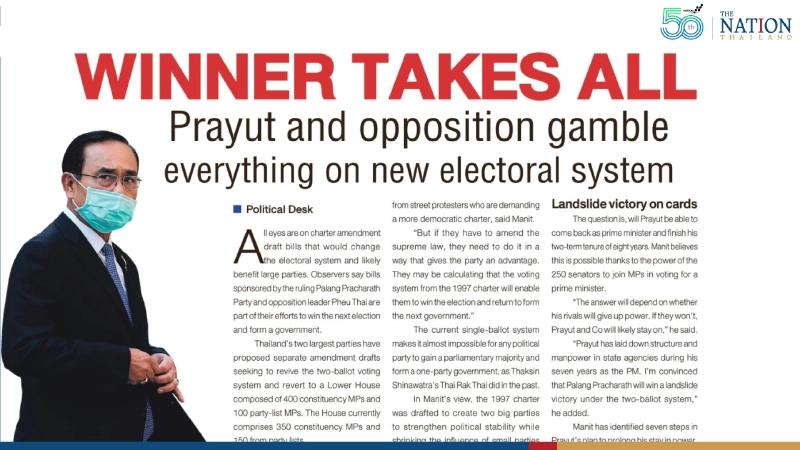


All eyes are on charter amendment draft bills that would change the electoral system and likely benefit large parties. Observers say bills sponsored by the ruling Palang Pracharath Party and opposition leader Pheu Thai are part of their efforts to win the next election and form a government.
Thailand’s two largest parties have proposed separate amendment drafts seeking to revive the two-ballot voting system and revert to a Lower House composed of 400 constituency MPs and 100 party-list MPs. The House currently comprises 350 constituency MPs and 150 from party lists.
In the 2019 general election – the first to be held under the 2017 Constitution – voters cast a single ballot to select constituency MPs and also calculate the number of list MPs for each party.
Under the 1997 and 2007 charters, each voter cast two separate ballots – one for a constituency MP and one for a party.
Large parties like Palang Pracharath and Pheu Thai favour the two-ballot system because it is beneficial to them. But it leaves small and medium-size parties disadvantaged since the calculation makes it difficult for them to gain seats.
The newly founded Future Forward became the third-largest party on its election debut in 2019 thanks to the single ballot system, before being dissolved by court order.
Associate Professor Manit Jumpa, from Chulalongkorn University’s Law Faculty, said the two-ballot system – in which the whole country is considered as one constituency – would enable politicians to predict their winning seats in Parliament.
Under the system, constituency MP candidates are independent of party-list candidates, but the most significant point is that well-known party figures who run as list candidates can usually be assured of winning a seat.
Palang Pracharath’s push for charter change comes in response to pressure from street protesters who are demanding a more democratic charter said Manit.
“But if they have to amend the supreme law, they need to do it in a way that gives the party an advantage.
They may be calculating that the voting system from the 1997 charter will enable them to win the election and return to form the next government.”
The current single-ballot system makes it almost impossible for any political party to gain a parliamentary majority and form a one-party government, as Thaksin Shinawatra’s Thai Rak Thai did in the past.
In Manit’s view, the 1997 charter was drafted to create two big parties to strengthen political stability while shrinking the influence of small parties and their traditional bargaining role in coalition governments. The two-ballot voting system was designed to meet this purpose.
“But the system led to a ‘parliamentary dictatorship’ or one-party rule in which the system of checks and balances failed to function,” he said.
Revenge for the coup?
Prime Minister Prayut Chan-o-cha is unhappy at having to work with other coalition partners when he can merely “press an order button” to the 250-junta-appointed senators, said Manit. He added that if Prayut and the ruling party want to return to power after the next election, they must find ways to get rid of the bargaining for power by their coalition partners.
The ruling party could face a backlash from political rivals if they lose the reins of power, hence they want to tighten their hold, said Manit.
Then-Army chief Prayut took power after staging a coup to topple prime minister Yingluck Shinawatra in 2014. After the 2019 election, he returned as Palang Pracharath’s candidate for prime minister, winning the post thanks to votes from its MPs, coalition partners and the 250 senators.
Still seen as an extension of the junta, the ruling party and its allies may face revenge if opponents overthrown by the coup return to power.
“Like boxers, those in power must keep their guard up and retain power for as long as possible to ensure their rivals don’t make a comeback,” said Manit.
Landslide victory on cards
The question is, will Prayut be able to come back as prime minister and finish his two-term tenure of eight years. Manit believes this is possible thanks to the power of the 250 senators to join MPs in voting for a prime minister.
“The answer will depend on whether his rivals will give up power. If they won’t, Prayut and Co will likely stay on,” he said.
“Prayut has laid down structure and manpower in state agencies during his seven years as the PM. I’m convinced that Palang Pracharath will win a landslide victory under the two-ballot system,” he added.
Manit has identified seven steps in Prayut’s plan to prolong his stay in power.
First, a Bt500-billion Covid-19 relief scheme was approved to ease people’s financial burdens and pay medical costs.
Second, the ruling party leadership was recently reshuffled to appoint Deputy Agriculture and Cooperatives Minister Thammanat Prompow as secretary-general.
Third, a draft bill was proposed to restore the two-ballot electoral system.
Fourth was the acceleration of disease-control efforts, rollout of vaccination nationwide, and announcement that Thailand would reopen fully by October (within 120 days). Achieving all these missions would help the government boost its popularity and win voters’ hearts.
Fifth, the House will be dissolved and an election called at a time that suits the ruling party.
Sixth, Palang Pracharath will propose that Prayut return as the next PM with the expectation of gaining more constituency MPs under the two-ballot system.
Lastly, with the victory, Palang Pracharath will form the next government with Prayut voted in as premier.
The stakes are high for Prayut and Palang Pracharath and they have bet everything on the two-ballot electoral system. The result could go either way: a landslide victory for Prayut and Palang Pracharath or a return to power for the Thaksin-Pheu Thai camp.

