
OSP moves towards a Circular Future, advancing Bottle to Bottle into Closed-Loop Glass Circularity


A glass bottle retains its value even after the drink inside has been consumed because glass can be recycled 100% without losing its material properties.
Yet there remains a gap between being “recyclable” and actually being recycled. Challenges include sorting, collection and bringing bottles dispersed among households and communities back into the production process, particularly small glass bottles that are more likely to fall outside the collection system.
This is the challenge that Osotspa Public Company Limited (OSP) is addressing by advancing its OSP Bottle to Bottle initiative towards Closed-Loop Glass Circularity, linking design, production and post-consumer packaging management into a single cycle under the concept “From Consumers’ Hands to New Bottles”.
The initiative is also being developed as a flagship corporate social responsibility project to mark Osotspa’s 135th anniversary.

Designing to use fewer resources and bring materials back into use
Osotspa’s circular-economy approach begins with developing lighter glass bottles while maintaining their strength, alongside the use of recycled glass, or cullet, as a raw material for producing new bottles.
This reduces dependence on virgin raw materials and lowers energy consumption during production. Lighter bottle design improves material efficiency from the outset, while cullet enables resources that have already been used to be put back to productive use.
However, this process depends on an effective collection system that can continuously move bottles from consumers back into the recycling process.

Mookda Pairatchavet, Chief Executive Officer of Osotspa Public Company Limited, said:
“Glass bottles are one of Osotspa’s main forms of packaging, so we see our responsibility as extending from design and production through to ensuring that post-consumer glass bottles can be put to use again.
“This helps reduce the consumption of virgin raw materials, lower energy use in production and reduce the likelihood of glass bottles remaining in the environment. OSP Bottle to Bottle is therefore not simply a project to collect bottles for recycling, but a system designed to bring more glass bottles back into the cycle on a more consistent basis.”
Three mechanisms to bring bottles back: incentives, collection channels and participation
One of the main challenges in collecting glass bottles, particularly smaller ones, is that they are scattered across many locations, making them difficult to gather. They must also be separated from other types of waste before recycling.
Glass is relatively heavy, which also creates collection and transport costs. These factors prevent some bottles from returning to the system even though the material itself can be reused.

Osotspa is therefore seeking to create incentives while expanding collection channels and encouraging waste separation at source through three interconnected mechanisms:
- Directly connecting collectors with recyclable-waste buyers. The programme purchases glass bottles, particularly smaller bottles, with an emphasis on market-based prices and same-day payment to maintain incentives for collection. It also seeks to build awareness that small bottles, including M-150 bottles, have value and can enter recycling purchasing systems in the same way as other glass bottles.
- Expanding collection networks and channels. OSP works with business partners, recyclable-waste buyers, communities and relevant organisations, including the Stock Exchange of Thailand (SET) and 40 member companies, to increase collection points for bottles dispersed across different areas and channel them into the recycling process.
- Encouraging employee and community participation. Employee volunteers take part in glass-bottle collection and environmental activities while encouraging correct waste separation at source so that post-consumer materials are ready to enter the appropriate waste-management system.
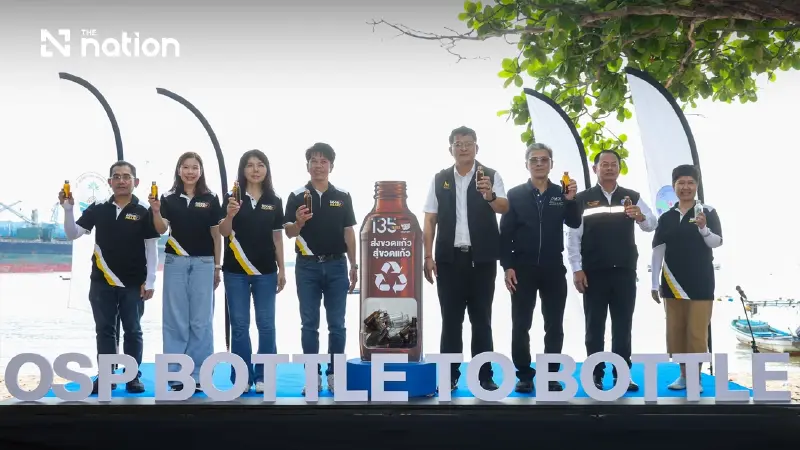
One example of putting this approach into practice was an OSP Bottle to Bottle activity at Laem Chabang Beach in Chonburi province.
OSP joined the Department of Marine and Coastal Resources, government agencies in Chonburi, business partners, local networks, communities and employee volunteers to collect and separate waste, with the aim of building awareness and encouraging participation in waste management from the point of disposal.
The activity demonstrated that making circularity work in practice requires participation from everyone. Correct separation at source is the starting point for enabling used materials to become resources and create value again.
More than 250 people participated in the activity, collecting 425 kilogrammes of waste, including 340kg of small glass bottles.
Managing the collected waste is expected to reduce greenhouse-gas emissions by 337kg of carbon dioxide equivalent, demonstrating the results that can be achieved by jointly separating waste and returning materials to the appropriate management system so discarded resources have an opportunity to be used again.

625,000-tonne target links collection with the scale of the business
Collected glass bottles are sorted and recycled into cullet before being returned to the furnace to produce new bottles.
This process directly connects OSP Bottle to Bottle with the company’s business operations in terms of raw materials, energy use and resource efficiency.
The project aims to collect 625,000 tonnes of waste glass by 2030, equivalent to 99% of the estimated volume of M-150 sales between 2026 and 2030.
The target reflects OSP’s commitment to returning post-consumer packaging to productive use and provides direction for expanding collection areas, collection channels and partner networks.
At the heart of Closed-Loop Glass Circularity is the connection between consumers, collectors, recyclable-waste buyers, recyclers and manufacturers, allowing material from used packaging to be continually returned as raw material for new packaging.

Small Action, Big Impact: when small actions create wider results
For an organisation producing goods on the scale of billions of bottles, waste separation by individual households or adding a collection point in each community can produce greater results when such actions are sustained and expanded more widely.
Mookda said:
“Osotspa produces products on the scale of billions of bottles, but only some of those glass bottles are currently collected and recycled, while many others do not return to the cycle.
“We believe change can begin with something simple — correctly separating glass bottles so that they have the opportunity to be put to use again. When small actions take place simultaneously on a wider scale, they can create a much greater impact for both society and the environment.”
OSP will continue expanding cooperation with government agencies, policymakers, waste-management service providers, businesses, communities and consumers to support long-term collection.
Moving towards a Circular Future therefore means building a system in which producer responsibility and participation from all parties are connected — transforming the end of a used bottle’s life into the beginning of a new bottle.
