
Same president. Different spellings. What’s in a y?
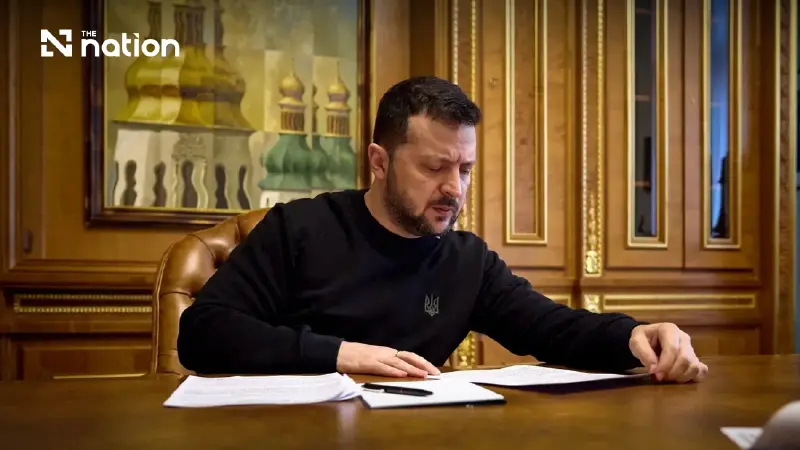


Ukraine’s president uses Zelenskyy, but English-language media differ over his surname, while place names such as Kyiv carry political weight.
- The official English spelling of the Ukrainian president's name is "Zelenskyy," as adopted by his administration in 2019 and used in his passport.
- The different spellings ("Zelensky," "Zelenskiy," "Zelenskyy") exist due to varying approaches to transliterating the Ukrainian Cyrillic name into the Latin alphabet.
- News organizations have not adopted a single standard, with different major outlets using different versions of the name based on their own conventions and style guides.
- The article contrasts the spelling of the president's name with the more politically significant choice for place names, such as using "Kyiv" (Ukrainian form) over "Kiev" (Russian form).
Ukrainian President Volodymyr Zelenskyy has an official English spelling, but readers will not necessarily find it in every headline. Zelensky and Zelenskiy also appear in international coverage, reflecting different approaches to representing his Ukrainian surname in the Latin alphabet.
The double-y form is used by Ukraine’s presidential office. The alternatives have persisted because official preferences, transliteration systems and newsroom conventions do not always produce the same result.
The official spelling was clarified in 2019
Zelenskyy’s administration adopted the double-y ending in May 2019, establishing a preferred English form early in his presidency.
Iuliia Mendel, his spokesperson at the time, subsequently confirmed that Zelenskyy was “the official form of the last name that the President has in his passport”, according to Ukrainian outlet Hromadske. Mendel attributed the spelling to Ukraine’s passport service.
The clarification followed an initially inconsistent approach within the administration itself. Peter Dickinson, a nonresident fellow at the Atlantic Council, wrote in June 2019 that different versions had appeared in official communications and social media accounts during the president’s first days in office.
The president’s English-language website now uses Volodymyr Zelenskyy. His Twitter account, highlighted in CNN’s March 2022 analysis, also carried the double-y form in the handle @zelenskyyua.
Different alphabets leave room for different choices
The Ukrainian surname is Зеленський. Rendering it in English involves transliteration: representing a name written in Cyrillic with Latin letters.
The resulting variations are familiar to people who work with Ukrainian names. Dickinson described spelling confusion as “the rule rather than the exception”, noting that relatively straightforward names such as Shevchenko coexist with others that generate several competing English forms.
Newsroom practice illustrated the differences during March 2022. CNN, The New York Times and The Washington Post used Zelensky, while Fox News, MSNBC and the Associated Press used Zelenskyy, according to CNN’s analysis at the time.
Sky News and Al Jazeera also used Zelenskyy. The Guardian and Reuters used Zelenskiy. These examples describe the publications’ usage during that period, rather than a permanent rule governing every outlet.
The Independent’s then chief sub-editor, Ross McKinnon, cited searchability and George Orwell: “Never use a long word where a short one will do”.
Spelling can affect how a country is understood
For Dickinson, inconsistent English spellings created a problem beyond individual editorial decisions. Readers could encounter different versions of the same person’s name in journalism and academic writing, adding to an already limited international understanding of Ukraine.
Dickinson argued that greater consistency would not determine the outcome of an information war. It could, however, make Ukraine appear less confusing to outside audiences and reduce uncertainty over the identities of people appearing in coverage.
The discussion also raised questions about whether Zelenskyy’s double-y ending should be read as a political statement against Russia. That interpretation requires care: a personal spelling preference and the choice of a country’s place names are related linguistic questions, but they are not necessarily equivalent political acts.
Kyiv carries a distinct political significance
The distinction between Kyiv and Kiev provides a clearer example of the relationship between language and national identity. Kyiv represents the Ukrainian name for the capital, while Kiev follows the Russian form.
Dr Yuri Shevchuk, a Ukrainian-language lecturer in Columbia University’s Department of Slavic Languages, told The Forward in March 2022 that using Kyiv acknowledged the city’s Ukrainian identity.
“By doing so you recognize the fact that it is Ukrainian,” Shevchuk said. He argued that avoiding the Ukrainian form called that recognition into question.
Dickinson likewise distinguished the often inconsistent spelling of personal names from the more politically charged debate over place names. Promoting Ukrainian forms, he wrote, was part of a broader effort to move beyond the legacy of Russian domination.
For the president’s surname, the official reference remains straightforward: Volodymyr Zelenskyy. The other familiar spellings reflect the conventions readers encounter when Ukrainian names move between alphabets and publications.
