
Green concept taking root


Play
More architects and builders are taking environmental concerns into account
Following the impact of climate change on people’s lives and lifestyle, most architects and associated parties are redesigning their buildings under the green concept, a trend that is global and encompasses Thais as well.
Associate Prof Dr Jin Anotai, lecturer of the department of Environmental Engineering of King Mongkut’s University of Technology Thonburi, said that engineers and architects have to design residences and other buildings with concern for the environment. The project design and construction raw material should both be environmentally friendly.
The building design should have a waste-disposal system to reduce wastes in the building.
For example, Dr Jin has joined a programme to rehabilitate 19 residents at Maharaj Village in Ayutthaya province when the village was hit by floods last year. The residential designs were by Prof Bandit Julasai, dean of architecture faculty at Chulalongkorn University, and sponsored by Siam City Cement.
Prof Bandit designed 19 residences in Maharaj Village taking into account environmental concerns, especially floods. The residences are built on a high platform. There also a path on the second floor that links the 19 residences in case of floods.
Meanwhile, the village also has the idea to set up a waste-disposal system designed by Dr Jin.
Dr Jin said that he had designed the waste disposal system with concern for the village facilities and the extent of waste in the village. Then he decided to use a waste disposal system to manage biodegradable waste as organic fertiliser and also get bio-gas as a byproduct to serve energy consumption in the village.
“We designed the project with concern for the environment and how to manage waste in the village,” he said.
Meanwhile, Associate Prof Pirast Pacharaswate, a lecturer at the Architecture Faculty of Chulalongkorn University, designs for residences should not be only about structure and architectural features. An architect has to take environmental concerns into account to consume less resource. The residence also has to be environmentally friendly.
“In the past, we have taken factors such as environment and safety in designing our houses. But now, how to co-exist with water is likely to become another factor that should receive attention at least two or three years from now,” he said.
The architecture should be responsive to the weather, which has become increasingly severe over the past few years. The right design can reduce environmental destruction. This should be a clear and desirable concept for everyone, including Thais. The local climate has influenced people’s lifestyle. Cold and warm climates have affected the tradition and culture of people, he said.
Green building
Following the recent green trend, the Association of Siamese Architects under Royal Patronage and the Engineering Institute of Thailand under HM the King’s Patronage has launched the TREES standard. TREES is a rating system based on LEED (Leadership in Energy and Environmental Design) in the United States, which has been modified to suit Thailand’s environment. It was launched this year and six pioneering companies have joined the TREES scheme. They are: Univenture, Toyota Motor Thailand, Toyota Nakornratchasima (Tai-Yen), Kasikornbank, Siam Cement Group's Siam Fibre Cement, and Ananda Development.
About 30 per cent of TREES criteria come from LEED, with the remainder are modified to fit Thailand’s environment. The criteria was finalised after discussions that began in 2008.
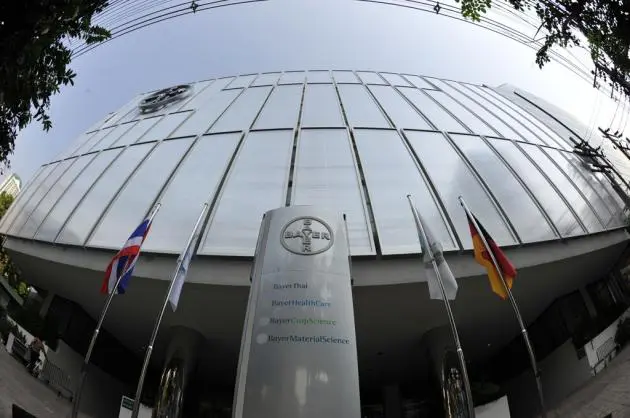
Bayer Thai Co also unveiled its new eco-friendly angulated fac?ade on North Sathon Road to underline the company’s environmental design principles.
The Bayer Thai building was built in 1997 with five floors and an underground parking lot. After serving as the company’s landmark for 15 years, the building’s facade has undergone renovation.
The new facade design takes environmental concerns into account by using UV-coated triple and wall polycarbonate sheet. These strategies include: improving the efficiency of the building envelope, incorporating daylight and views, enabling a speedy construction process, minimising waste, and employing energy-efficient LED lighting, said Celina Chew, managing director of Bayer Thai.
“The new fa?cade demonstrates that it is possible to incorporate sustainable design strategies into a renovation project simply and effectively,” Chew said.
Green construction raw materials
As most building owners show greater concern for the environment, it is also driving most construction raw-material producers to develop eco-products that support the demand in the market.
Siam Cement Group (SCG) aims to develop eco-products comprising at least 10 per cent of its total products.
Siam City Cement has also developed innovative eco-products to achieve 10 per cent of total sales.
Meanwhile, Siam City Cement continues to use its “Green Heart” campaign to not only promote the brand but also promote green concept among its staff and community who are located close to the production plant.
