
More developers turn to M&A for survival, growth


Play
Joint ventures also an option as smaller players grapple with fiercely competitive market dominated by big names
Mergers and acquisitions are one means for small and medium-sized developers, both listed and non-listed, to survive and even grow at a time of intense competition from the major players in the sector.
There has been much M&A activity of late, with deals totalling nearly Bt13 billion having been agreed since the beginning of December for the acquisition of fellow residential developers.
“We [bought a listed developer as we] wanted to survive the market competition after the country’s two beverage tycoons, Charoen Sirivadhanabhakdi and Santi Bhirombhakdi, expanded their investment in the industry,” said Chainid Adhyanasakul, CEO of Property Perfect Plc.
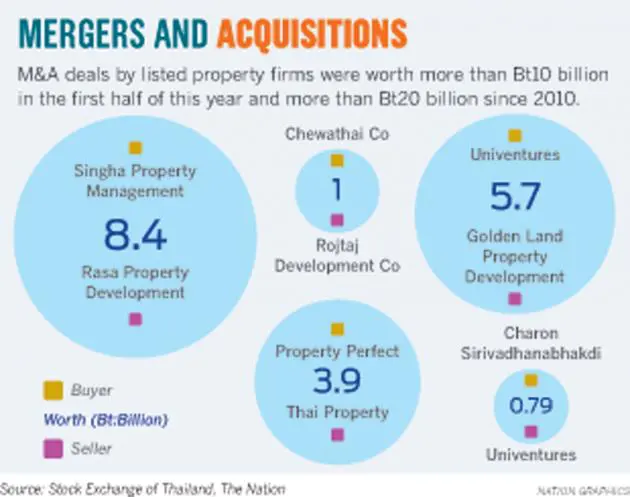
During the past seven months, Santi took over a major stake in Rasa Property Development Plc for Bt8 billion, Property Perfect announced a takeover deal with Thai Property Plc worth up to Bt3.9 billion, and Chewathai Co Ltd took over Rojtaj Development Co Ltd for Bt1 billion.
Moreover, Charon took over both Univentures Plc and Golden Land Property Development Plc two years ago.
While mergers and acquisitions can be a fast track to growth, success in M&A is far from a sure thing, according to Grant Thornton research.
The company said M&A helps high-growth, dynamic companies navigate complex transactions – whether buying or selling – with speed and agility.
From deal strategy, through due diligence and to the integration of a new business, the company helps clients solve problems, manage risk and seize opportunities to unlock their potential for growth.
Chainid, meanwhile, said that if his company’s takeover of Thai Property were completed by the end of this year, its assets would increase 47 per cent, from Bt30.66 billion to Bt45.22 billion, and its equity would nearly double – from Bt8.64 billion to Bt16.39 billion.
Property Perfect’s purchase would make it a top-four player in terms of assets among listed developers in the Stock Exchange of Thailand (SET).
DBS Vickers (Thailand) Securities said M&A activity would be the market trend not only in the property sector, but for all listed companies. It offers a way to drive business growth and also provide a back-door listing in the SET for some companies.
A number of small and medium-sized listed property developers also have the potential to merge with either listed or non-listed real-estate companies, as this would boost their market share and enable them to compete with residential developers that are in a healthier financial situation, said the securities house.
Joint ventures, meanwhile, are another means of surviving intense competition. JVs with large overseas property companies with a view to expanding investment have been undertaken by two listed Thai developers – AP (Thailand) and Ananda Development – in recent times.
The former established a JV with Japan’s Mitsubishi Estate Group to develop three condominium projects worth Bt8 billion combined, while the latter set up a JV with Mitsui Fudosan Residential, also from Japan, to develop a Bt6-billion condominium project last year.
“Our joint-venture firm is not only developing a condominium project, but it is also a way to transfer design and technology for residential development in the future. This is the best way to develop our business in the long term,” said Ananda Development president and CEO Chanond Ruangkritya.
M&A activity, along with joint ventures, is changing the face of the property market during this period of very tough competition. The top 10 residential developers now have more than 70 per cent of a market valued at some Bt600 billion a year.
