
Japan upbeat about Thai investment


Play
Joint venture preferred as AEC nears, with local partners also benefiting from their technical, other expertise
Leading Japanese developers have been expanding their property investment in Southeast Asia, and especially in Thailand, since the beginning of last year as they see increased business opportunities in the region when the Asean Economic Community (AEC) comes into effect next year.
“We have expanded our investment in Asia over more than 40 years. The first country was Singapore, followed by Malaysia, Indonesia, [mainland] China, Taiwan and [most recently] Thailand,” Mitsui Fudosan executive managing officer Takeshi Suzuki said last week after the group introduced the two latest condominium projects – worth Bt10 billion combined – by Ananda MF Asia, its joint venture with Ananda Development.
Suzuki said that half of Mitsui Fudosan’s overseas investment budget worth ¥500 billion (Bt148 billion) in the period 2012-2017 would go towards the Asian market, and to Asean countries in particular in light of the AEC’s upcoming implementation.
Meanwhile, real-estate giant Mitsubishi Estate Group has a budget of US$1.8 billion (Bt58 billion) for investments in Europe, the United States and Asia through to the end of 2016, said Shojiro Kojima, managing director of subsidiary Mitsubishi Estate Asia.
In Asia, the group now has investments in China, Singapore, Vietnam and Thailand, and it is negotiating with partners to take the next steps into Malaysia and Indonesia, he said.
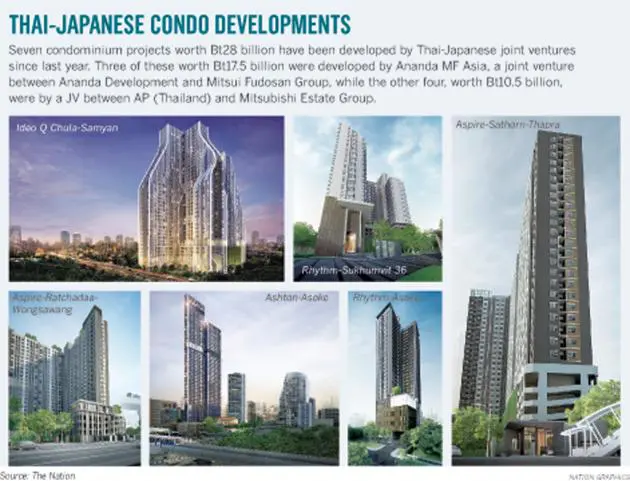
In Thailand, the group has invested Bt10.5 billion via a joint venture with AP (Thailand) to develop four condominium projects.
Three were developed last year, with the fourth project – the Bt3.3-billion Aspire Sathorn-Thapra – launched this week.
“We expanded to Europe and the US more than 40 years ago. But in Asia, we started in 2008 in Singapore, in 2010 in Vietnam, in 2011 in China, and last year in Thailand, after seeing growth in Asian countries in all property segments, including residential, office and retail,” Kojima added.
Saha Group, meanwhile, plans to form a joint venture with Japanese firm Tokyu Group to develop residential property for rental purposes in Chon Buri province this year.
The main targets are Japanese working at the industrial estates in the province.
Prior to Japanese developers starting to expand their investment in Thailand over the past two years, property firms from Singapore, Hong Kong and mainland China began to expand their investment in the Kingdom in 2008.
These include Singapore-based City Development Group, CapitaLand Group, Fraser and Neave, Keppel Land Group, the Government of Singapore Investment Corp, JS Asset Group, and Hotel Property, and Hong Kong- and China-based HKR International, Hong Kong Land, and Hope Land Group.
Some of these companies have succeeded in developing residential projects in Thailand in recent years, while others have withdrawn from the local property market.
Focus on mass-transit routes
Investment by Japanese firms has been carefully planned through the establishment of joint ventures with Thai developers, and also by focusing on the development of condominium projects located close to greater Bangkok’s mass-transit system.
Katsuaki Mori, a senior executive in the international business division of Mitsubishi Jisho Residence, said the company had confidence in the Thai property market’s strong growth, especially in Bangkok, where urbanisation is following the mass-transit system – both the BTS Skytrain and the MRT underground.
“We believe Bangkok will expand as Thailand’s government plans to develop the country’s mass-transit routes, which will link people from outside Bangkok and make it faster to travel from outside the capital to the central business districts than before there was a mass-transit system,” he said.
Thai lifestyles have also changed towards small families that need to stay in condominiums, like Tokyo residents do, and people’s incomes are also increasing enough to buy homes in the city, so the group has invested in residential projects in Thailand, he added.
Mitsui Fudosan’s Suzuki said his company saw Bangkok as a city that still had strong demand for residential, retail and office buildings in locations where there are mass-transit systems.
Meanwhile, Thai developers in joint ventures with Japanese firms also expect to get technology transfer from their partners, which have experience in developing condominiums and maximising the use of limited space in the design process.
Beneficial tie-up
Ananda Development president and chief executive Chanond Ruangkritya said that one year after tying up with Mitsui Fudosan Group to develop condominium projects here, the company had learned how to manage the construction process called the Total Quality Project Management system, or TQPM for short.
TQPM controls the construction process to meet the Japanese standard, which reduces time and cost when developing condominium projects.
“Our firm was only 15 years old when we found a partner with more than 40 years’ experience in condominium development, and that will help us gain more knowledge to develop our business for sustainable growth in the long term,” he said.
AP (Thailand) CEO Anuphong Assavabhokhinm said the company’s joint-venture relationship with Mitsubishi Estate Group did not only provide financial support for expansion, but was also a way to improve its business structure by learning from its Japanese partner, resulting in improvement in its construction process, architecture, design and business management.
This is important in helping meet the challenge of achieving long-term sustainable growth, he added.
Japanese firms have expanded their investment in Thailand over more than a half of century in industrial sectors including manufacturing, the auto industry and consumer products, but they have only recently moved into the Thai property sector.
This shows they have the confidence to enter a market viewed as offering long-term potential.
