
Developers await govt measures


Property companies, currently considering whether to develop housing priced at no more than Bt600,000 under the government's project to provide affordable homes for low-income people, are waiting to see what measures might be introduced to mitigate for l
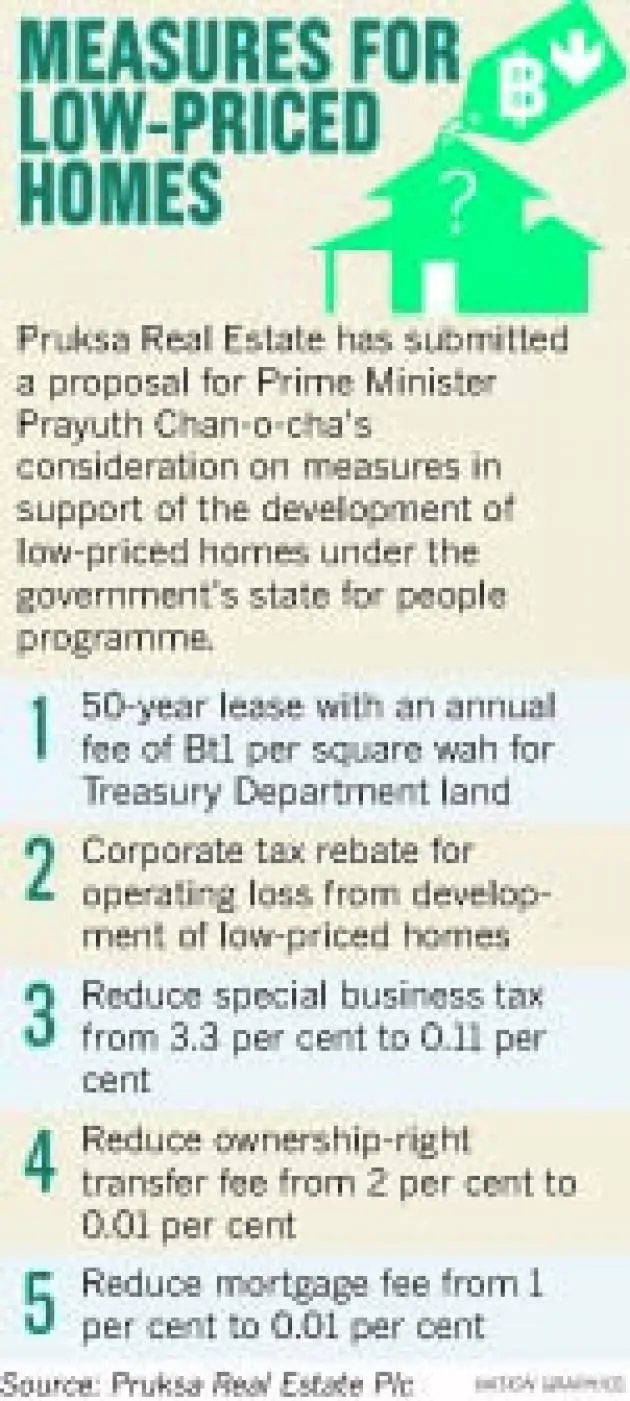
One of them, Pruksa Real Estate, stands ready to construct up to 10,000 low-price homes to support the programme, as long as the government agrees to provide a corporate-tax rebate to alleviate the effect of any losses.
"We studied the matter for three weeks before meeting with Prime Minister Prayut Chan-o-cha last week," president and chief executive officer Thongma Vijitpongpun told The Nation on Friday.
Pruksa’s proposal could apply to all residential developers interested in participating in the scheme, he said.
There are two possible options for project development under the low-cost programme – doing so on Treasury Department land, and developing homes on land owned by the property companies themselves.
Thongma said the first option would enable the development of condominiums priced under the scheme at Bt600,000, and townhouses at Bt900,000.
The former would be developed on a par with condominium quality at a normal market price of between Bt1.2 million and Bt1.5 million per unit, while similar-quality townhouses would normally be put on the market for between Bt1.5 million and Bt2 million apiece, he explained.
Under this option, the Treasury Department would have to offer a 50-year lease at a price of Bt1 per square wah (4 square metres) per year. This would reduce the land cost for the development of homes for low-income buyers.
Meanwhile, the second option – to develop housing on property companies’ own land – would enable the development of condominiums priced at Bt800,000 per unit, and townhouse costing Bt1.2 million.
Again, these would be developed on a par with condominium quality at a normal market price of between Bt1.2 million and Bt1.5 million per unit, while this quality of townhouse would normally be put on the market for Bt1.5 million to Bt2 million, Pruksa’s chief executive said.
Both options entail the government providing an incentive for property developers to engage in what would effectively be a loss-making venture, with proposals including a corporate-tax rebate for participating firms; a reduction in special business tax from 3.3 per cent to 0.11 per cent; lowering the transfer fee from 2 per cent to 0.01 per cent; and cutting the mortgage fee from 1 per cent to 0.01 per cent – all solely for homes developed under the scheme.
Meanwhile, the Government Housing Bank should revise its policy in order to approve more mortgages for the low-income segment by revising its debt-service ratio from 40-50 per cent to 80 per cent, and offering a special interest rate, Thongma said.
This would give people with earnings of between Bt9,000 and Bt12,000 a month the purchasing power required to buy a home under the programme, he explained.
Meanwhile, the proposed corporate-tax rebate would be based on the business loss incurred from constructing housing under the government project.
"The government may lose some of its tax income as a result of this project, but people would be able to own a home that provided them with a more sustainable life. This is an example of a corporate social responsibility programme undertaken in collaboration between the government and the private sector," he said.
He added that if the government agreed with his incentive proposal, Pruksa would be ready to develop at least 10,000 units under the scheme – on both Treasury Department plots and its own land.
Demand could reach 1 million homes
"I estimate the overall demand for homes under this programme at between 500,000 and 1 million units nationwide," he said.
Property Perfect CEO Chainid Adhyanasakul said that if the business model under the scheme could be finalised, the company was ready to participate by offering to build between 1,000 and 3,000 units.
Meanwhile, LPN Development managing director Opas Sripayak said his company was already developing 10,000 condominiums priced at no more than Bt600,000 in Rangsit, Pathum Thani.
That particular project did not require government support for it to go ahead. However, it needs the commercial banks to approve mortgage applications for customers, he said.
"If the government has a policy to build homes costing a maximum of Bt600,000 each, we are also willing to participate, but the banks have to support this programme," he stressed.
