
Govt’s Q4 property incentives boost 2015 results of listed developers
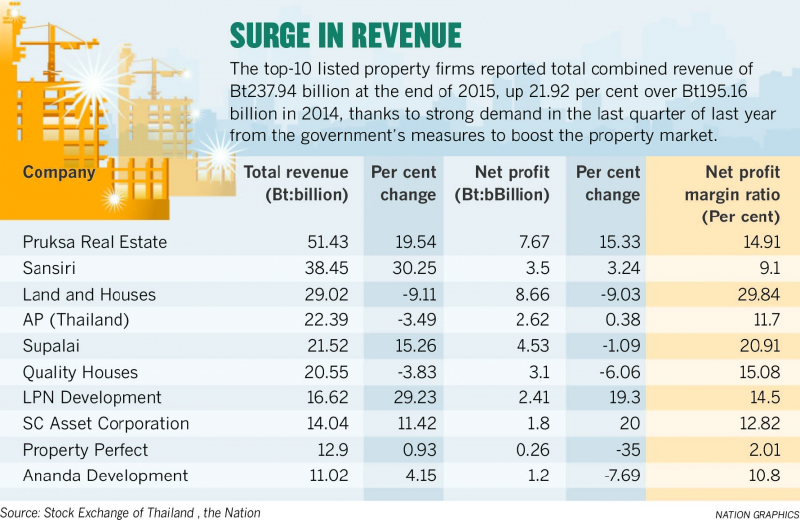


THE COUNTRY’S top 10 listed residential developers have posted combined revenue of Bt237.94 billion for last year, up 21.92 per cent from Bt195.16 billion in 2014, thanks largely to strong demand in the final quarter following the government’s measures to
Their net profit for 2015 came in at Bt37.75 billion, some 7.27 per cent higher than the level achieved the previous year.
The 10 developers’ average net profit ratio for the year was about 15.8 per cent.
The companies’ combined revenue of Bt237.94 billion accounted for 72 per cent of a residential market estimated by the Real Estate Information Centre to be valued at around Bt330 billion in Bangkok and its suburbs last year.
Pruksa Real Estate reported strong year-on-year growth of 19.54 per cent, achieving Bt51.43 billion last year.
The company’s performance was down to strong residential demand in the last quarter, when the government introduced incentives to boost the property market by cutting transfer and mortgage fees and also offering a special interest rate for mortgages on homes priced up to Bt1 million from the Government Housing Bank, said Pruksa’s president and chief executive officer, Thongma Vijitpongpun.
Sansiri posted 30.25-per-cent revenue growth, generating income of Bt38.45 billion over the course of the year.
“Our total revenue grew strongly, with the number of units at ready-to-stay condominium projects being transferred to customers exceeding our estimate, plus some of our income was from management fees to develop condominiums under our joint venture with BTS Group Holdings,” chief operating officer Wanchak Buranasiri said.
SC Asset Corp, meanwhile, broke its record for a year’s performance in terms of gross income and net profit with Bt14.184 billion and Bt1.89 billion, up by 12 per cent and 22 per cent, respectively, from 2014 levels.
CEO Nuttaphong Kunakornwong said the company’s financial results had been better than expected thanks to strong demand for residences priced above Bt15 million, which is the business’s main customers base.
“We are confident that demand to buy homes in both the middle- and upper-income markets will remain strong,” he added.
Heavy investment planned
Against a backdrop of overall revenue growth of nearly 22 per cent last year, during a period when Thailand’s gross domestic product expanded by just 2.8 per cent, both listed and non-listed residential developers are planning to launch new projects worth over Bt250 billion combined in 2016 – a year for which economists are forecasting GDP growth of 2.8 per cent to 3.5 per cent.
“Despite the country’s slight economic growth, we are confident that the property market will grow by 5-10 per cent nationwide this year, especially in greater Bangkok, thanks to the government’s investment in infrastructure projects,” Pruksa’s Thongma said.
Pruksa plans to launch about 60-65 residential projects worth between Bt50 billion and Bt54 billion during the course of the year, which it expects will help the company to achieve revenue growth of more than 10 per cent, he added.
Sansiri intends launching 21 projects worth Bt50.5 billion, comprising 11 condominiums, seven detached-housing projects, and three townhouse developments.
These projects will drive revenue to a targeted Bt36 billion this year, president Srettha Thavisin said.
Meanwhile, AP (Thailand) plans to launch 20 projects worth up to Bt32 billion, and has set a presales target of Bt31 billion for the year.
This is expected to drive full-year revenue to Bt23.7 billion, of which Bt13.8 billion will be from low-rise sales and Bt9.9 billion from condominiums, chief executive officer Anuphong Assavabhokhin said.
CP Land, a non-listed developer, has set aside an investment budget of Bt12.1 billion for the year.
Up to Bt2 billion will be spent on the CP Industrial Estate in Rayong province, which has a total investment value of Bt7 billion. Construction of the estate is due to commence this year, with completion scheduled for next year.
Another Bt3.6 billion will be spent on developing 16 condominium projects in the provinces of Chon Buri, Nakhon Ratchasima, Khon Kaen, Surat Thani, Chiang Rai, Kanchanaburi and Trang.
A further Bt4 billion will be invested in 10 new hotels in Nakhon Phanom, Nakhon Si Thammarat, Chiang Rai, Mae Sot, Nakhon Ratchasima, Buri Ram, Loei, Khao Yai and Bangkok.
Another Bt1 billion has been earmarked to develop a convention and exhibition centre in Khon Kaen, and Bt1.5 billion is to be spent on developing five new office buildings in Nakhon Si Thammarat, Surat Thani, Bangkok, Hat Yai and Udon Thani.
“Although Thailand’s economy has shown signs of only slight growth … we are continuing to expand our investment aggressively, because this is the right time for investment – before the economy achieves strong growth,” said CP Land’s president and chief executive officer, Sunthorn Arunanonchai.
