
New law to raise tax income, efficiency
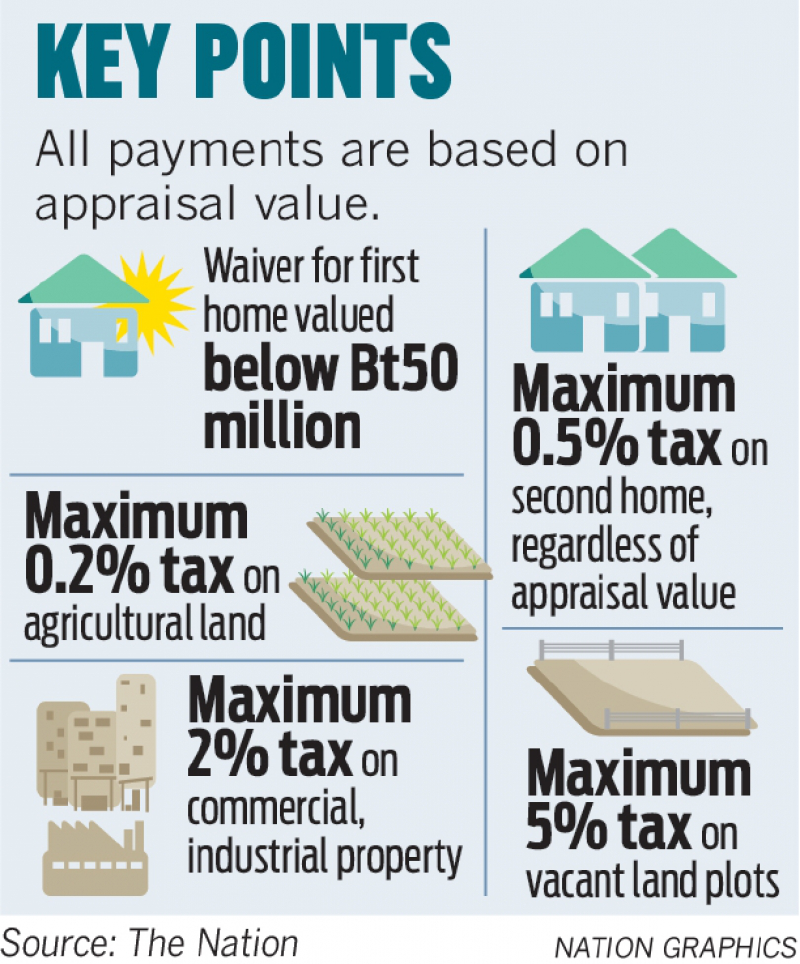


WHEN the groundbreaking land and buildings tax law goes into effect next year, it is expected to double tax revenue for local governments as well as narrow the property-ownership gap for Thais nationwide.
“In the first year, tax [collected under the new law] should hit Bt60 billion,” Somchai Sajjapongse, permanent secretary of the Finance Ministry, said yesterday.
This more than double the Bt20 billion to Bt30 billion collected annually under two existing laws – the Property Tax Act and Local Maintenance Tax Act.
The new law, approved by the Cabinet yesterday, is set to replace the two obsolete ones.
The law seeks to levy taxes on nationwide property and land according to their use. Under the new law, which will be enforced by local governments nationwide, a first home valued below Bt50 million will be exempted from tax, while a maximum 0.5-per-cent rate will be applied to a second home or first home appraised above Bt50 million.
A maximum 0.2-per-cent rate will be levied on agricultural land and 2 per cent on commercial and industrial land.
A 5-per-cent rate will be slapped on undeveloped land in the first three years and the rate will be doubled if the land remains vacant in the following three years.
The rates will vary from province to province, the Finance Ministry said. This will give them greater flexibility in tax collection.
The local governments also reserve the right to waive this tax for property and land damaged by disasters.
Taxing idle land is also believed to be an incentive for landlords to reduce their real-estate holdings.
First-year rates
According to the ministry, a Royal Decree will be promulgated this year to specify the first-year rates. It has been finalised that next year local governments can levy the 0.03-0.3-per-cent rate on second-home owners, 0.05-0.1 per cent on a first home valued over Bt50 million, 0-0.1 per cent on agricultural land, 0.3-1.5 per cent on commercial and industrial property and 1-3 per cent on undeveloped land.
Kim Eng Securities Thailand estimates that 90 per cent of homeowners will be unaffected by the new law, as only 10 per cent own more than one house or own houses valued above Bt50 million.
Prasert Taedullayasatit, president of the Thai Condominium Association, also believes the impact on homeowners will be minimal. Only about 100 residences worth more than Bt50 million are sold each year, he said.
The real-estate industry will both win and lose from the new law, he said.
On the negative side, this will dampen demand for new city condominium projects. He estimates that demand for condos as second homes is about 40,000-50,000 units per year.
“More and more people living in the outskirts of Bangkok buy city condos as their second home. This tax will add to their financial burden and may affect second-home demand and the property market as a whole,” he said.
Condos now account for about half of all residential units launched each year.
On the plus side, developers can anticipate the release of more sites by landlords, he said.
Meanwhile, the market is being driven by low interest rates.
