
Thailand Marks Clean Air Day with 'BEAT TO BREATHE' Amid Stalled Legislation
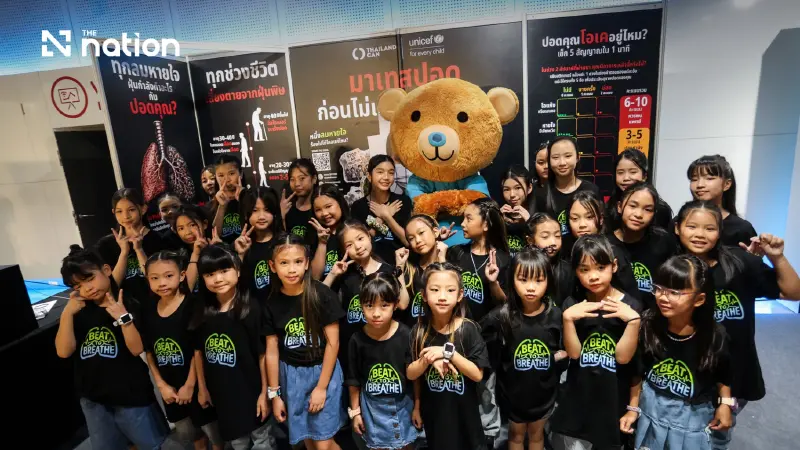


UNICEF and Thailand CAN launch a hip-hop campaign for children’s right to clean air as parliament stumbles over long-awaited Clean Air Act
- On International Day of Clean Air, UNICEF and Thailand CAN launched "BEAT TO BREATHE," a hip-hop campaign advocating for children's right to clean air.
- The campaign was launched as Thailand's comprehensive Clean Air Act remains stalled in a legislative deadlock after MPs rejected amendments introduced by the Senate.
- Using a song called "Lung Test" by a prominent artist, the initiative aims to raise awareness of the severe health risks of air pollution, which affects an estimated 11 million children in the country.
UNICEF and Thailand CAN launch a hip-hop campaign for children’s right to clean air as parliament stumbles over the long-awaited Clean Air Act.
Marking the International Day of Clean Air for Blue Skies, UNICEF Thailand and the Thailand Clean Air Network (Thailand CAN) have launched BEAT TO BREATHE, an innovative campaign leveraging hip-hop culture to advocate for children’s fundamental right to clean air.
The movement arrives at a critical juncture, highlighting the human cost of environmental inaction while Thailand's long-awaited Clean Air Act remains caught in legislative deadlock.
The campaign’s cornerstone is the track "Lung Test", composed and performed by prominent Thai artist TangBadVoice (Tawanwad Wanavit). Drawing on the precise breath control required in rap music, the track serves as a stark reminder that every individual relies on the same shared atmosphere.

For Tawanwad, whose family resides in Chiang Mai, the crisis is personal. The northern city recorded some of the world's worst air pollution in early 2026, with Air Quality Index (AQI) levels surging into "hazardous" territory between 300 and 800—drastically exceeding the World Health Organisation's (WHO) safe threshold of 0 to 50.
"Growing up, we just learned to adapt—staying indoors, using air purifiers, avoiding going outside, or wearing masks," Tawanwad reflected. "It was only after speaking with experts during this project that I realised clean air is actually something we can choose and create. Living with unhealthy air had simply become something we accepted as normal."

As part of the initiative, the public is invited to join the "Beat Test Challenge", an educational activity adapted from Maximum Phonation Time (MPT) measurements.
While designed for self-observation rather than official clinical diagnosis, the challenge encourages individuals to gauge their lung endurance while raising awareness of respiratory health.

Medical Evidence and Childhood Vulnerability
The medical imperative for intervention is supported by extensive health data. According to UNICEF figures, approximately 11 million children across Thailand are regularly exposed to high levels of fine particulate matter (PM2.5).
Paediatric health experts emphasise that children under five are uniquely vulnerable to airborne toxins due to their developing lungs, brains, and immune systems.
Physical exposure during these formative years—or even during gestation—can result in permanent physiological damage, reduced lung capacity, and elevated lifelong risk of cardiovascular and respiratory diseases.
Global findings reinforce the urgency. Data from the fifth State of Global Air report indicates that air pollution contributed to 8.1 million deaths globally in 2021.
More than 700,000 of those fatalities were children under five years old, with PM2.5 exposure accounting for 90 per cent of total air-pollution-related mortality.
"Air pollution is often invisible, but its impact on children is not," said Severine Leonardi, UNICEF Deputy Representative for Thailand. "Every breath a child takes in polluted air adds up—to a cough today, breathing problems tomorrow, and a childhood spent indoors. Children should not have to get sick before we act to protect them."

Economic Imperatives and International Standards
Beyond public health, air pollution presents a growing bottleneck to Thailand's broader economic ambitions, including its bid for membership in the Organisation for Economic Co-operation and Development (OECD).
The OECD Economic Surveys: Thailand 2025 report highlighted toxic air as a primary structural challenge, recommending stricter emission standards, reduced transport pollution, and the swift adoption of comprehensive clean air legislation.
Economists point out that chronic air pollution inflicts severe financial strain on the nation by inflating healthcare expenditures, reducing workforce productivity, and diminishing tourism revenues. Enacting strict environmental regulations is increasingly viewed not as a cost, but as a crucial investment in human capital and economic resilience.

Legislative Delay and Grassroots Action
Despite broad consensus on the need for reform, legislative progress has stalled. The origin of the Clean Air Act dates back to 2022, when Thailand CAN initiated a citizen-led bill. That proposal was later consolidated with six other drafts from political parties and the Cabinet.
Although a unified bill passed unanimously through the House of Representatives following nearly two years of parliamentary review, recent amendments introduced by the Senate led to an overwhelming rejection by MPs. A joint parliamentary committee of MPs and senators is now being formed to reconcile the conflicting versions.
"As clean air is ultimately a basic and fundamental human right, it is hoped that sensibility will prevail above all political and business interests to deliver effective clean air legislation for Thailand," said Kandhana Apirapakon, Head of Communication at Thailand CAN. "This will protect the quality and longevity of life for all 70 million citizens and residents, including over 11 million children."

In parallel with legislative advocacy, UNICEF and Thailand CAN will launch a pilot programme across six Bangkok schools this November. Medical doctors will train educators and students to conduct preliminary lung health screenings, allowing for early detection and medical referral of at-risk children.
Organisers hope the empirical data gathered from these screenings will provide concrete evidence to inform upcoming parliamentary debates and secure lasting statutory protections.
Photo: UNICEF
