
People’s Party launches shadow cabinet to scrutinise Anutin government
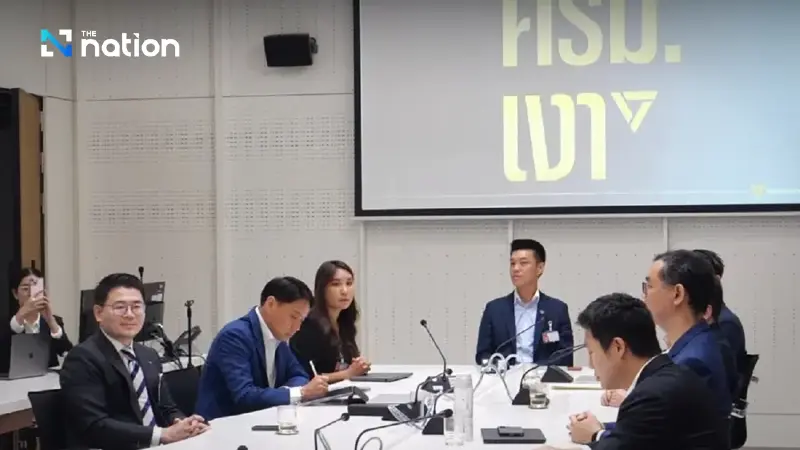


The People’s Party has unveiled a shadow cabinet to monitor the Anutin government, focusing on relief measures, power bills, the Land Bridge and clean-air laws.
The opposition People’s Party has launched a “shadow cabinet” to intensify scrutiny of Prime Minister Anutin Charnvirakul’s government, setting four urgent issues it will monitor over the next month as Thailand faces pressure from the global energy crisis and rising living costs.
People’s Party leader Natthaphong Ruengpanyawut unveiled the shadow cabinet at the House of Representatives on Wednesday (April 29), saying the mechanism would allow the party to examine government decisions more systematically while offering alternative policy proposals to the public.
The move marks a more aggressive phase for the opposition, with the party seeking to position itself not only as a watchdog but also as an alternative policy platform at a time when energy costs, economic strain, infrastructure spending and environmental issues are high on the national agenda.
The People’s Party said its shadow cabinet would meet every week to assess decisions by the Anutin government, identify who benefits or loses from those decisions, and present policy alternatives based on the public interest. Thai media reported that the party framed the mechanism as a parliamentary-style shadow cabinet model aimed at closely following cabinet resolutions and government policy.
Four policy teams to monitor government
The shadow cabinet is divided into four mission-based teams.
The New Economy team is led by Weerayut Kanchuchat, deputy leader of the People’s Party.
The New Quality of Life team is led by Decharut Sukkumnoed, party adviser and director of the Think Forward Center.
The New Security team is led by Phicharn Chaowapatanawong, the party’s secretary-general.
The State Reform team is led by Sirikanya Tansakun, deputy leader of the party.
The structure is designed to mirror key areas of government responsibility, allowing the opposition to track policy decisions across the economy, welfare, security and state administration. Reports from The Momentum and The Standard both listed the four teams and said the party would use them to monitor the government and propose alternative policies.
Opposition sets four urgent issues
At the launch, the shadow cabinet announced four urgent agendas it said the government must address immediately.
The first is relief measures, including the proposed Thai Helps Thai Plus scheme. The party said government assistance and compensation measures must not leave out key affected groups, particularly farmers, fishers and transport operators.
The second is electricity bills. The party warned the government against using short-term fixes that shift the burden back to the public. It urged the government to negotiate cuts to capacity payments and remove quota limits on electricity purchases from people’s solar power generation.
The third is the Land Bridge project. The People’s Party called on the government to reassess the project and review the proposed Southern Economic Corridor Act, saying development should begin from the goal of improving the economy and quality of life in the South.
The fourth is what the party called “breathing rights”. It urged the government to revive two pending bills — the draft Clean Air Act and the draft Pollutant Release and Transfer Register Act, or PRTR Act — and move them forward by May 12.
The Standard reported that the party’s one-month watchlist would cover Thai Helps Thai Plus, electricity bills, the Land Bridge and the Clean Air and PRTR bills. The Momentum also reported the same four urgent agendas, including the May 12 deadline for the clean-air legislation.
Energy crisis gives opposition new attack line
The launch comes as energy security and living costs have become politically sensitive issues for the Anutin government.
The People’s Party said the global energy crisis was hitting the Thai economy and households hard, making relief measures and electricity costs immediate priorities. Reuters reported last month that Anutin, after winning parliamentary backing to continue as prime minister, went into an energy-security meeting and said Thailand could still purchase oil while the government sought to maintain public confidence.
The opposition is likely to use the shadow cabinet to challenge the government on whether its economic response is targeted enough, especially for vulnerable groups and sectors facing higher fuel and operating costs.
Shadow cabinet revives opposition model
The shadow cabinet also carries political symbolism. Bangkok Biznews reported that the model has returned to Thai politics after being used by the Democrat Party in earlier opposition periods, including after the 2007 and 2011 elections. The report described the latest version as a renewed opposition tool led by the People’s Party.
For the People’s Party, the mechanism is an attempt to turn parliamentary opposition into a more visible and structured challenge to the government.
From now on, the party said its shadow cabinet will hold weekly meetings to examine the Anutin government’s decisions and present alternatives aimed at helping Thailand navigate the current crisis in a fairer and more future-oriented way.
