
China solar power capacity poised to eclipse coal power in 2026
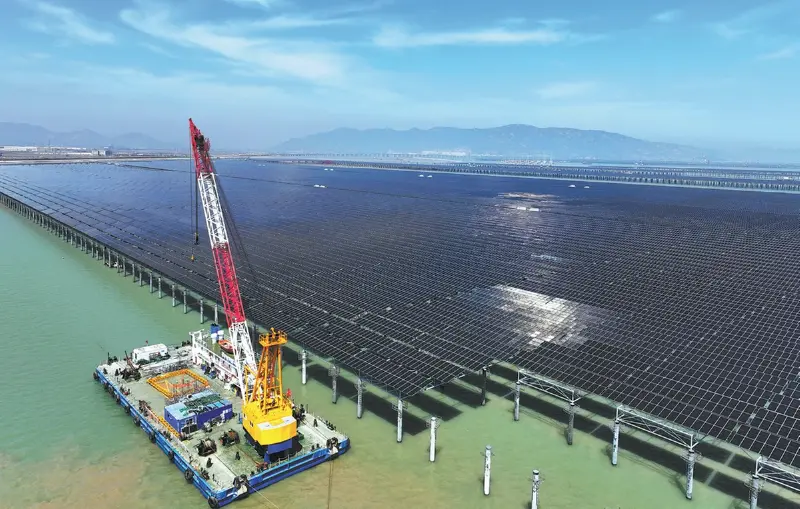


CEC report says renewables, grid investment and new infrastructure demand are reshaping China’s electricity system in the first year of the 15th Five-Year Plan.
- China's solar power capacity is forecast to exceed its coal-fired capacity for the first time in 2026, according to a report by the China Electricity Council (CEC).
- By the end of 2026, combined wind and solar power are projected to account for half of China's total installed power generation capacity.
- This milestone is driven by a rapid green energy transition, with China expected to add over 300 million kW of new energy capacity in 2026 alone.
- The shift is fueled by rising electricity demand from new sectors like AI data centers, 5G networks, and electric vehicle charging infrastructure.
China’s solar power capacity is on track to exceed coal-fired capacity for the first time in 2026, as the country’s shift toward greener and lower-carbon energy gathers pace, according to an industry report released on Tuesday.
The projection was made by the China Electricity Council (CEC) in its report analysing national power supply and demand in the first quarter of 2026.
The CEC said the power industry opened the first year of the 15th Five-Year Plan (2026-30) with solid momentum, supported by stronger electricity use, a cleaner generation structure and rising investment in renewable energy.
Data from the National Energy Administration (NEA) showed that China’s combined installed wind and solar power capacity had reached about 1.9 billion kilowatts by the end of March, up 28.1 per cent from a year earlier. Renewable power generation continued to expand steadily, making up nearly 40 per cent of the country’s total electricity output.
Energy investment also grew strongly in the first quarter, helping drive a rebound in national fixed-asset investment, the report said.
Xing Yiteng, deputy director-general of the NEA’s department of development and planning, said power grid expansion and safety upgrades had accelerated this year. He also pointed to faster investment in hydrogen energy, coal-to-fuel projects and new energy storage.
Private companies have also stepped up their role in major national energy research programmes, Xing added.
Lin Boqiang, head of the China Institute for Studies in Energy Policy at Xiamen University, said the 2026 outlook reflects a major structural change in China’s energy consumption.
“As facilities such as artificial intelligence-driven data centres, 5G base stations and expansive electric vehicle charging networks are highly energy-intensive, China is transitioning from an era where heavy manufacturing dictated power demand to one where the digital and green economies are the primary load drivers,” Lin said.
According to the CEC, China’s total electricity consumption reached 2.51 trillion kilowatt-hours in the first quarter, up 5.2 per cent year-on-year.
By the end of March, total installed power generation capacity stood at 3.96 billion kW. Non-fossil energy capacity reached 2.46 billion kW, an increase of 21.3 per cent from a year earlier, accounting for 62 per cent of total capacity.
The report said the green transformation of the power sector remains strong. In the first three months, newly installed wind and solar power capacity totalled 57.16 million kW, representing 68.2 per cent of all new power generation capacity added across the country.
Looking ahead, the CEC said stable macroeconomic growth and the buildout of new infrastructure are expected to keep electricity demand rising at a steady and rapid pace.
China’s total power consumption in 2026 is forecast to reach 10.9 trillion to 11 trillion kWh, up 5 to 6 per cent year-on-year. The maximum power load for the year is projected at 1.57 billion to 1.63 billion kW.
The council expects China to add more than 400 million kW of new power generation capacity in 2026, including over 300 million kW from new energy.
By the end of 2026, combined wind and solar power capacity is expected to account for half of China’s total installed power generation capacity, while solar capacity alone is set to overtake coal power for the first time in the country’s history.
China Daily
