
WMO says 2025 among driest years for rivers in 35 years
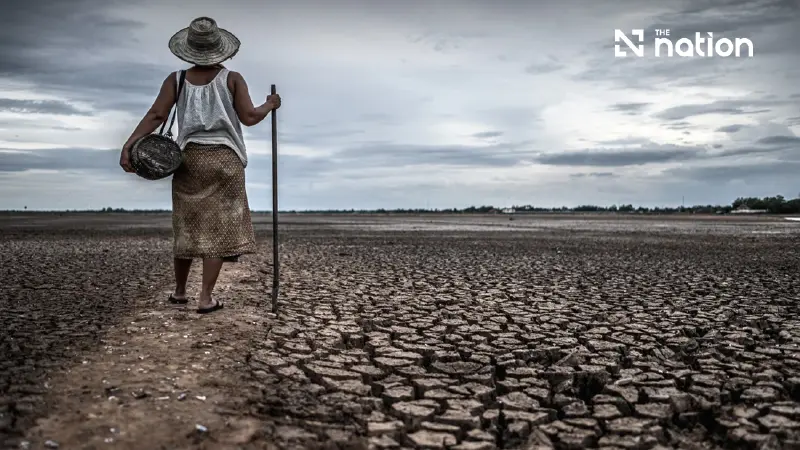


The WMO says freshwater reserves are shrinking worldwide, with storage below normal across 42% of land and widespread glacier losses in 2025
- The World Meteorological Organization (WMO) reports that climate change is severely disrupting the global water cycle, causing alternating droughts and floods worldwide.
- 2025 was one of the driest years for the world’s rivers in 35 years, with normal flows recorded across just 36% of global river basin area.
- Freshwater stored on land, including groundwater and glaciers, continues to decline, indicating that the planet’s water reserves are being steadily depleted.
The world’s rivers experienced one of their driest years in 35 years in 2025, while groundwater and glaciers continued to lose reserves that help communities withstand drought, the World Meteorological Organization (WMO) said in findings released in Geneva on September 17, 2026.
The WMO’s State of Global Water Resources 2025 assessment describes an increasingly erratic and unpredictable water cycle, with sharp swings between drought and flooding.
Only 36% of river basin area recorded normal flows
Normal river flows covered just 36% of global basin area in 2025, according to the WMO. Another 36% recorded below-normal or much-below-normal flows, while 21% had above-normal or much-above-normal flows. The remaining 7% was classified as having no data.
The WMO found that the seven years from 2019 to 2025 had the smallest shares of river basins with normal flows since 1991. Those shares ranged from 34% to 38%, compared with an average of 46% over 1991–2020.
Across 2021–2025, recurring low flows affected major parts of South America’s Amazon and La Plata basins, as well as North America, central and eastern Africa, Central Asia and the Middle East, the WMO said.
Africa’s contrasting conditions were particularly pronounced in 2025. The WMO recorded much-below-normal flows in the Nile, Congo and Zambezi basins, while the Senegal, Niger and Limpopo basins had above-normal flows. South and Southeast Asia also experienced high flows during intense monsoons.
The economic consequences of low river levels extended into summer 2026. Falling Danube levels forced reactor shutdowns and reductions in nuclear power output in Romania and Hungary as cooling-water supplies came under pressure, according to notices from plant operators.
In North America, the Mississippi was contending with chemical pollution, recurring drought and saltwater intrusion.

Groundwater and glacier reserves continue to shrink
The WMO found a continuing decline in freshwater stored on land, including groundwater and glaciers, since around 2014–2016. Satellite observations and hydrological models showed that 42% of global land area had below-normal water storage in 2025. The measure covers water in rivers, streams and lakes, groundwater, soil moisture, snow and ice.
WMO Secretary-General Celeste Saulo said precipitation and river flows respond quickly to changing conditions, whereas groundwater and glaciers accumulate or diminish more slowly. “These reserves should normally serve as a savings account, but we are now drawing that account down,” she said.
Nearly two-thirds of monitored groundwater wells worldwide had levels outside historical norms in 2025, the WMO said. Persistent deficits affected the central United States, the Middle East, India, Latin America, eastern Europe and parts of South Africa, the depletion as evidence of withdrawals exceeding natural replenishment.
Glaciers lost mass across every major glaciated region for the fourth consecutive year in 2025, according to the WMO. The estimated loss during the 2025 hydrological year was about 408 gigatonnes, equivalent to roughly 1.1 millimetres of global sea-level rise. Glacier loss creates immediate hazards such as downstream flooding as well as longer-term threats to water supplies.
Cumulative global glacier losses reached about 1,400 gigatonnes in 2023–2025, the WMO said. That is equivalent to roughly 560 million Olympic-sized swimming pools, or about one-third of the freshwater withdrawn for human use worldwide in a year.
Central Asia, western Canada and the United States were among the regions recording particularly severe glacier losses. The WMO said some regions dominated by smaller glaciers, including western Canada and the United States, the Caucasus and central Europe, may already have reached “peak water”, the point of maximum runoff from melting glaciers.
Asia and Africa account for over 80% of disaster deaths
Asia and Africa together accounted for more than 80% of reported deaths associated with extreme water-related events and at least half of all recorded events during 2021–2025, the WMO said. Repeated swings between drought and flooding, or “weather whiplash”, left some communities without time to recover.
Nigeria experienced major floods in two consecutive years and the Democratic Republic of the Congo in three, according to the WMO’s assessment. In South and Southeast Asia, tropical cyclones and intense monsoons caused up to 3,600 deaths across affected countries in 2025.
Jamaica reported economic losses from Hurricane Melissa equivalent to 41% of its gross domestic product, the WMO said, illustrating the scale of damage that a single disaster can inflict.
The WMO identified 2025 as one of the warmest years on record. A weak La Niña emerged towards the end of the year, while a predominantly negative Indian Ocean Dipole also influenced rainfall.
Looking ahead from September 2026, Saulo warned that a strengthening El Niño would increase drought risks in some areas and flood risks in others. That warning concerns the developing 2026 climate pattern, rather than an El Niño event during 2025.
WMO urges shared data and cross-border early warnings
The WMO called for stronger international cooperation on water monitoring, common standards and early-warning systems, alongside better management to protect freshwater reserves, lives and long-term water security.
“Water resources do not stop at national borders. A river basin’s water balance depends on what happens in upstream countries, just as the melting of a glacier in one country affects water supplies for people hundreds of kilometres away. That is why we need shared data, common standards and joint early-warning systems,” Saulo said.
Dr Mattia Saccò, co-leader of the Subterranean Research and Groundwater Ecology Group at Curtin University, warned in published expert comments that declining water quality and quantity threatened biodiversity and ecosystem stability.
“The continued decline in the quality and quantity of the world’s water will lead to biodiversity loss, weaker ecosystems and a more fragile planet,” Saccò said. “The health of the global water cycle is at risk, and we must act now.”
