
Drones over Dams: How Thailand’s Irrigation Department Is Automating Water Quality Care
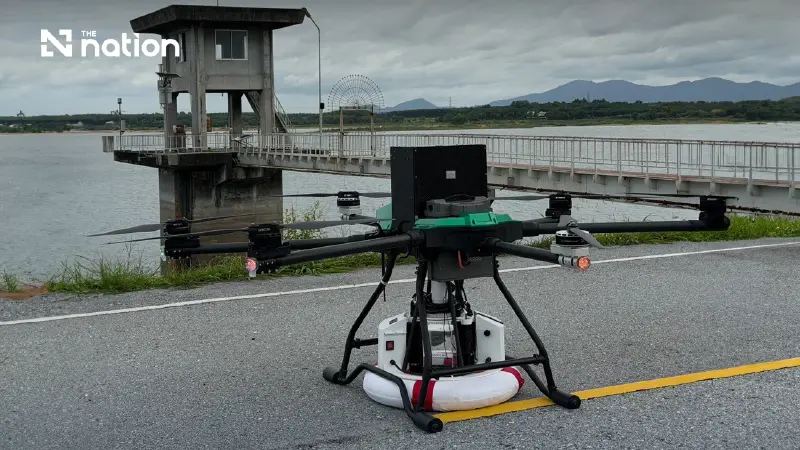


Robotic UAVs and real-time cloud data replace risky boat trips in Thailand, cutting water-testing costs by up to 90% and eliminating operational hazards
- Thailand's Royal Irrigation Department is deploying automated drones to monitor water quality in its reservoirs, replacing hazardous manual collection by boat.
- The new system significantly improves personnel safety by allowing operators to remain on the shoreline and reduces per-mission costs by up to 90%.
- The drones feature a dual-payload system that transmits real-time sensor data via a mobile app while also collecting physical water samples for lab analysis in a single flight.
- This initiative is a key part of the department's long-term strategy to create a fully digitalized national water security system by 2037.
Robotic UAVs and real-time cloud data replace risky boat trips in Thailand, cutting water-testing costs by up to 90% and eliminating operational hazards.
Field technicians at the Royal Irrigation Department (RID) have long faced a perilous routine: navigating turbulent reservoir waters, dodging submerged timber, and braving toxic run-off simply to collect a jar of water.
Now, a pioneering homegrown innovation is set to make those hazardous boat trips obsolete. The RID has unveiled its Automated Water Quality Monitoring Drone, an integrated aerial system that combines high-agility multi-rotor drones with real-time sensor arrays and physical sampling payloads.
Developed to replace heavy, unwieldy monitoring boats, the technology allows operators to assess water health entirely from the safety of the shoreline.
The initiative directly addresses Thailand's Category 8 water quality standards, which demand rigorous monitoring across six scientific parameters: temperature (max 40°C), pH levels (6.5–8.5), dissolved oxygen (minimum 2 mg/L), electrical conductivity (max 2,000 µmho/cm), salinity (max 1 g/L), and total dissolved solids (max 1,300 mg/L).

Dual-Layered Intelligence
Unlike floating buoys or unmanned surface vessels—which frequently get stranded in shallow mudflats or swept away by strong currents—the multi-rotor drone glides effortlessly over surface obstacles.
To maximise mission efficiency, researchers engineered a dual payload system. On-board sensors instantly measure field parameters and transmit live readings to field staff via the LINE messaging platform.
Concurrently, an integrated container retrieves physical water samples from the exact same depth as the sensor reading, preserving them for complex microbiological and biological testing in the laboratory.
By combining immediate digital readings with physical sampling in a single flight, the department captures two distinct layers of intelligence without putting staff in harm's way.

The "3Ps" Principle: Proven Payback and Efficiency
Built strictly around the "3Ps" doctrine—Pay less, Prompt execution, and Personnel safety—the system delivers dramatic operational and financial gains over legacy methods.
Initial development costs ranged between 1.0 million and 1.3 million Baht, encompassing software design, custom apps, multi-rotor frames, and sensor integration.
However, commercial production costs per unit drop significantly to between 250,000 and 500,000 Baht, depending on sensor grades and sample capacity.
Where traditional boat deployments cost up to 8,000 Baht due to fuel, transport logistics, and staff per diems, the drone method slashes per-mission expenses to a mere 100 to 300 Baht for battery charging and basic maintenance. This represents a cost reduction of 80% to 90% per task.

For large reservoirs requiring four to eight routine checks per month, each unit saves up to 40,000 Baht monthly, achieving full capital payback within just one to two years.
Furthermore, field crew requirements drop from up to five personnel down to just one or two operators, while data processing speeds have accelerated by up to 85%, providing near-instantaneous telemetry.

Zero Risk for Personnel
Beyond impressive balance-sheet metrics, the technology's most crucial victory is human.
Operating under a strict Zero-Risk for Personnel framework, field staff remain 100% on shore, completely insulated from hazardous weather, waterborne pathogens, and toxic chemical contact.

Paving the Way for 2037 Water Security
The drone rollout marks a key stepping stone in the RID’s long-term strategic roadmap to become a fully digitalised, smart organisation ensuring national water security by 2037.
Looking ahead, the department plans to scale the initiative nationwide through two core expansion tracks:
1. IoT & Cloud Integration: Automatically routing sensor parameters from the mobile app into the central RID Water Information Centre via 4G, 5G, and satellite networks.
2. Regional Drone Hubs: Establishing dedicated drone units across all 17 Regional Irrigation Offices to maintain continuous surveillance over major rivers and reservoirs.
By merging modern aerospace engineering with environmental stewardship, the Royal Irrigation Department is proving that high-tech efficiency and workforce safety can go hand in hand—setting a modern benchmark for resource management across South East Asia.

